

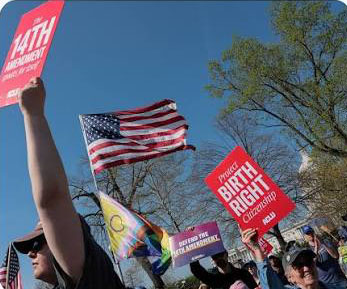
- 6-3 ruling deals major blow to Trump’s immigration agenda; Chief Justice Roberts traces birthright citizenship through 14th Amendment and 1898 Wong Kim Ark precedent
- The US Supreme Court ruled 6-3 against President Donald Trump’s executive order seeking to end birthright citizenship for individuals born on US soil to parents on temporary legal status or without documentation.
- The ruling upholds a lower court’s determination that Trump’s order violated the US Constitution, as well as a subsequent Supreme Court decision on the matter.
- Chief Justice John Roberts, writing for the majority, traced birthright citizenship through English common law, the 1868 ratification of the 14th Amendment, and the Supreme Court’s 1898 ruling in United States v. Wong Kim Ark.
- Roberts said the Trump administration and dissenting justices offered “scant evidence” for their revisionist interpretation of the law.
- Trump had not directly responded to the ruling but earlier posted on Truth Social suggesting Congress could pass legislation to change birthright citizenship, despite little evidence of political will for such a move.
Washington, DC, June 30, 2026 (Agencies) — The United States Supreme Court has ruled against President Donald Trump’s order to end birthright citizenship for all individuals born on US soil, in one of the most consequential immigration rulings in decades.
The 6-3 ruling represents a major blow to Trump and his broader effort to transform immigration policy in the United States. Upon taking office on January 20, 2025, Trump signed an executive order seeking to bar children born in the US to parents on temporary legal status or without documentation from automatically receiving citizenship.
The nine-member Supreme Court’s ruling upholds a lower court’s determination that Trump’s order ran counter to the US Constitution, as well as a subsequent Supreme Court decision on the matter.
Writing for the majority, Chief Justice John Roberts traced the American practice of birthright citizenship back through English common law, through the ratification of the 14th Amendment in 1868, and through the Supreme Court’s landmark 1898 ruling in United States v. Wong Kim Ark, which affirmed citizenship for children born on US soil regardless of their parents’ nationality.
In his opinion, Roberts wrote that Trump administration lawyers, along with the dissenting justices, had offered insufficient evidence to support their reinterpretation of longstanding constitutional law. “The trouble is that there is scant evidence for this dramatically revisionist view,” he wrote. Addressing the scope of the 14th Amendment directly, he added: “The Framers of the Fourteenth Amendment extended that promise to ‘every free-born person in this land.’ We keep that promise today.”
Trump did not immediately respond to the ruling. Earlier in the day, however, he had posted an article on his Truth Social platform arguing that Congress could pass legislation to change birthright citizenship — though there is little evidence of anything close to the political will needed among lawmakers to pursue such a move.