

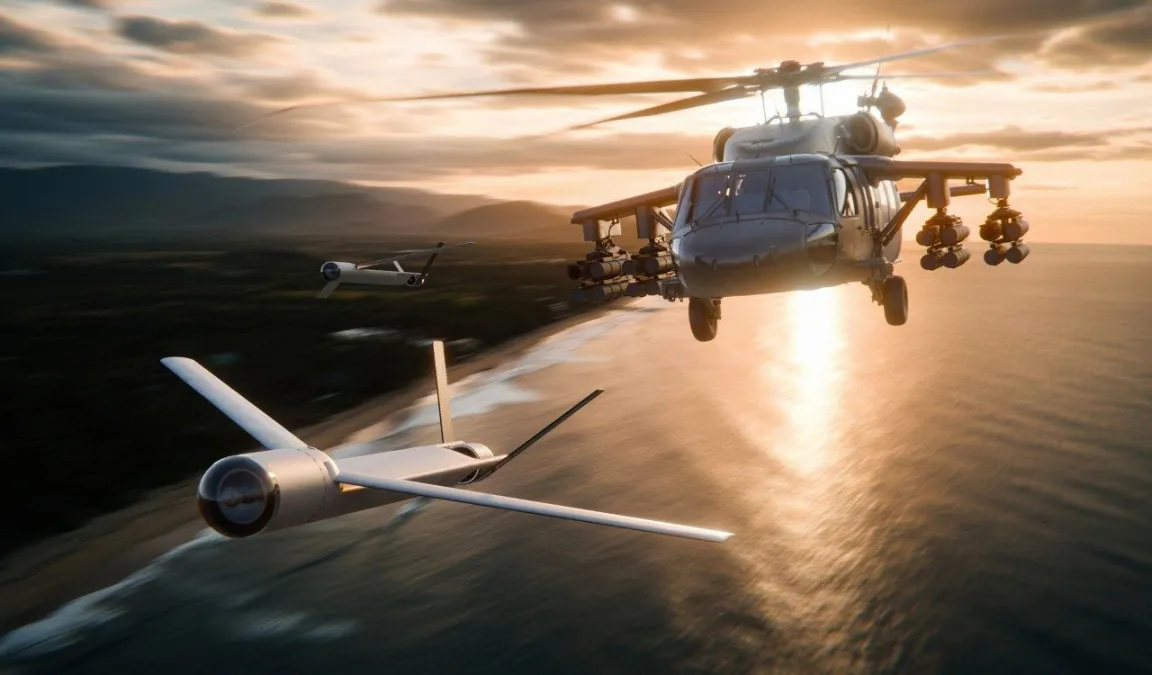
Washington, D.C., August 21, 2025 (Agencies) — The U.S. Army has announced a major upgrade to its fleet of UH-60 Black Hawk helicopters, enabling them to launch drones mid-flight starting next year. The move is part of a $43 million modernization contract awarded to Sikorsky, a Lockheed Martin company, and reflects the Army’s broader push toward “launched effects”—a key pillar of its Transformation Initiative.
The contract includes software and hardware enhancements that will allow air crews to operate unmanned aerial systems (UAS) directly from the Black Hawk platform. These upgrades are designed to improve mission flexibility, situational awareness, and combat effectiveness, particularly in strategic theaters like the Indo-Pacific.
“Sikorsky is ready to implement new technologies that will strengthen the combat-proven Black Hawk helicopter and give U.S. Army soldiers greater advantage,” said Hamid Salim, Vice President of Army and Air Force Systems at Sikorsky.
In addition to drone integration, the modernization package includes airframe enhancements, a main fuel upgrade, and a more powerful engine. Future upgrades will introduce autonomous flight controls and AI-assisted navigation, aimed at improving safety and performance in complex operational environments.
Despite these advancements, questions remain about the long-term role of the Black Hawk in the Army’s vertical-lift strategy. In 2022, the Army selected Bell’s V-280 Valor tiltrotor to replace the Black Hawk for long-range assault missions, and the Future Vertical Lift (FVL) program continues to explore next-generation airframes.
Concerns have also surfaced in Congress following the Army’s May announcement to scale back several major programs. Rep. Rosa DeLauro (D-Conn.), whose district includes the Sikorsky plant, warned that the Black Hawk could face reduced procurement or operational scope.
“I see Black Hawks are going to be with us for a while,” said Army Secretary Dan Driscoll during congressional testimony. “But I do think we’re going to have to adapt what we’re doing. There just may be less Black Hawks.”
The Army’s current contract for new Black Hawk helicopters is set to expire next year. While no formal adjustments have been announced, Army Chief of Staff Gen. Randy George acknowledged that evolving battlefield dynamics and autonomous systems may reshape future deployment strategies.
The integration of drone-launch capabilities into the Black Hawk marks a significant milestone in the Army’s effort to modernize legacy platforms while preparing for multi-domain operations in increasingly contested environments.