

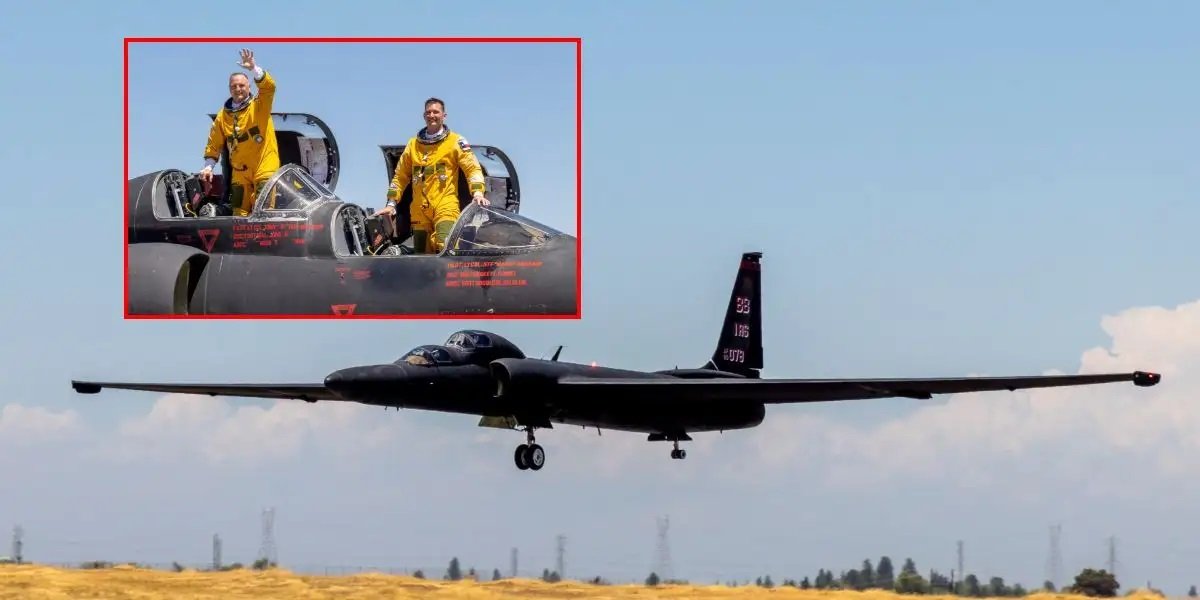
Beale Air Force Base, California (Agencies) August 7, 2025 — In a powerful tribute to seven decades of high-altitude reconnaissance, the U.S. Air Force’s iconic U-2 Dragon Lady has completed a record-setting mission just one year before its planned retirement. On July 31, 2025, exactly 70 years after the aircraft’s first flight, a two-seat TU-2S variant from the 9th Reconnaissance Wing flew a 14-hour, 6,000-mile mission, overflying all 48 contiguous U.S. states and reaching altitudes near 70,000 feet.
The flight, launched and recovered at Beale Air Force Base, pushed the aircraft and its pilots to the edge of operational and physiological limits. U-2 pilots operate in pressure suits similar to those worn by astronauts, with limited mobility and sustenance delivered through tubes. Previous missions rarely exceeded 11 hours due to endurance constraints.
“This flight maxed out the operational range of the U-2 and placed the pilots at the edge of their physiological limit,” the 9th Wing stated. The mission was flown by two of the most experienced U-2 pilots in the fleet, including Corey Bartholomew, a flight safety officer and instructor who also flew NASA’s ER-2 variant, and a lieutenant colonel identified only by the callsign “Jethro.”
Bartholomew said he had envisioned such a mission for over a decade. “Now that we’re on the 70th anniversary of the U-2—70 years at 70,000 feet—it seemed right to demonstrate the true capability of this aircraft,” he said.
The flight also validated new mission planning software, which had never been used for such a complex and extended sortie. The route was designed to pass over the homes of U-2 pilots who made the ultimate sacrifice, honoring their legacy.
- A Legacy of Intelligence and Innovation
Developed in secrecy by Lockheed’s Skunk Works in the 1950s, the U-2 was originally commissioned by the CIA to conduct surveillance over the Soviet Union. Its first flight took place on July 31, 1955, and it famously entered global headlines in 1960, when pilot Francis Gary Powers was shot down over Soviet territory and later exchanged in a Cold War spy swap.
The U-2 underwent major upgrades in the 1980s, including a 40% enlargement, modular payload systems, and GE F118 engines, allowing it to carry three times the original payload. Further classified enhancements in the 1990s and 2010s added advanced sensors and real-time data processing capabilities.
Despite its age, the U-2 has remained a flexible and reliable intelligence, surveillance, and reconnaissance (ISR) platform, outperforming unmanned systems like the RQ-4 Global Hawk in mission adaptability. However, both aircraft are now slated for retirement—U-2 in fiscal year 2026, and RQ-4 in 2027—as the Air Force transitions to space-based ISR and classified platforms, including the rumored RQ-180.
- Operational Challenges and Retirement
The U-2’s mission capability rate has declined in recent years, with single-seat variants dropping from 76% to 61.9%, and TU-2S models from 81% to 59.2% between FY 2023 and 2024. The Air Force cites rising operating costs, diminishing manufacturing sources, and the growing reach of adversary air defenses as reasons for the retirement.
Congress has previously resisted the phase-out, especially due to the U-2’s unique ability to carry the now-retired Optical Bar Camera, a wet-film system unmatched in resolution. However, digital technologies have since closed the gap.
The U-2 remains one of the most challenging aircraft to fly, requiring a chase car to assist with landings due to its long nose and limited cockpit visibility. Fewer than 1,000 pilots have ever qualified to fly the Dragon Lady.
As the Air Force prepares to sunset one of its most storied aircraft, the July 31 mission stands as a testament to the U-2’s enduring legacy and unmatched capability in the realm of high-altitude reconnaissance.