

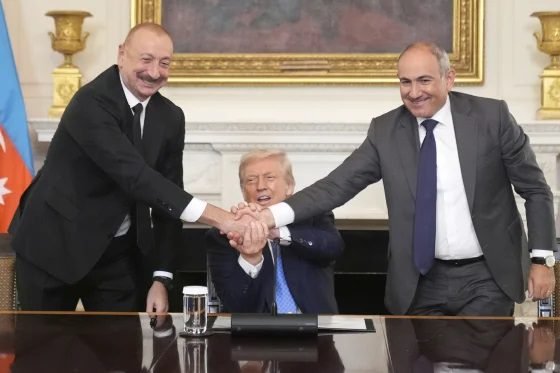
WASHINGTON, August 9, 2025 (Agencies) — In a historic breakthrough, Armenia and Azerbaijan signed a comprehensive peace agreement at the White House this week, formally ending decades of hostility over the disputed Nagorno-Karabakh region. The accord, brokered by former U.S. President Donald Trump and endorsed by the Biden administration, includes the creation of a strategic transit corridor through southern Armenia, granting the United States exclusive development rights for 99 years.

Dubbed the “Trump Route for International Peace and Prosperity,” the corridor will connect mainland Azerbaijan to its Nakhchivan exclave, facilitating the flow of goods, energy, and digital infrastructure across the South Caucasus. The route is expected to host railways, oil and gas pipelines, fiber optic cables, and electricity transmission lines, with construction led by a consortium of American firms under U.S. oversight. Armenian officials proposed the name to honor Trump’s role in mediating the deal, which both sides credited with achieving what previous administrations could not.
The peace agreement marks a dramatic shift in regional dynamics. Armenia and Azerbaijan agreed to mutual recognition of borders, the demilitarization of contested zones, and the establishment of joint economic commissions. The accord also includes provisions for humanitarian reconciliation, prisoner exchanges, and the reopening of diplomatic missions. U.S. Secretary of State Antony Blinken hailed the deal as “a model for conflict resolution in Eurasia,” while European leaders praised the corridor’s potential to diversify energy routes and reduce dependence on Russian supplies.
In a rare display of unity, Armenian Prime Minister Nikol Pashinyan and Azerbaijani President Ilham Aliyev jointly announced their intention to nominate Donald Trump for the Nobel Peace Prize, citing his decisive role in brokering the agreement. “I think President Trump deserves to have the Nobel Peace Prize and we will defend that, and we will promote that,” Pashinyan said during the signing ceremony. Aliyev added, “So maybe we agree with Prime Minister Pashinyan to send a joint appeal to the Nobel committee to award President Trump with the Nobel Peace Prize.” The nomination is expected to be formally submitted later this month, with backing from several regional governments.
Strategically, the Trump Corridor enhances U.S. access to the Caspian basin, though it does not authorize military deployment in the Caspian Sea itself. The 2018 Caspian Sea Convention, signed by Russia, Iran, Azerbaijan, Kazakhstan, and Turkmenistan, prohibits foreign military forces from operating in the inland sea. However, analysts say the corridor could evolve into a dual-use infrastructure supporting both civilian and strategic logistics, especially if Azerbaijan deepens its defense ties with NATO.
The corridor’s development is expected to challenge Russian and Iranian influence in the region, offering the West a new foothold in the South Caucasus. Moscow and Tehran have expressed concern over the deal, warning that it could destabilize existing security arrangements. Nonetheless, regional observers note that the agreement reflects a growing appetite among Caspian-adjacent states for diversified partnerships and economic modernization.
Construction of the Trump Corridor is scheduled to begin in early 2026, with initial funding provided by the U.S. International Development Finance Corporation and private investors. The project is projected to generate billions in trade and energy revenues, while serving as a symbol of post-conflict cooperation and Western engagement in a historically volatile region.