

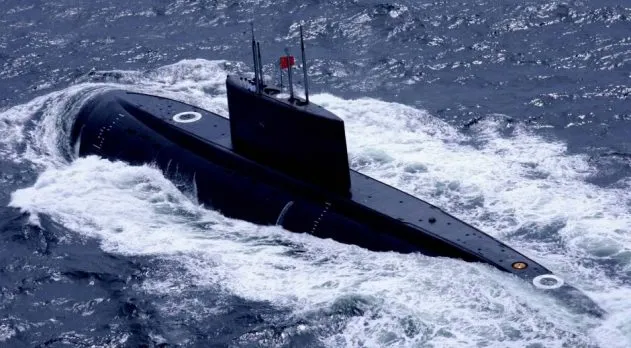
Bangkok, August 22, 2025 (Agencies) — After years of uncertainty and diplomatic wrangling, Thailand has officially recommitted to its long-stalled acquisition of a Chinese-built S26T diesel-electric submarine, following cabinet approval of a revised contract on August 5. The move ends a prolonged impasse that began in 2021, when Germany refused to supply the originally specified MTU 396 diesel engines, citing a longstanding EU arms embargo on China.
The submarine, based on China’s Type 039 Yuan-class design, was ordered in May 2017 from China Shipbuilding & Offshore International Co. (CSOC). Fiscal constraints had reduced Thailand’s initial plan for three submarines to a single unit. The vessel’s keel was laid in Wuhan in September 2019, and construction is now 64% complete.
The Royal Thai Navy (RTN) had insisted on German engines for performance and reliability, but with Berlin’s export block, China proposed its domestically produced CHD620V16H6 engines. After extensive 6,000-hour bench testing, the RTN concluded that the Chinese engines met required standards and would not compromise the submarine’s operational capabilities.
In exchange for accepting the engine substitution, Thailand secured a US$24.7 million compensation package from Beijing. This includes:
- Extension of warranty and maintenance support from 2 to 8 years
- Provision of future equipment and weapons
- Support for submarine simulators
While the exact weapons package remains undisclosed, it is expected to include heavy torpedoes, sea mines, and possibly CM-708UNB anti-ship missiles.
Thailand has so far paid 7.7 billion baht (US$237 million) across ten installments, with 5.5 billion baht still outstanding. The revised timeline gives China until December 2028 to complete the submarine, originally slated for delivery in 2023.
The saga has exposed flaws in procurement planning and raised broader questions about China’s naval engine capabilities. Analysts note that if China had to qualify the CHD620 engines for Thailand, it suggests these are not standard in the People’s Liberation Army Navy’s own submarines.
The episode also underscores shifting geopolitical dynamics. Thailand’s decision to proceed with the Chinese submarine—despite viable European and South Korean alternatives—reflects deepening military ties with Beijing, especially as relations with the United States cooled following the 2014 coup d’état.
Australian scholar Dr. Greg Raymond observed that the submarine deal was “not solely about capability, but also intertwined with geopolitics and diplomacy,” noting that the Thai government had exerted pressure on its navy to favor the Chinese option.
With the contract now revived, Thailand is poised to become the fifth Southeast Asian nation with an active submarine fleet, joining Indonesia, Malaysia, Singapore, and Vietnam.