

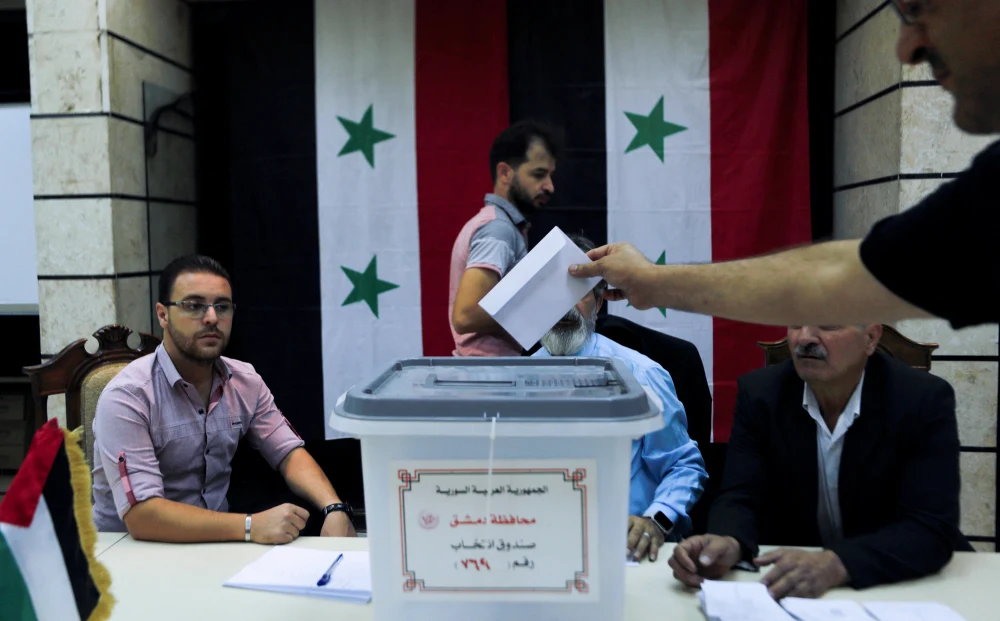
Damascus, October 5, 2025 (Agencies): Syria on Sunday began its first parliamentary elections since the collapse of Bashar al-Assad’s regime, marking a pivotal moment in the country’s political transition after more than six decades of Baath Party dominance.
According to the state-run Syrian Arab News Agency (SANA), accredited electoral centers across all provinces opened early in the morning to receive voters and members of electoral bodies, initiating the first parliamentary vote under the country’s new transitional administration.
The elections follow months of political restructuring after Assad’s ouster in late 2024. Syrian President Ahmad al-Sharaa, who heads the transitional government, received the draft of a temporary electoral law in late July and formally approved it through a decree on August 27. The law sets out the conditions for electoral eligibility, voting mechanisms, and the formation of committees overseeing the process.
The new People’s Assembly will consist of 210 seats. One-third of the members will be appointed directly by the president, while the remaining two-thirds will be chosen through public voting under the temporary electoral framework. Officials have emphasized that this mechanism is provisional, tailored to the country’s current transitional phase.
Assad, who ruled Syria for nearly 25 years following his father Hafez al-Assad, fled to Russia in December 2024 as his regime collapsed amid intensified domestic unrest and regional political shifts. His departure ended the Baath Party’s uninterrupted rule since 1963, ushering in a new political era.
Since assuming office in January 2025, President Sharaa’s administration has undertaken a series of political and economic reforms, including efforts to foster social cohesion, rebuild institutions, and expand cooperation with regional and international partners. Observers view the parliamentary elections as a crucial step toward establishing a more representative political system and laying the groundwork for a future constitutional framework.
International monitors from the Arab League, the European Union, and the United Nations have been invited to observe the elections, signaling Damascus’s attempt to project transparency and legitimacy on the global stage. Early voter turnout was reported to be steady in major cities including Damascus, Aleppo, Homs, and Latakia, despite lingering security and infrastructure challenges.
The outcome of the election is expected to shape the transitional government’s legislative priorities and influence the next phase of Syria’s political reconstruction.