

London, May 30, 2026 (Agencies) – Sweden will gift 16 Gripen fighter jets to Ukraine and facilitate the purchase of 20 additional new aircraft in a deal that will see essential components built in Britain and support more than 5,000 UK jobs, the British government has announced. But beyond the industrial benefits, military analysts say the deal — and specifically the weapons the Gripen carries — will cause serious alarm in Moscow.
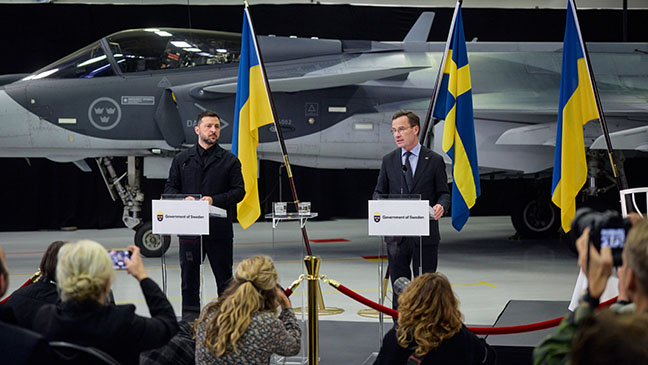
The deal was announced jointly by Swedish Prime Minister Ulf Kristersson, Ukrainian President Volodymyr Zelenskyy, and British Prime Minister Keir Starmer. The 16 older jets will be transferred urgently by Sweden as outright donations, while Ukraine will purchase the additional 20 new Gripens through a €2.5 billion EU support loan to ensure longer-term air force capacity. The deal is intended to give Ukrainian forces modern multirole combat platforms fully interoperable with NATO allies.
The Gripen is a collaborative programme between Sweden, the UK and the United States, with more than 30 percent of each aircraft manufactured in Britain. At least 50 UK-based companies are set to be involved in the deal, including Saab UK in Fareham and Leonardo UK in Edinburgh, covering critical components such as radar systems and landing gear. Saab is investing £100 million in its Fareham facility to support expanded production.
Starmer said the deal shows what British industry can achieve on the world stage, supporting thousands of jobs from Yeovil to Edinburgh while helping deliver the air power Ukraine needs to defend itself against Russia’s invasion. He added that by standing with allies and backing Ukraine, the UK is securing real benefits for British workers and businesses.
Minister for Defence Readiness and Industry Luke Pollard said Britain will not waver in its support, describing the deal as both a major boost for Ukraine’s air power and a show of confidence in the UK’s world-leading defence industry.
The 16 jets being donated are the JAS 39 Gripen C/D, currently in service with the Swedish Armed Forces. The Gripen C can operate from runways measuring just 800 by 16 metres, including ordinary highways, and its engine can be replaced in the field in less than one hour using only one technician and five mechanics. A full turnaround including rearming, refuelling, and inspection takes just ten minutes before the aircraft is ready to fly again. The aircraft can carry weapons including IRIS-T air defence missiles, AMRAAM beyond-visual-range missiles, and the long-range Meteor air-to-air missile, which Ukraine has specifically requested.
The 20 jets to be purchased are the newer JAS 39 Gripen E/F. The Gripen E is powered by a GE F414G engine and is capable of carrying a large payload across ten hardpoints. It incorporates an advanced AESA radar, an Infrared Search and Track System, updated electronic warfare systems, and modern communication technology. The estimated unit cost of the Gripen E is approximately $85 million, with lifecycle costs significantly lower than comparable Western fighters, making it attractive for nations seeking modern airpower on a moderate defence budget.
Ukraine’s air force currently operates a mix of legacy Soviet-era platforms and Western fighters, including the MiG-29 Fulcrum, Su-27 Flanker, Su-24 Fencer, and Su-25 Frogfoot, alongside newly acquired Western jets such as the F-16 Fighting Falcon and the Mirage 2000-5. Ukraine began receiving F-16s from European allies including the Netherlands and Denmark in 2024. The Gripen represents a further significant step away from Soviet-era platforms toward full NATO interoperability.
Training of Ukrainian pilots and technicians on the Gripen C/D is already underway and will be expanded this autumn. Deliveries of the donated Gripen C/D aircraft are scheduled to begin in early 2027, after necessary approvals are granted. The newer Gripen E jets are expected to arrive by around 2030.
Russia has been launching record numbers of glide bombs in 2026, according to the Ukrainian Ministry of Defence. The bombs pose a major challenge to Ukrainian defenders by grinding down fortified positions at the front, with aircraft such as the Sukhoi Su-34 dropping the munitions at stand-off range behind the Russian frontline, where they are relatively safe from air defences. Ukraine’s existing fighters — F-16s and Mirage 2000s — carry shorter-range missiles that cannot reach Russian aircraft operating from inside Russian airspace. The Gripen changes that equation entirely.
- The Meteor: Russia’s New Nightmare
With an estimated range exceeding 200 kilometres, the Meteor offers a much larger no-escape zone than conventional air-to-air missiles, enabling Ukraine to threaten Russian jets that remain out of reach for its F-16 and Mirage fighters.
The Meteor’s key advantage is an adjustable ramjet engine, which allows the missile to reliably hit a target at significantly greater distances, even when the target is actively manoeuvring. Zelenskyy was direct about the intention, saying Ukraine believes it will be able to push Russian aircraft back so they cannot use guided aerial bombs on a massive scale.
Fabian Hoffmann, a senior research fellow at the Norwegian Institute, said the Gripen C/D with Meteor in principle offers the best capability to counter Russian glide bombs before they are launched that Ukraine realistically has access to.
- Gripen vs Russia’s Best Fighters
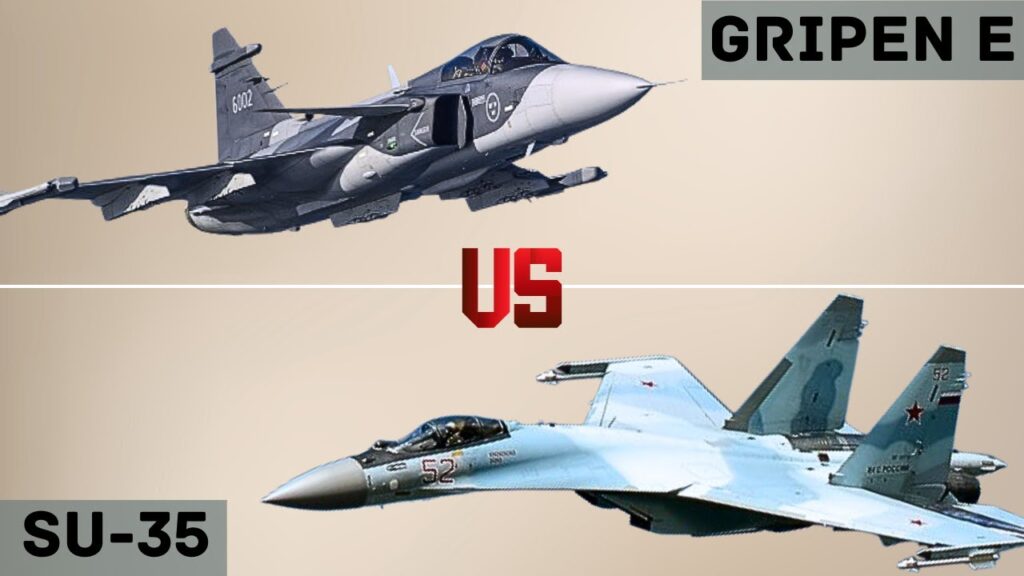
On paper, Russia’s premier fighter the Su-35 appears dominant. The Su-35 brings brute strength — twin engines, huge payload, and thrust-vectoring agility backed by a powerful radar, dominating in raw performance and close-in manoeuvring. The Su-35 has a top speed of 2,500 km/h against the Gripen’s 2,100 km/h, and an operational range of 3,600 km compared to the Gripen’s 805 km.
But analysts say the Gripen was never designed to win a straight dogfight. It was designed to survive and kill at range. The Gripen E acts as a force multiplier to NATO’s air fleet and poses a formidable threat to Russian fighters. According to retired Indian Air Force Air Marshal Anil Chopra, the Gripen can be effectively used as a decoy to lure away and confuse Russian fighters and air defence systems, while F-35s and Eurofighter Typhoons engage in beyond-visual-range combat.
Russian analysts guided by patriotic sentiment and complacency over the Su-35’s superior numbers have hastily concluded that the Gripen variants pose no real threat to Russia’s air force. However, this conclusion relies on a surface-level overview of specifications and fails to consider how the Gripen’s avionics, electronic countermeasures, and armaments are designed to work in tandem for the express purpose of countering Russia’s current Sukhoi line.
The Gripen was specifically designed with a threat from Russia in mind. It can take off and land quickly, operating from taxiways, small public airports, and motorways, allowing dispersed operations that are much harder to target. This makes it far harder to destroy on the ground than conventional fighter operations that depend on large, fixed airbases — a critical advantage in a war where Russian missiles routinely strike Ukrainian airfields.
Combined UK and Swedish military support to Ukraine since Russia’s full-scale invasion in February 2022 now stands at £11.4 billion. Britain is also separately providing 120,000 drones to Ukraine this year as part of its broader military assistance package. BAE Systems maintains a long-standing presence in Sweden through BAE Bofors and BAE Hägglunds, further deepening the industrial ties underpinning the deal. Last summer, a squadron of Swedish Gripens deployed to Poland alongside the Royal Air Force to conduct NATO air policing operations.
The arrival of the Gripen and Meteor missile would represent one of the most significant upgrades yet for the Ukrainian Air Force. Beyond simply adding another Western fighter type, the package would introduce a highly survivable, dispersed-operating combat jet paired with one of the world’s most capable long-range air-to-air missiles and supported by Swedish airborne early warning assets.
For Russia, the combination means its Su-34 bomber crews — currently operating with relative freedom dropping glide bombs just behind the front line — will face a genuine long-range threat for the first time. That alone could force a significant change in Russian air tactics, potentially reducing the effectiveness of one of its most destructive weapons in the conflict.
In the longer term, Ukraine aims to build a fleet of between 100 and 150 Gripen E aircraft, with localised production in Ukraine planned to begin by 2033, a long-term step toward strengthening Ukraine’s air power and defence industry. If realised, it would fundamentally transform the balance of air power over Eastern Europe for decades to come.