


Solar Observatory Networks (Agencies) – Astronomers have captured a dramatic solar event as the Sun released a 160,000-mile-long filament of plasma from its southwest limb, marking one of the most visually striking eruptions of the year. The filament, visible as a dark ribbon against the Sun’s bright disk, erupted with immense force, ejecting material into space in what scientists describe as a coronal mass ejection (CME).
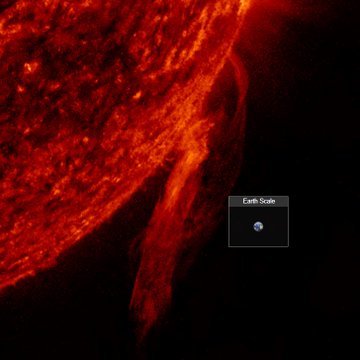
Solar filaments are cooler, denser strands of plasma suspended above the Sun’s surface by magnetic fields. When destabilized, they can erupt violently, releasing charged particles and magnetic energy into the solar system. This particular filament dwarfed recent eruptions and was described by aurora chaser Jure Atanackov as “absolutely enormous”.
The eruption did not appear to be Earth-directed, meaning it’s unlikely to trigger geomagnetic storms or auroras. However, scientists are closely monitoring the CME’s trajectory to confirm its impact potential. If it had been aimed at Earth, it could have caused disruptions to satellites, communications, and power grids.
This event is part of what some observers are calling “Filament Eruption Week”, with multiple solar filaments erupting in rapid succession. The Sun is currently in an active phase of its 11-year solar cycle, and such eruptions are expected to increase in frequency and intensity through 2025 and 2026.