

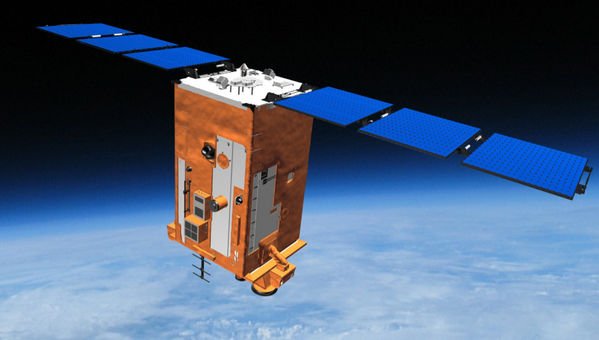
Vostochny, December 28, 2025 (Agencies) – Russia has successfully launched two Aist-2T stereoscopic Earth observation satellites into orbit as part of efforts to strengthen its domestic remote sensing and geospatial capabilities, the state space corporation Roscosmos said. The satellites were launched aboard a Soyuz-2.1b rocket with a Fregat upper stage from the Vostochny Cosmodrome in Russia’s Far East.
In a statement shared on Telegram, Roscosmos confirmed that both Aist-2T satellites reached their designated orbit and separated successfully from the Fregat upper stage following Sunday’s launch. The mission represents another step in Russia’s plan to expand its Earth observation satellite constellation.
The Aist-2T satellites are designed for stereoscopic imaging of the Earth’s surface, enabling them to capture paired images from different angles. This capability allows for the creation of highly accurate three-dimensional models of the planet, supporting applications such as terrain mapping, urban planning, environmental monitoring, agriculture, disaster management, and infrastructure assessment.
Developed under the Aist satellite program, the Aist-2T variant is considered a more advanced operational platform. Unlike earlier versions that focused largely on scientific research and technology demonstration, the new satellites are intended for practical Earth observation and detailed geospatial data production.
The launch also carried several small satellites developed by Russian universities. These satellites are typically used for scientific experiments, testing new space technologies, and providing practical training opportunities for students in aerospace and engineering fields.
The successful deployment further underscores Russia’s efforts to increase the use of the Vostochny Cosmodrome as a primary national launch site, reducing reliance on the Baikonur Cosmodrome in Kazakhstan and reinforcing independent access to space. Roscosmos has placed growing emphasis on Earth observation missions to support civilian, commercial, and security requirements while limiting dependence on foreign satellite data sources.