

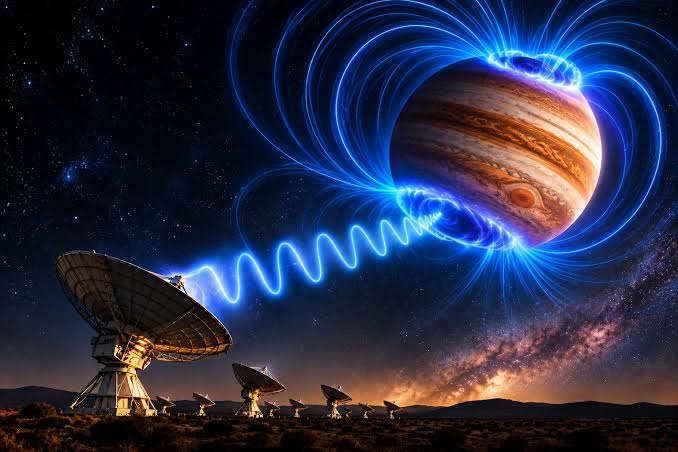
- Astronomers trace repeating radio bursts from gas giant Beta Pictoris b to a magnetic field at least 200 times stronger than Jupiter’s, though researchers stress the signal is not a sign of intelligent life
CAMBRIDGE 4 OCTOBER 2026 (Agencies) – Astronomers say they have directly detected the first-ever radio emission from a planet outside the solar system, though researchers say the signal is evidence of a colossal magnetic field rather than intelligent life.
“I know radio signals are associated with searches for extraterrestrial intelligence,” said Edo Berger, a professor of astronomy at Harvard University and researcher at the Center for Astrophysics | Harvard & Smithsonian in Cambridge, Massachusetts. “But this is something very different.” The discovery, described in a new paper awaiting publication in a peer-reviewed journal, traces repeating radio bursts that appear to come from the exoplanet Beta Pictoris b, located 63 light-years from Earth, a short distance by astronomical standards. The gas giant, about 12 times the mass of Jupiter, is one of three planets orbiting a young star that is 1.75 times as massive as the sun.
Processes associated with the planet’s magnetic field produce the radio emission, according to Berger, a coauthor of the paper posted September 15 to the preprint platform ArXiv. Specifically, the detection involves auroras similar to Earth’s northern lights, the displays sparked by magnetic storms involving charged particles from the sun. “In order to see radio waves that extend all the way to the frequencies that we observed, you need an incredibly strong magnetic field,” Berger said.
Not all planets have a magnetic field, and those that do benefit from a natural shield that deflects disruptive energy. Earth’s magnetic field, for example, protects the atmosphere from being stripped away by solar wind, a continuous outflow of plasma containing charged particles such as protons and electrons. “The magnetic field on this planet is at least 200 times stronger than the magnetic field of Jupiter,” Berger said, referring to Beta Pictoris b. Jupiter’s magnetic field, according to NASA, is powerful enough to generate a magnetosphere, the region of space influenced by the magnetic field, that ranks as the largest structure in the solar system, stretching up to 2 million miles toward the sun.
Jupiter’s field also creates striking auroras, when electrically charged particles spewed from volcanoes on its moon Io become trapped around the field’s poles. As the gas giant rotates, the charged particles emit a glow as well as a radio signal. “As these very high-energy particles are spiraling inside the magnetic field, along with the aurora they also produce radio waves,” Berger said. Astronomers call this type of signal an auroral radio emission, a phenomenon previously observed from Jupiter, Saturn and the sun, as well as stars outside the solar system and cool objects known as brown dwarfs, which sit between a star and a planet. This is the type of signal Berger and his colleagues detected from Beta Pictoris b, pointing to an intense magnetic field driving auroras and the resulting radio emission.
Magnetic fields have implications for the structure of exoplanets and their atmospheres, according to Berger. “Radio observations can give us a completely new view on planets beyond our system,” he said.