

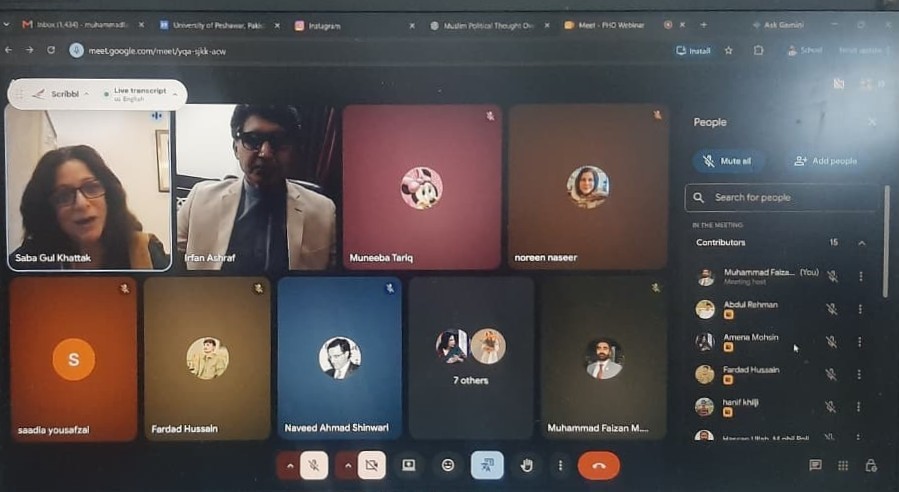
- Researcher Dr Irfan Ashraf says surveillance, self-censorship and managerial control have turned campuses into security-oriented spaces, restricting scholarship and critical discussion
PESHAWAR 29 OCTOBER 2026 (Khyber Mail) – The Pakistan Humanitarian Observatory hosted a webinar led by Dr Irfan Ashraf examining the impact of militancy and the War on Terror on higher education in Khyber Pakhtunkhwa, based on his research on academic freedom.
Dr Ashraf teaches in the Department of Communication at the University of Peshawar and is the author of The Dark Side of Journalism, published in 2022. His research focuses on geopolitics, campus securitisation and the role of international actors that influence curricula and teaching. The webinar was part of the observatory’s series exploring the often-overlooked effects of militancy and conflict on education and research.
Dr Ashraf examined how campus life reflects and resists securitisation, linking higher education to the region’s geopolitical history. Tracing the relationship back to the Cold War, he highlighted how initiatives such as the Franklin Book Program connected knowledge production to US influence and marginalised progressive ideas.
Drawing on interviews with about 35 academics from militancy-affected areas, he described post-9/11 changes in universities, including increased workloads, surveillance, military involvement in campus activities and growing self-censorship. He said piety politics had further eroded academic freedom, citing banners that discouraged Western education and directed students towards mosques rather than classrooms. Insecure employment, limited resources and increasing managerial control had also transformed campuses into security-oriented spaces, he said, restricting scholarship and critical discussion.
Dr Ashraf described student politics as a “missing link” in academic freedom, citing the abduction of two political science students after they attended a peace jirga and the limited support they received from teachers. On research restrictions in conflict-affected areas, he said protecting participants and ensuring responsible publication should remain paramount, without compromising academic freedom.
Responding to a question on power, knowledge and intellectual autonomy, he argued that intellectual autonomy was “not part of the equation”, as universities were expected to generate their own resources while remaining answerable to the state. He warned that these pressures could reshape higher education over the next 10 to 15 years, restricting critical scholarship and access for poorer students.
Before thanking Dr Ashraf for what she called his insightful and candid presentation, Dr Saba Gul Khattak placed the concerns within a wider international context, referring to restrictions on academic freedom in Hungary, the United States, Britain and Germany, particularly concerning Palestine and Gaza. Concluding the session, Dr Ashraf observed that attacks on progressive education in Pakistan had begun earlier than similar pressures elsewhere, while noting that progressive teachers, alongside students, were increasingly speaking up.