

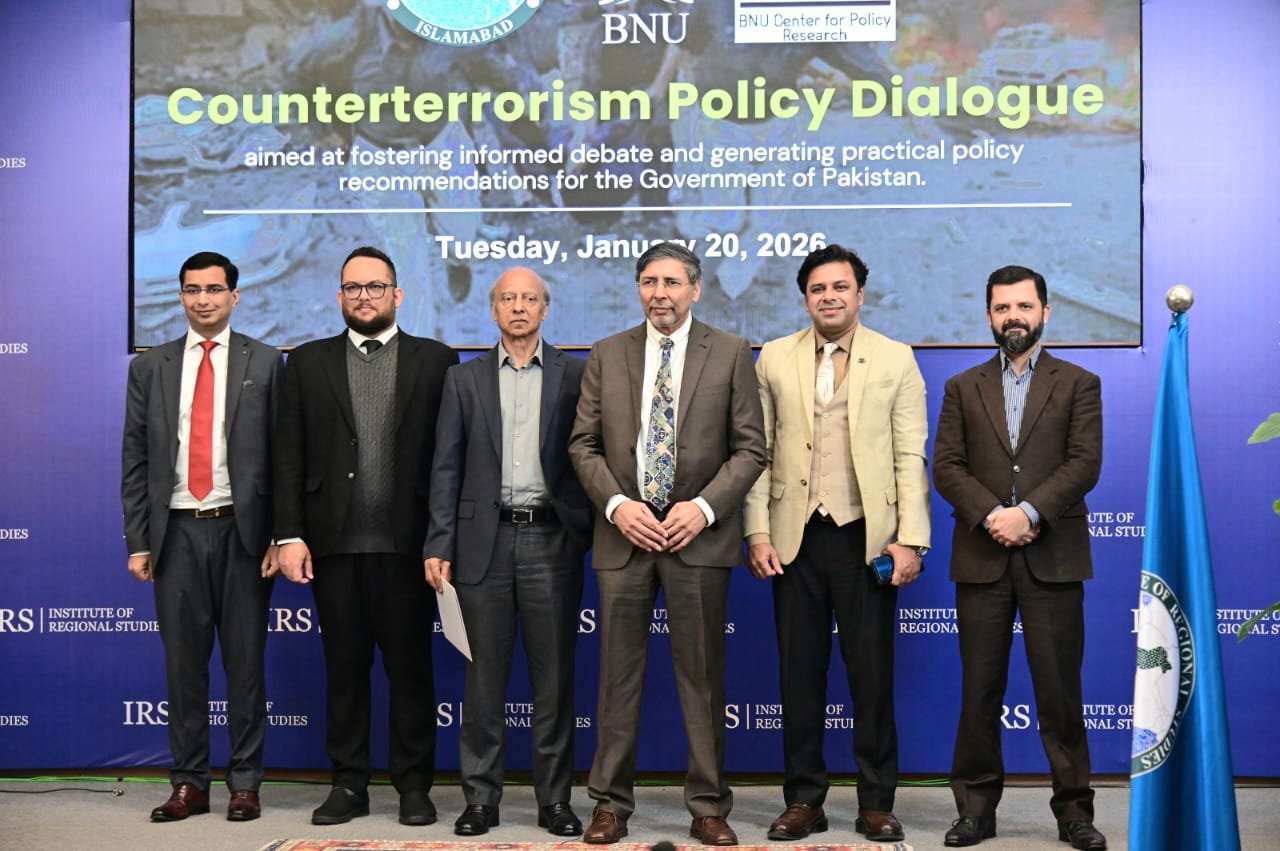
Islamabad, January 25, 2026 (Khyber Mail) – A Counterterrorism Policy Dialogue aimed at fostering informed debate and generating practical policy recommendations for the Government of Pakistan was held in Islamabad. The dialogue was jointly organised by the Institute of Regional Studies Islamabad in collaboration with the BNU Centre for Policy Studies, bringing together security experts, academics and journalists to assess Pakistan’s counterterrorism landscape and identify actionable pathways forward.
In his opening remarks, Ambassador Jauhar Saleem, President of the Institute of Regional Studies, stressed the importance of engaging Afghanistan through peaceful means to address shared security challenges. He said the objective of the dialogue was to move beyond rhetoric and develop practical, implementable policy recommendations. He also highlighted the need for long-term societal resilience by prioritising literacy, promoting tourism, fostering tolerance and strengthening cultural values as essential components of countering extremism.
Ambassador Mansoor Khan, Pakistan’s former ambassador to Afghanistan, provided a historical overview of terrorism in Pakistan, identifying three major waves since 2001, 2006 and 2021. He pointed out key gaps in Pakistan’s counterterrorism policy and said an effective strategy must combine kinetic operations, sustained dialogue and social and economic integration. He noted that maintaining balance among these pillars remains a major challenge. He also linked regional connectivity projects such as CASA-1000 and TAPI with security, arguing that cross-border challenges must be addressed for these initiatives to succeed. Ambassador Khan called for improved institutional coordination and trilateral cooperation among Pakistan, Afghanistan and China, particularly in view of attacks targeting Chinese interests, and stressed that NACTA must play a central coordinating role.
Dr Rizwan Naseer, Director of the Centre for Countering Terrorism and Violent Extremism Studies at IRS, highlighted the growing threat of violent extremism and emphasised the need for evidence-based and community-focused responses. Mr Imtiaz Gul, Executive Director of the Centre for Research and Security Studies, underscored the economic cost of insecurity, noting that farmers in Pakistan and Afghanistan have collectively suffered losses of nearly 800 million dollars. He criticised the lack of civilian ownership of counterterrorism policy, observing that no single entity has effectively filled this space.
Professor Samina Yasmeen, Professor Emerita and Director of the Centre for Muslim States and Societies at the University of Western Australia, challenged traditional narratives about Balochistan, stating that the province is no longer entirely dominated by sardars. She highlighted the important role of women in addressing social divisions and countering extremism.
Mr Amir Rana, Director of the Pakistan Institute for Peace Studies, traced the evolution of NACTA since 2009, noting its ambitious beginnings under its founder Tariq Pervez. He criticised the stagnation of policy development and said Pakistan’s counterterrorism policy has largely remained unchanged since 2014, failing to evolve in response to emerging threats.
Dr Rakesh Parkash, Director at NACTA, spoke about the organisation’s engagement with 49 stakeholder agencies and highlighted emerging challenges, including the spread of leftover NATO weaponry and the growing use of cryptocurrencies in terror financing. While acknowledging NACTA’s reliance on kinetic approaches, he emphasised the importance of non-kinetic strategies. Mr Iftikhar Firdous, Founder and Executive Editor of The Khorasan Diary, called for indigenous mechanisms to counter extremism and referred to regional examples, including China’s handling of tribal dynamics, while questioning how NACTA is addressing the evolving threat of IS-K.
Mr Aarish Ullah Khan, Editor Publications and Head of the Afghanistan Programme at IRS, highlighted NACTA’s strengths, including its efficient control rooms, but stressed the urgent need for a more effective diplomatic approach toward Afghanistan.
The dialogue concluded with a consensus on the need for an inclusive, indigenous and coordinated counterterrorism framework that balances security operations with socio-economic measures and diplomatic engagement.