

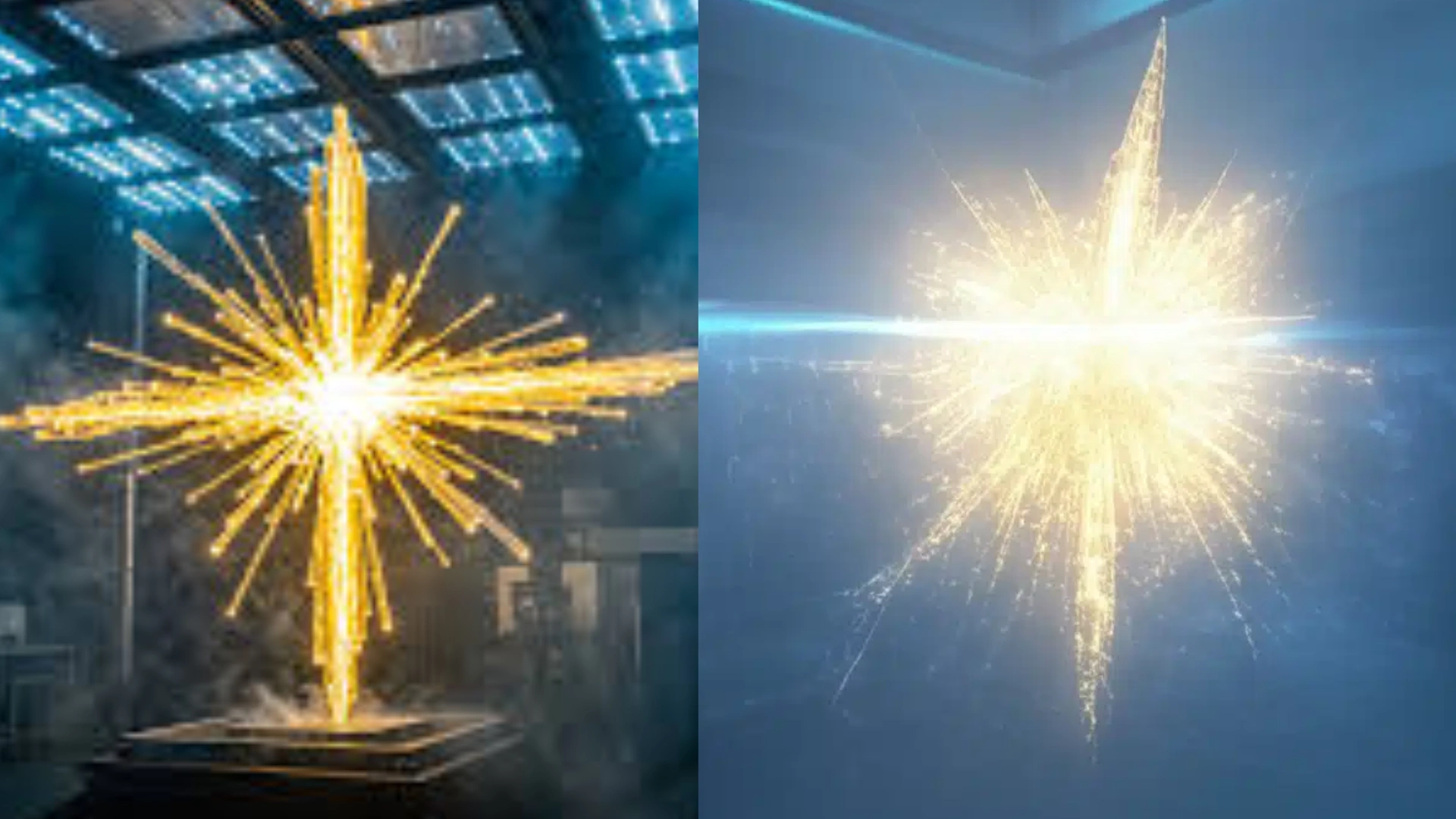
Darmstadt, Germany (Agencies) 30 July 2025 — Scientists have frozen light for a full minute and triggered its transition into a supersolid state, redefining long-held assumptions in quantum physics and positioning photonic matter at the forefront of next-generation technologies.
In an unprecedented advance that stretches the boundaries of particle behavior, physicists at Technische Universität Darmstadt, working jointly with an Italian research team, have achieved what was previously theoretical—immobilizing light for 60 seconds and transforming it into a supersolid form. The development opens new pathways for quantum computing, frictionless transport, and high-resistance shielding technologies.
Using a praseodymium-doped glass crystal and laser-induced excitations, German scientists successfully halted a light pulse by embedding its quantum information in the spin states of the crystal’s atoms. The result: light no longer moved, but its properties remained intact.
Simultaneously, the Italian team cooled photon-exciton pairs to near absolute zero using Bose-Einstein Condensate protocols and forced them into optical lattices. This produced a supersolid state, wherein photons displayed both solidity and superfluidity—rigid yet flowing without resistance.
The process involved encoding light as a stable spin wave within the atomic structure of rare-earth ions, while cryogenic isolation minimized thermal interference and preserved quantum coherence. Structured laser arrays arranged photons into repeating patterns, creating a stable lattice that mimicked solid matter.
Researchers expect the implications of this discovery to extend far beyond theoretical physics. Supersolid light may power the development of quantum processors with enhanced stability and processing speed, pave the way for near-zero-resistance transport systems, and lead to the creation of resilient light-based structural materials for aerospace and defense applications. It may also redefine models in quantum gravity and wave-particle duality.
“We’re not simply manipulating photons—we’re reinventing how light interacts with the universe,” said Dr. Francesca Bellini, a lead researcher on the project. “The emergence of photonic supersolidity reveals untapped quantum architectures and offers extraordinary control over quantum states.”
This landmark study not only freezes light in its tracks but reshapes its role as a controllable medium in engineered systems. From quantum infrastructure to futuristic defense, the fusion of low-temperature physics and photonic structuring is accelerating the transformation of science fiction into scientific reality.