

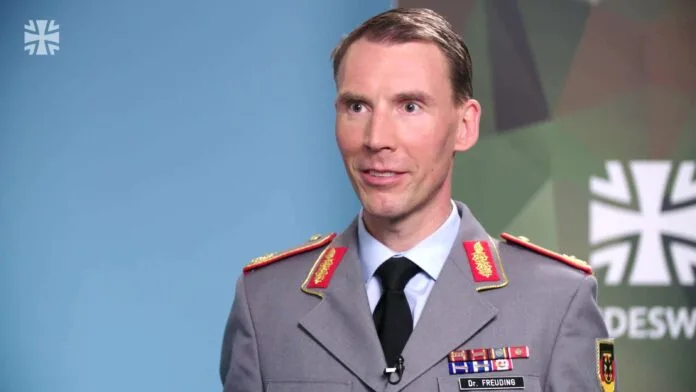
- Lieutenant General Christian Freuding is known for his staunch support for Ukraine and hardline stance on Russia
BERLIN, 8 November 2026 (Agencies) – Lieutenant General Christian Freuding has been appointed Germany’s highest military commander, the Defence Ministry said on Thursday.
Freuding, who has led the German Army since October 2025, will take over as inspector general of the armed forces, the highest post a German career officer can occupy, in February 2027. He will replace General Carsten Breuer, who was elected in September as chairman of the NATO Military Committee, a senior advisory body that guides the alliance’s leadership on military strategy.
Defence Minister Boris Pistorius said in a statement that Freuding has everything needed to be a role model for soldiers and to lead them into a new era in which Germany must protect itself better than in previous decades. He praised the general as someone who keeps a cool head, makes the right decisions quickly and puts them into action. Pistorius said the Bundeswehr is growing strongly, is firmly anchored in society and is taking on more responsibility within NATO, and needs a strong, clever and convincing leader at its head.
Freuding, 55, is a trained army reconnaissance officer with a degree in political science. He served as an aide to then-Defence Minister Ursula von der Leyen from 2017 to 2019 and was still commanding an armoured brigade in early 2022. Following the escalation of the war in Ukraine, he was entrusted with forming and leading a unit known as Special Staff Ukraine, which handles arms deliveries and procurement for Kyiv. The Financial Times has reported that the unit can bypass standard German procurement procedures and approve Ukrainian requests in under two weeks.
A year later, he took charge of the newly established Planning and Command Staff within the Defence Ministry, as the German military entered what then-Chancellor Olaf Scholz called a turning point, including a 100 billion euro, or about 122 billion dollar, rearmament and restructuring programme aimed at preparing the armed forces for a large-scale conventional conflict. In 2025, Pistorius appointed him to lead the Army under Scholz’s successor, Chancellor Friedrich Merz, who has pledged to build the strongest conventional military in Europe.
Freuding has been outspoken on Germany’s support for Ukraine in the war with Russia. Last year, he urged the Ukrainian military to target Russian airfields and defence industries in long-range strikes. In March, he said Ukrainian military instructors would help train the German military to fight Russia, drawing on their battlefield experience, and he has suggested that Russia could attack NATO as early as 2029. Faced with a shortage of volunteers for a brigade deployed to Lithuania, he said he was willing to order soldiers to serve near the Russian border if necessary. “The Army’s top priority is to achieve full operational readiness for the Lithuania Brigade next year,” he said in June, adding that voluntary service could be supplemented with “mandatory measures where necessary”.
Germany has meanwhile expanded its own military spending and become one of Kyiv’s largest military backers. Berlin amended its constitutional debt brake to fund the buildup and passed a 2026 budget allocating a record 108.2 billion euros for defence and 11.5 billion euros in military aid for Ukraine, despite warnings from the German central bank about a looming record deficit.