

NEW DELHI, 5 July 2026 (Agencies) – India has approved another massive tranche of arms purchases worth approximately $5.5 billion (roughly ?52,000 crore) as part of a broader effort to modernize its armed forces.
The Defence Acquisition Council (DAC), chaired by Defence Minister Rajnath Singh, granted Acceptance of Necessity (AoN) — in-principle administrative approval — to the procurement proposals during a meeting on Friday. AoN is the first stage in India’s defence procurement process before tendering and contract negotiations begin. The meeting was also attended by Army Chief General Dhiraj Seth and Navy Chief Admiral Krishna Swaminathan, among other senior officials.
In March, New Delhi had already given the green light for arms purchases worth $25 billion, making this the latest in a series of major procurement pushes this year.
For the Indian Army, the DAC approved the procurement of the Anti-UAV Electronic Warfare System “Akash Tarang,” Man Portable Anti-Tank Guided Missile (MPATGM) systems, the Medium Range Surface-to-Air Missile (MRSAM) weapon system, the Very Short Range Air Defence System (V-SHORADS), an Active Protection System for tanks, and a jet-based kamikaze drone system.
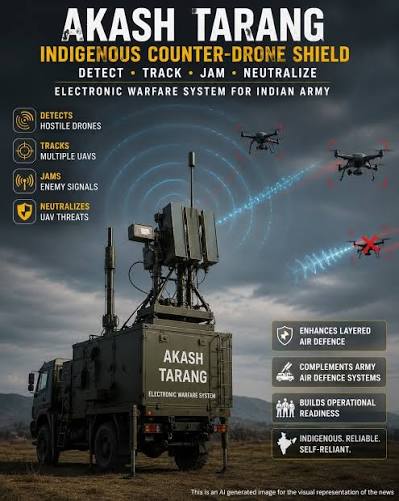
According to the Defence Ministry, Akash Tarang is designed to safeguard against threats posed by hostile drones, providing effective anti-UAV protection to Army formations. The system is an indigenously developed electronic warfare platform built to detect, track, jam, and neutralise hostile drones, and is designed to counter reconnaissance drones, swarm drones, and kamikaze UAVs using radio frequency detection and GPS jamming technology. Officials say Akash Tarang will operate alongside upgraded L-70 air defence guns and Akash missile batteries as part of India’s broader “Sudarshan Chakra” air defence shield.
The Ministry said the MPATGM will strengthen infantry capability against enemy armoured and mechanised forces, while the MRSAM system will provide medium-range defence against a range of aerial threats. The V-SHORADS, equipped with multi-spectral sensing, is expected to improve resilience against countermeasures, and the Active Protection System is intended to boost tank survivability. The jet-based kamikaze drone system is expected to offer enhanced electronic warfare capability with greater lethality and survivability at a lower cost.
For the Indian Navy, the DAC approved the procurement of Multi Influence Ground Mines (MIGM), Naval Shipborne Unmanned Aerial Systems (NSUAS), and the establishment of a Land-Based Testing Facility for electric propulsion systems. Officials said the naval mines would help deny freedom of manoeuvre to adversaries, while the shipborne drones, equipped with advanced sensors, would enhance the Navy’s situational awareness at sea.
For the Indian Air Force, the council cleared the procurement of Fixed-Wing High Altitude Pseudo Satellites (FW-HAPS), intended to provide persistent intelligence, surveillance, and reconnaissance capabilities, along with telecommunication and remote sensing functions.

India has moved to accelerate the modernization of its armed forces following a brief military conflict with nuclear-armed rival Pakistan last year, and now maintains a defense budget of $85 billion — a record 15 percent annual increase. Capital expenditure for the armed forces has been set at $23 billion, earmarked for funding major procurement programs.
India has been the world’s leading importer of major arms by value since 1950, according to the Stockholm International Peace Research Institute (SIPRI).