

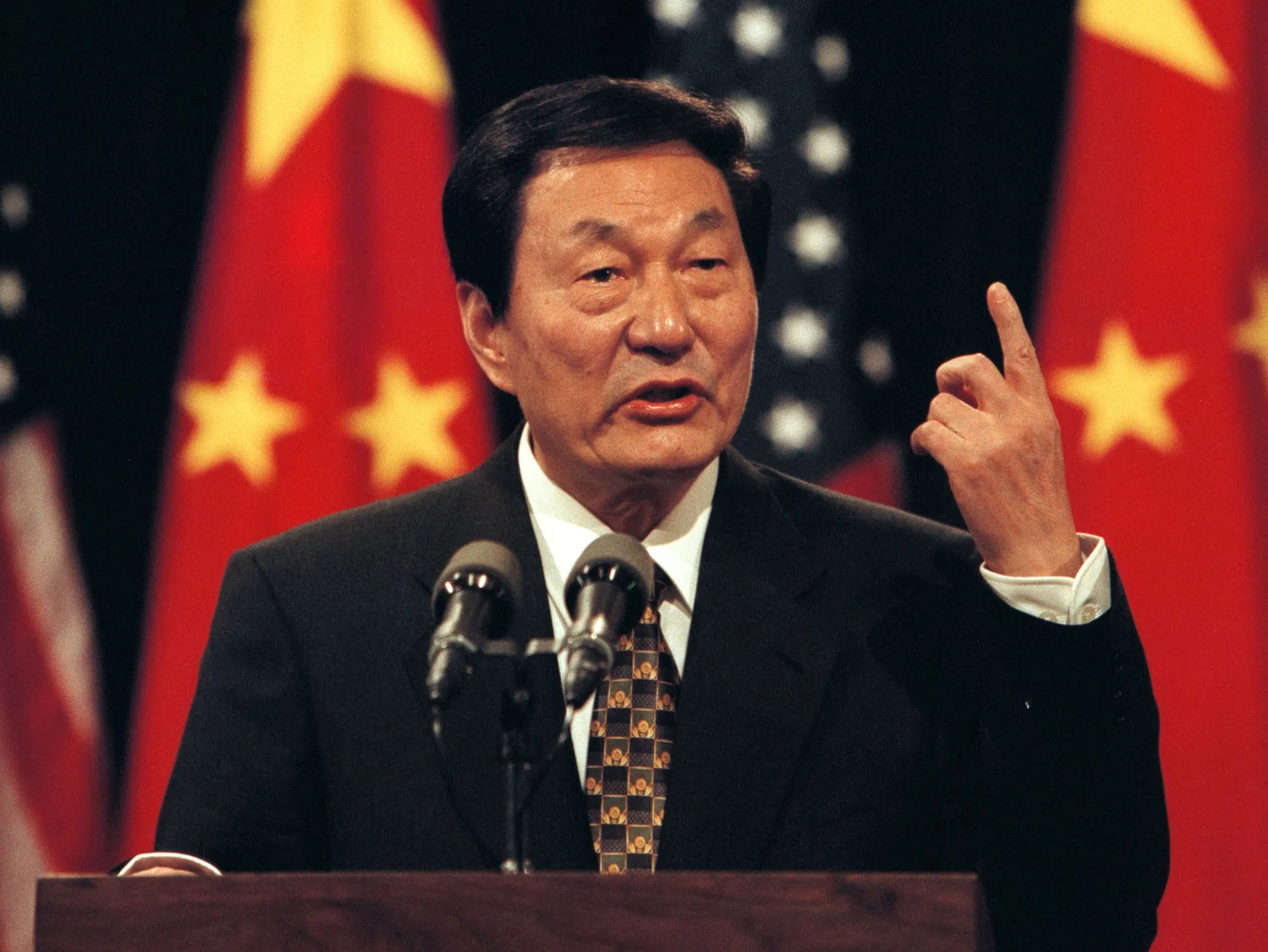
BEIJING, August 12, 2026 (Agencies) — Former Chinese Premier Zhu Rongji, a key architect of the country’s economic reforms and one of China’s most influential leaders of the late 20th century, died of illness in Beijing on Wednesday at the age of 98, state media reported. He died at 11:06 a.m. local time.
An obituary jointly issued by the Communist Party of China (CPC) Central Committee, the Standing Committee of the National People’s Congress, the State Council and the National Committee of the Chinese People’s Political Consultative Conference described Zhu as an outstanding Party member, loyal communist fighter, statesman and leader of the Party and state.
Zhu served as China’s premier from 1998 to 2003, succeeding Li Peng, after serving as vice premier from 1991 to 1998. He was also a member of the Politburo Standing Committee during the 1990s and early 2000s.
Before becoming premier, Zhu served as mayor of Shanghai from 1987 to 1991, where he gained a reputation as a tough and pragmatic economic manager. He later served as governor of the People’s Bank of China from 1993 to 1995 while also holding senior economic responsibilities.
Zhu played a central role in transforming China’s economy toward a more market-oriented system. During his premiership, his government pursued sweeping reforms of state-owned enterprises, the banking sector, taxation, government administration and housing, while working to contain inflation and strengthen economic stability.
One of his most significant achievements was helping secure China’s accession to the World Trade Organization in 2001, with membership formally taking effect in December that year. The move accelerated China’s integration into global trade and investment and became a major milestone in the country’s economic rise.
Zhu also guided China through the aftermath of the 1997-98 Asian financial crisis, maintaining economic stability while resisting international pressure to devalue the Chinese yuan. His administration combined fiscal and monetary measures with large infrastructure investments to sustain growth.
His reforms, however, came with substantial social costs. The restructuring of state-owned enterprises resulted in millions of workers losing their jobs, while the government’s drive to modernize the economy generated significant changes in China’s urban employment and welfare systems.
Known for his direct and outspoken style, Zhu was widely regarded as a forceful economic technocrat. His tenure coincided with a period of rapid economic expansion that helped lay foundations for China’s emergence as a major global economic power.
Zhu was born in Changsha, Hunan province, in October 1928 and studied electrical engineering at Tsinghua University. He retired from China’s top leadership in 2003, when Wen Jiabao succeeded him as premier.
Note: Some international reports are giving Zhu’s age as 97, based on his October 1928 birth date and the date of his death. China’s official Xinhua report and the supplied statement describe him as 98. For your newspaper copy, 98 is appropriate if you are following the official Chinese government/Xinhua report.