

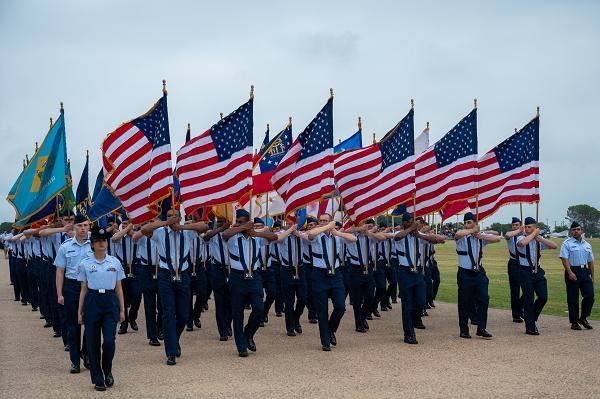
SAN ANTONIO, 4 July 2026 (Agencies) – A flu outbreak at Air Force Basic Military Training has killed one recruit and sickened more than 280 others at Joint Base San Antonio-Lackland, Texas, according to the congressman who represents the base.
Reports of the outbreak first surfaced in mid-June when the 37th Training Wing, which oversees Basic Military Training (BMT), announced the death on June 16 of trainee Keon McDaniel following what it described as “a medical emergency.” The wing’s initial release said the cause was under investigation, but on June 30, Rep. Joaquin Castro (D-Texas) said in a statement that the Air Force had confirmed McDaniel’s death was related to the flu.
In a subsequent press conference, Castro — whose district includes Lackland — said the Air Force informed his office that it has recorded 284 cases and four hospitalizations connected to the outbreak. Air Education and Training Command, which oversees the 37th Training Wing and BMT, did not respond to queries about the number of cases and hospitalizations, or whether McDaniel’s death has been formally linked to the flu.
In a statement, a wing spokesperson said the unit “has been managing a localized influenza outbreak among trainees at Basic Military Training,” adding that “medical professionals and Public Health officials have implemented mitigation measures to isolate and treat symptomatic trainees to reduce further exposure and continue to monitor the situation.” The statement said medical personnel are also monitoring trainees who had close contact with sick members in case they become symptomatic, and that symptomatic trainees are receiving antiviral medications such as Tamiflu.
The outbreak is drawing additional scrutiny because it comes just months after Defense Secretary Pete Hegseth announced in April that he was rescinding the mandate requiring active-duty troops and trainees to receive the annual influenza vaccine. In a video posted to social media at the time, Hegseth said “the notion that a flu vaccine must be mandatory for every service member, everywhere, in every circumstance at all times is just overly broad and not rational.”
The Associated Press reported on June 24 that only around 40 percent of Air Force trainees received the flu shot after Hegseth made it optional — slightly lower than the 46.5 percent of American adults who got the shot this past flu season, according to the CDC.
Since the outbreak, however, the vaccine has once again become mandatory for Air Force trainees. Chief Pentagon Spokesman Sean Parnell confirmed in a statement to Air & Space Forces Magazine that the Air Force, along with the Army, Navy, National Security Agency, and Defense Health Agency, requested and were granted exceptions to the new policy, effectively restoring the requirement for their trainees.
The Pentagon has long required vaccinations for service members, citing their effectiveness in limiting the spread of contagious illness in the crowded, close-quarters environment of military training. That risk is especially pronounced at BMT, where trainees sleep in open-bay barracks and spend most of the day in close groups.
The annual flu vaccine was first required in the 1940s, according to the bulletin of the U.S. Army Medical Department, and while it has not been mandated every single year since, Pentagon policy dating back to at least 1995 required all active-duty troops and trainees to receive the shot.
Vaccine hesitancy has grown more pronounced in recent years, however, and a 2021 mandate requiring all service members to receive COVID-19 vaccinations fueled significant political debate at the time. Around 8,000 service members were ultimately required to separate from the military for refusing that mandate, and the Pentagon has since taken steps to allow some of those separated members to return to service.