

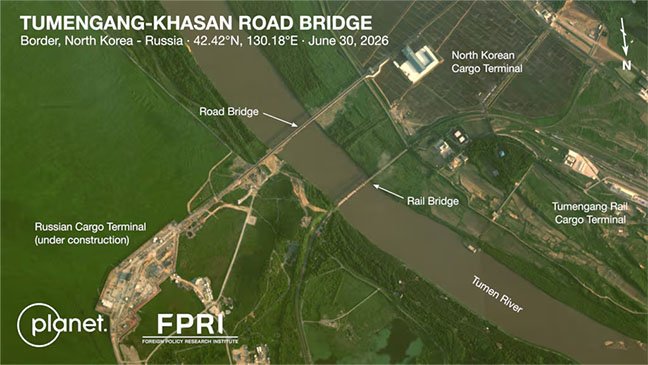
MOSCOW, August 26, 2026 (Agencies) — The first-ever road bridge linking North Korea and Russia across the Tumen River is nearing completion, according to recent satellite imagery, offering a visible symbol of the rapidly deepening strategic and military relationship between the two countries.
High-resolution satellite images reviewed by Defense News show that construction on the North Korean side is largely complete. A customs facility and controlled entry point have been established several hundred metres from the riverbank, while work on the Russian side remains unfinished.
Construction crews are still working on border facilities and the connecting road in Russia. The site for a large customs building has been prepared and gravel has been laid for the future highway, but the crossing is not yet ready for commercial traffic.
The bridge is located near Tumangang, a long-standing rail crossing that once served as an important route for Soviet-era trade with North Korea. The area had remained largely inactive following the collapse of the Soviet Union in 1991, but activity has increased significantly since Russia launched its full-scale invasion of Ukraine in 2022.
The development comes amid growing military cooperation between Moscow and Pyongyang. North Korea has been accused by Western governments and international analysts of providing Russia with artillery ammunition and troops for its war in Ukraine, while Russia has increasingly strengthened political, economic and military ties with Pyongyang.
The North Korea-Russia border stretches for only about 17 kilometres, but its strategic importance has grown considerably as relations between the two countries have expanded.
“It’s clear that Kim Jong Un has decided, ‘Our way forward is with Russia,’ and this is emergent proof of it,” said John Ford, a research fellow at the Foreign Policy Research Institute who has studied North Korean infrastructure and arms production.
Ford said Pyongyang had sought construction of a road bridge at the border for decades, but Moscow had previously been reluctant to approve the project. Russia’s deteriorating relations with the West following its invasion of Ukraine, however, have fundamentally changed its relationship with North Korea.
The new crossing could also provide a practical solution to logistical problems at the existing rail link. North Korea uses different standards for some freight containers, meaning cargo arriving by rail can require manual transfer between rail cars.
That bottleneck has contributed to the use of alternative routes, including the movement of cargo through North Korea’s Rason port and onward by sea to Russia.
A road crossing could allow trucks to bypass some of these restrictions and potentially increase the movement of goods between the two countries. However, analysts say it remains unclear whether the bridge will primarily be used to transport Russian goods into North Korea or North Korean products, including potentially military supplies, into Russia.
The remote location of the crossing also raises questions about its long-term commercial viability. The bridge is situated far from major population centres in Russia’s Far East, while Tumangang itself is located in a remote part of North Korea.
Ford said the location could indicate that the facility will be used primarily as a specialised transfer point rather than as a major commercial highway linking the two countries.
The bridge nevertheless carries considerable political significance. Russia and North Korea have moved closer since Moscow’s invasion of Ukraine, culminating in the signing of a Comprehensive Strategic Partnership Treaty in 2024.
The agreement includes a mutual defence commitment under which each side pledges assistance to the other in the event of armed aggression. It also provides for broader cooperation in areas including defence, nuclear energy, space and economic affairs.
North Korea has increasingly demonstrated its alignment with Moscow, while Russia has taken a more supportive position toward Pyongyang in international forums and has been accused of helping North Korea circumvent sanctions imposed by the United Nations.
The completion of the bridge would therefore represent both an infrastructure milestone and a physical manifestation of the expanding partnership between Moscow and Pyongyang.
Its true strategic and economic importance, however, will become clearer only after construction is completed and regular cross-border truck traffic begins.