

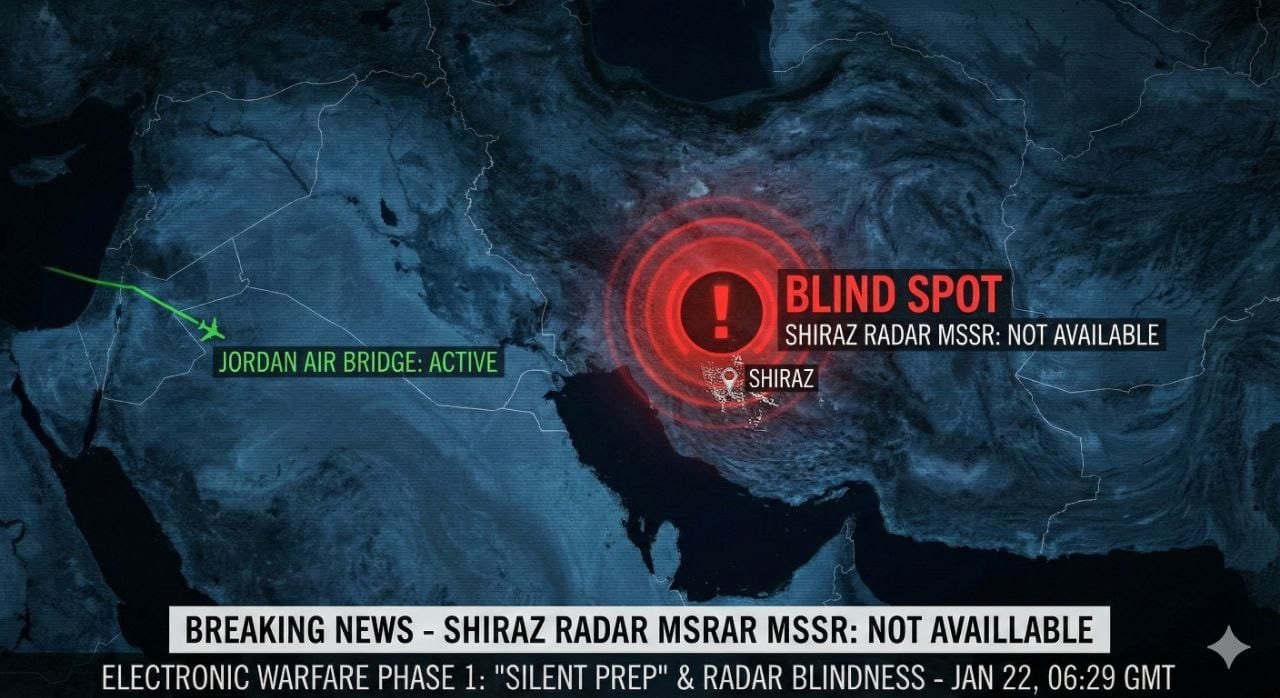
- Mean while Iran has deployed S-400 and HQ-9B air defence systems simultaneously to counter F-35, F-22 and B-52
Tehran, January 22, 2026 (Agencies) – Signs of possible electronic warfare activity have emerged in Iran after aviation authorities issued a notice indicating that key radar systems in the southern city of Shiraz were suddenly rendered inoperative, raising concerns of a new and sensitive phase in escalating regional tensions.
According to a newly issued Notice to Airmen (NOTAM A0285/26), the Monopulse Secondary Surveillance Radar (MSSR) in Shiraz became unavailable, with radar services in Sectors 3 and 4 of Iran’s Area Control Center potentially disrupted until the evening of January 22. Shiraz is considered a critical gateway for air traffic covering southern and central Iran, and the outage has created a significant gap in civilian airspace monitoring, with potential implications for military surveillance as well.
Security analysts note that the timing of the radar failure is particularly notable, coinciding with reports of United States naval assets operating in so-called “dark mode,” a term commonly associated with reduced electronic emissions. The concurrence of these developments has fueled speculation that the disruption may be linked to cyber or electronic warfare activities rather than a routine technical malfunction.
At the same time, observers have pointed to the apparent absence of US E-3G AWACS early warning aircraft in the region. Some analysts interpret this as a deliberate operational choice, suggesting reliance on alternative systems such as F-35 fighter jets acting as distributed sensor platforms, carrier-based E-2D Advanced Hawkeye aircraft, and an integrated ground radar network across Jordan, Saudi Arabia, and Israel. Others argue that the lack of AWACS presence could indicate preparations for missile-based or long-range strike scenarios rather than conventional aerial operations.
Further attention has focused on Jordan’s Muwaffaq Salti Air Base, where multiple US C-17 transport aircraft have reportedly continued to land in recent days. The sustained airlift activity has reinforced assessments that the base is serving as a central logistical and operational hub, effectively positioning Jordan as a key platform for both defensive coverage and potential offensive actions in the region.
Adding to the heightened rhetoric, recent remarks attributed to former US President Donald Trump, in which he reiterated that Iran would not be allowed to acquire nuclear weapons, have been interpreted by analysts as underscoring a strategic focus on disarmament rather than diplomatic pressure alone. References to updated intelligence on nuclear sites have further contributed to uncertainty and concern.
By Thursday morning, analysts described the regional situation as entering a “lights out” phase, citing the radar outage in Iran, reduced electronic visibility of naval forces at sea, and reports of GPS interference in northern Israel. While no official confirmation has been issued regarding deliberate hostile action, the Shiraz radar failure is being viewed by some observers as the first tangible sign of a broader electronic confrontation unfolding behind the scenes.