

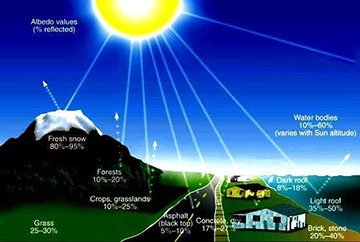
GENEVA (Khyber Mail) July 26, 2025 — Satellite observations have revealed that Earth reflected less sunlight in 2023 than in any year since systematic monitoring began, marking a dramatic decline in planetary albedo and adding a potent driver to the planet’s accelerating temperature rise.
According to data from NASA’s Clouds and the Earth’s Radiant Energy System (CERES), the planet reflected nearly 1 W/m² less solar energy than the 2000–2020 average. That loss of reflectivity is equivalent to an additional 0.23 °C of warming—unaccounted for by greenhouse gases alone—and helps explain the shortfall between observed warming and model projections.
Researchers attribute roughly two-thirds of the albedo decline to a reduction in bright, low-lying clouds, especially in the tropics and mid-latitudes. “If you lose those clouds, you lose this cooling effect,” said Helge Goessling of the Alfred Wegener Institute, co-author of the Science paper documenting the change. The retreat of Arctic sea ice and snow cover accounts for about 15 percent of the darkening, while cleaner skies—stemming from reductions in sulfate aerosols—contribute the remainder.
The feedback loop is self-reinforcing: fewer clouds and ice expose darker ocean and land surfaces, which absorb more solar energy, driving further melting and cloud loss. Since 2000, this mechanism has added an estimated 1.7 W/m² of absorbed energy—comparable to raising atmospheric CO? by 138 ppm—making cloud albedo feedback the single largest amplifier of recent warming trends.
Climate modelers warn that unless these albedo processes are better represented in projections, long-term forecasts may underestimate near-term warming. “Incorporating dynamic cloud and ice feedback is critical,” said Pushker Kharecha of NASA’s Goddard Institute for Space Studies.
Policymakers are now discussing whether to include albedo targets alongside greenhouse-gas reductions under international climate agreements. Proposals range from protecting and restoring reflective surfaces—such as sea ice and high-albedo vegetation—to researching marine cloud brightening, though experts caution that large-scale intervention carries ecological risks.
As Earth’s mirror continues to darken, scientists agree that understanding and mitigating albedo loss is essential to closing the gap between human emissions and the warming we experience.