

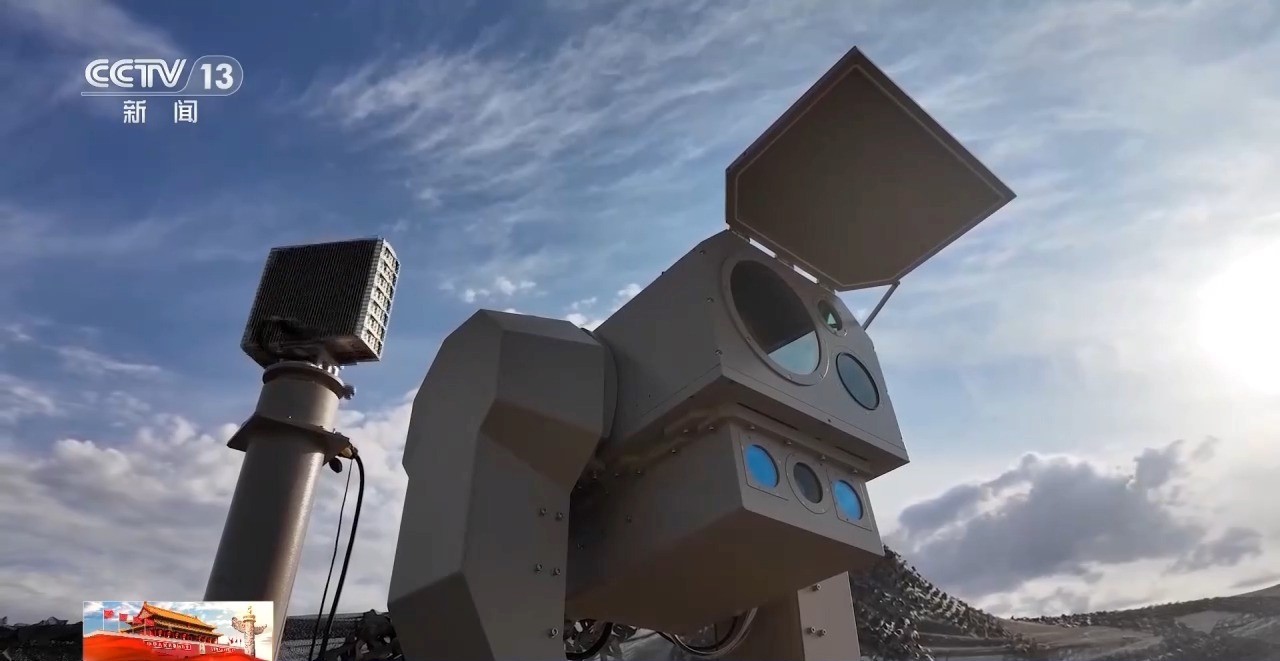
- CCTV News footage showcases laser weapons, integrated missile-gun systems and high-power microwave weapons used by the PLA Army’s 75th Group Army in combat-oriented training in the Gobi Desert
BEIJING 4 OCTOBER 2026 (Agencies) – China’s state broadcaster CCTV News released rare footage on Sunday of the People’s Liberation Army Army’s counter-drone units in combat-oriented training, highlighting laser weapons, integrated missile-gun systems and high-power microwave weapons as what the broadcaster called an “iron triangle” of anti-drone equipment.
China’s drone capabilities and counter-drone technologies are among the world’s most advanced after years of development, Chinese military affairs expert Song Zhongping told the Global Times, adding that the footage also showed how realistic training was helping refine the use of these weapons. According to CCTV News, a brigade of the PLA’s 75th Group Army conducted live-fire tactical drills involving multiple scenarios from daytime into the night, testing rapid response, firepower and sustained combat capabilities.
During the drills, air-defence units were assembled and deployed to designated positions after receiving orders to move, before radar detected a dense swarm of drones approaching at extremely low altitude. Counter-drone units activated ground-based laser and microwave systems, using optical dazzling and electromagnetic suppression to disrupt the swarm’s formation, with interceptor drones taking off to engage targets that broke through, followed by anti-aircraft gunfire against the remaining drones, CCTV reported. Jia Jingcheng, a PLA Army serviceman quoted by CCTV, said the exercise focused on coordinating different types of air-defence equipment, testing personnel’s ability to assess complex aerial threats, respond to unexpected situations and combine multiple methods of attack to address weaknesses in combat readiness.
Immediately after the first engagement, exercise controllers declared that the troops’ defensive position had been exposed, forcing them to withdraw their equipment, relocate and rapidly establish a new position, redeploying weapons and camouflage to restore their air defences. Radar units were networked to provide early warning and real-time tracking, and as the exercise continued into the night, units switched to nighttime operations, with radar, electro-optical and infrared equipment continuing to search for aerial targets. He Qing, another PLA Army serviceman quoted by CCTV, said the drills combined responses to different aerial threats with battlefield manoeuvring and the handling of unexpected situations in an unfamiliar, complex Gobi Desert environment, aimed at strengthening rapid reaction, mobile defence and sustained readiness under both daytime and nighttime conditions.
Alongside the exercise footage, CCTV detailed the complementary roles of the three types of counter-drone equipment shown. Laser weapons use high-energy beams to damage airborne drones, while integrated missile-gun systems provide terminal defence against small, slow and low-flying targets. The missile-gun system shown features a centrally mounted six-barrel rotary cannon alongside four short-range air-defence missile launchers, combining dense gunfire with precision missile strikes, and can operate independently or as part of a networked air-defence system, according to CCTV. The high-power microwave system shown uses an eight-wheel-drive chassis with a large panel and a detection radar mounted at the rear, releasing microwave pulses that damage a drone’s internal electronic components, causing it to fail and fall. While lasers engage individual targets, microwave weapons can affect a wider area and engage multiple drones in a swarm, helping counter attacks designed to overwhelm defences, the broadcaster said. Supported by radar, electro-optical sensors and electronic detection equipment, the systems form part of a layered defence combining long-range early warning, electronic suppression and close-range interception, CCTV reported.
The development of such systems addresses challenges that inexpensive drones pose to conventional air defences. Drones have relatively low barriers to development and procurement, allowing even countries and armed groups with limited technological capabilities to obtain them, Chinese military affairs expert Zhang Xuefeng was quoted by CCTV as saying. Their low cost permits large-scale use, while their small size, low flight altitude and limited radar signatures make detection and interception difficult, Zhang said, adding that conventional defences can struggle to detect drones, intercept them affordably and stop them effectively. Long-range air-defence missiles can cost millions of dollars each, while short-range missiles can cost tens or hundreds of thousands of dollars, Zhang noted, saying that using them against inexpensive drones creates an unfavourable cost exchange, compounded by limits on missile production.
China has responded by developing a broad range of counter-drone systems and interception weapons, Song told the Global Times, saying the diversity and sophistication of its equipment reflected years of attention to both drone development and the threats drones create. China had placed considerable emphasis on drones before the Russia-Ukraine conflict, and that conflict further deepened its understanding of their battlefield role, Song said, adding that China’s counter-drone equipment has developed alongside its drones, incorporating increasingly advanced technologies, and that China would continue testing the equipment under realistic combat conditions to optimise its use.