

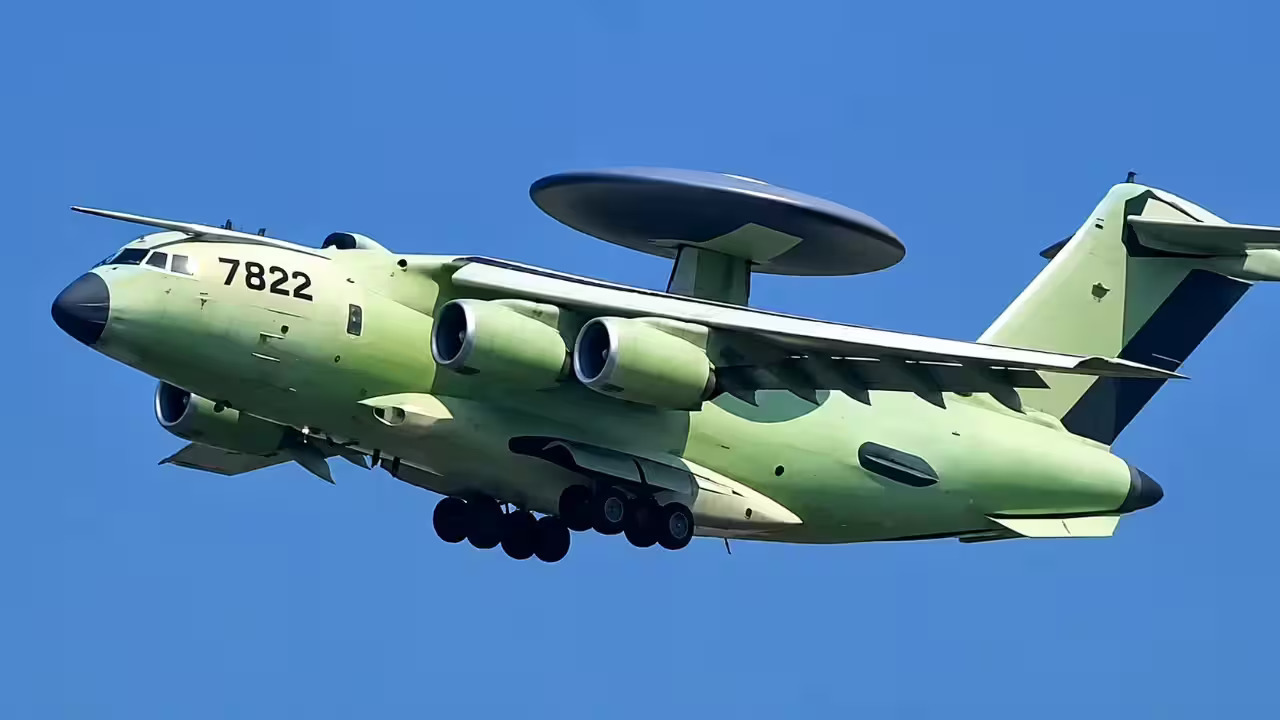
XI’AN, October 25, 2026 (Agencies) – Commercial satellite imagery showing four of China’s new KJ-3000 airborne early warning and control (AEW&C) aircraft at facilities in Xi’an has raised speculation that the advanced radar platform may be moving towards serial production, potentially strengthening China’s long-range surveillance and airborne command capabilities.

The images, captured by satellite imagery provider Vantor on October 5, show three KJ-3000 aircraft near Xi’an Aircraft Company’s production facilities and a fourth at the neighbouring China Flight Test Establishment. J. Michael Dahm, a senior fellow at the Mitchell Institute for Aerospace Studies, considers the sighting evidence that production may have begun. However, analyst Andreas Rupprecht has cautioned that the aircraft could be previously identified prototypes gathered at the same location. The imagery alone does not confirm serial production.
The KJ-3000, also referred to as the KJ-20, was first observed in flight-test imagery in December 2024. It is based on China’s four-engine Y-20B strategic transport aircraft, powered by domestically developed WS-20 turbofan engines. The platform features a large circular radar dome above the fuselage, multiple external antennas and an aerial refuelling probe above the cockpit. An intake near the base of the tailfin is believed to help cool its extensive onboard electronics.
The aircraft is expected to replace the KJ-2000, China’s existing heavy airborne early warning platform based on the Russian-built Il-76 transport aircraft. Only four KJ-2000 aircraft were completed, partly because of reliance on foreign airframes. The domestically produced Y-20B provides China with a more sustainable basis for expanding its heavy airborne surveillance fleet and developing future upgrades.
Unlike ground-based radar, an airborne early warning aircraft can operate at altitude to detect and track targets beyond the radar horizon. This is particularly important for monitoring low-flying aircraft and other threats that may be obscured from ground sensors by terrain or the curvature of the Earth. The KJ-3000’s large airframe is expected to provide greater speed, range and endurance than smaller turboprop-powered platforms, while offering additional space for sensors, communications equipment and mission operators.
The aircraft’s radar configuration remains classified. Open-source analysis suggests that it could incorporate advanced electronically scanned radar technology, potentially improving target detection, tracking and resistance to electronic interference. However, its precise radar architecture, detection range and ability to identify stealth aircraft have not been independently established.
Beyond surveillance, the KJ-3000 is expected to serve as an airborne command-and-control platform, collecting information and distributing it to combat aircraft and other military assets. Such a role could improve coordination among Chinese fighter formations, including advanced J-20 and J-35 aircraft, and support integrated air operations over large distances.
The KJ-3000 would complement China’s smaller KJ-500 fleet, which is based on the turboprop-powered Y-9 transport family. While the KJ-500 can support regional surveillance missions, the larger jet-powered KJ-3000 is intended to provide greater endurance, operating altitude and capacity for mission systems. China is also developing the KJ-700, another airborne surveillance platform whose operational capabilities remain unclear.
The development could have wider implications for the Indo-Pacific, including military operations around Taiwan and the South China Sea, where airborne early warning aircraft help commanders maintain situational awareness and coordinate forces. A larger fleet of domestically produced radar aircraft could also reduce China’s dependence on foreign platforms and support continued modernisation of the People’s Liberation Army Air Force.
The programme is emerging as the United States works to replace its ageing E-3 Sentry airborne warning fleet with the E-7 Wedgetail. However, direct comparisons between the KJ-3000 and American systems remain difficult because reliable specifications and independently verified performance data for the Chinese aircraft have not been released.
Despite the latest satellite imagery, the KJ-3000’s production status remains uncertain. Chinese authorities have not announced that serial production has begun, and the number of aircraft visible at Xi’an does not establish how many are completed, operational or assigned to military units. Further imagery, identifiable production aircraft or an official announcement will be needed to confirm the programme’s next stage.