

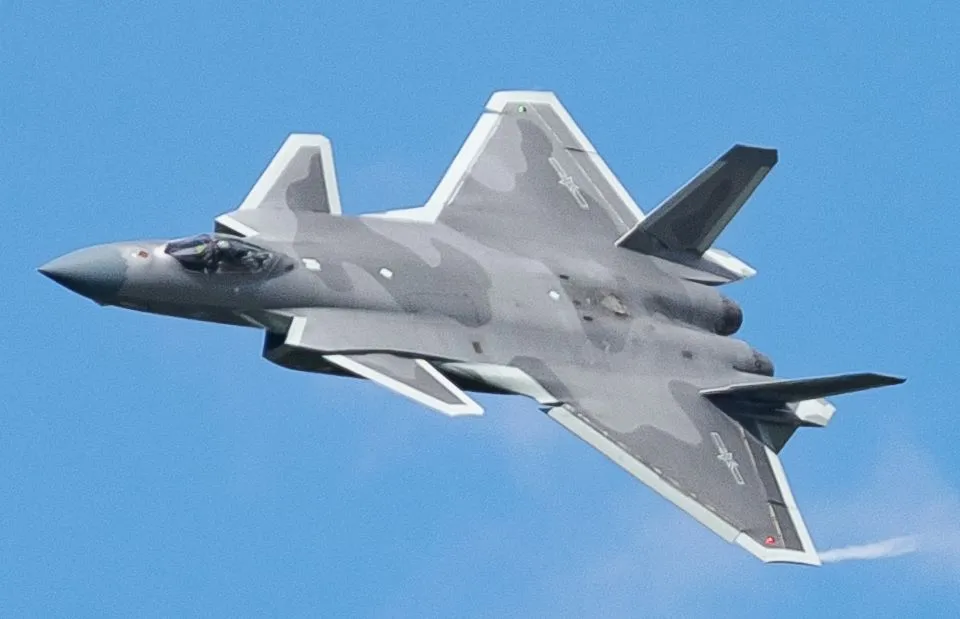
Beijing (Agencies) July 31, 2025 – China’s fifth-generation J-20 stealth fighter jets have reportedly flown through the heavily monitored Tsushima Strait and the Bashi Channel without detection, according to state-run broadcaster CCTV—raising questions about the effectiveness of regional air defense networks and marking a provocative development in East Asian military dynamics.
The report by CCTV claims that elite pilots from the First Fighter Brigade flew covert patrols near Taiwan and across the Tsushima Strait, which separates South Korea from Japan. While the broadcast did not explicitly name the aircraft, multiple references strongly indicated that the J-20 Mighty Dragon was used in the missions.
The Tsushima Strait falls within overlapping Air Defense Identification Zones (ADIZ) of both South Korea and Japan, and is watched by an extensive network of radars and missile defenses—including the U.S.-made THAAD system and dozens of Patriot batteries. Despite this, the CCTV narrative asserts no regional military issued alerts or tracked the aircraft’s passage.
Wing Commander Wang Nan of the First Fighter Brigade cited improvements in integrated air combat and stealth capabilities: “Our weapons, combat concepts, and personnel are all steadily improving,” he said. “We have made breakthroughs in integrated air combat.”
The J-20, developed by Chengdu Aircraft Corporation, is China’s premier fifth-generation stealth fighter. Introduced in 2017, it features a twin-engine configuration, advanced radar-evading design, and precision strike capabilities. The aircraft incorporates diverterless supersonic inlets (DSI), internal weapons bays, and a low-observable airframe optimized for air superiority missions2. Recent variants include thrust-vectoring engines and a twin-seat configuration for enhanced command-and-control roles.
With an estimated combat radius exceeding 1,100 kilometers and the ability to carry long-range air-to-air missiles, the J-20 is designed to challenge Western platforms such as the F-22 and F-35. Its deployment near contested maritime zones signals Beijing’s growing confidence in its stealth technology and strategic reach.
The timing of the report coincides with rising aerial tensions between China and Japan, each accusing the other of aggressive flights near contested maritime boundaries in recent weeks.