

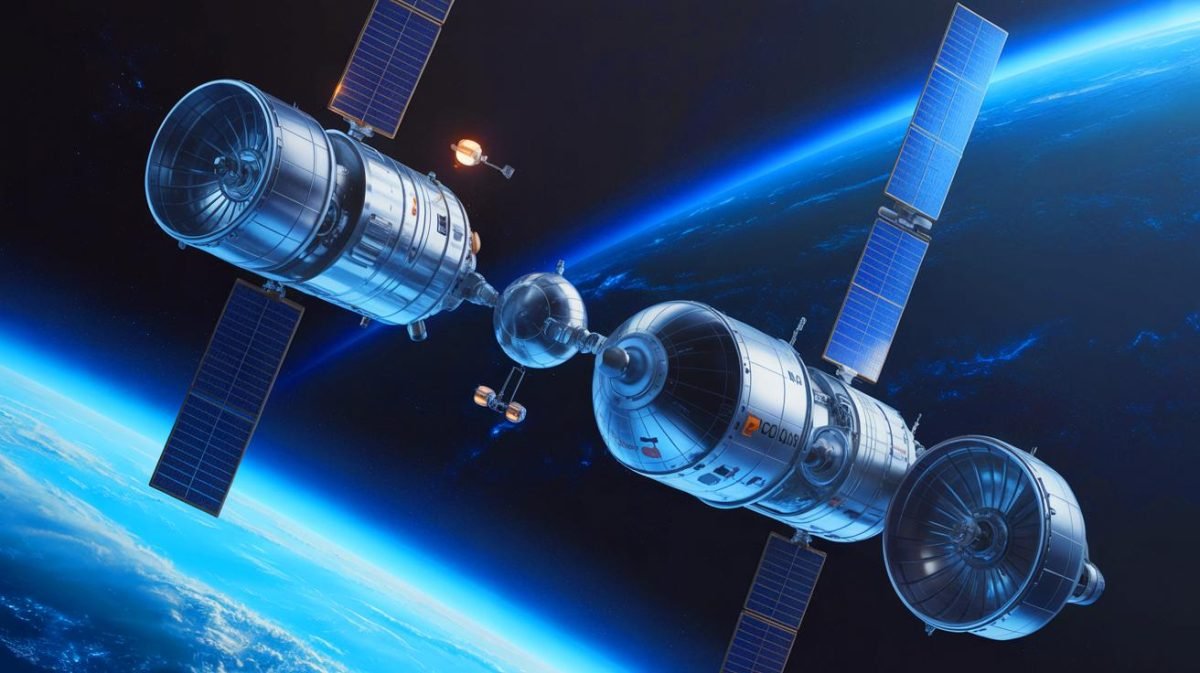
Beijing, China (Agencies) July 13, 2025 — In a landmark achievement for orbital sustainability, China has successfully conducted the world’s first autonomous satellite-to-satellite refuelling mission in geostationary orbit (GEO)—a feat that no other nation, including the United States, has yet accomplished.
The operation involved two experimental spacecraft: Shijian-21 (SJ-21), launched in 2021 to test space debris mitigation, and Shijian-25 (SJ-25), launched in January 2025 to demonstrate on-orbit servicing and life-extension technologies. Between July 2 and July 6, satellite tracking firms including COMSPOC and s2a systems observed the two satellites merging visually in optical sensor data, indicating a successful docking at an altitude of 35,786 km above Earth.
The maneuver followed weeks of rendezvous and proximity operations (RPOs), with SJ-25 gradually closing in on SJ-21. On June 13, the satellites came within 1 km of each other before separating, likely as a rehearsal. By July 2, they became indistinguishable to ground-based sensors, suggesting a sustained docking phase.
During the operation, SJ-25 reportedly transferred 142 kilograms of hydrazine propellant to SJ-21—enough to extend its operational life by up to eight years. The transfer required precise alignment, pressure control, and leak-free fluid exchange in microgravity, all executed autonomously without human intervention.
This milestone redefines satellite logistics. Traditionally, satellites in GEO are retired once fuel runs out, despite having functional systems. China’s success introduces a model where satellites can be serviced, repositioned, and sustained, reducing launch costs, space debris, and orbital congestion.
The U.S. Space Force, which plans its own refuelling tests in 2026, monitored the event closely using GSSAP surveillance satellites (USA 270 and USA 271). Analysts warn that such capabilities could be dual-use, enabling not just servicing but also anti-satellite operations like disabling or relocating foreign assets.
China’s achievement signals a shift toward modular, maintainable satellite systems, akin to terrestrial infrastructure. Future servicing missions may include component replacement, sensor upgrades, or robotic repairs, transforming how space assets are managed.
With no official statement yet from Beijing, the global space community is watching closely. Experts like Brian Weeden of the Secure World Foundation call the maneuver “an incredibly important capability,” while others urge international norms to govern such high-stakes orbital interactions.