

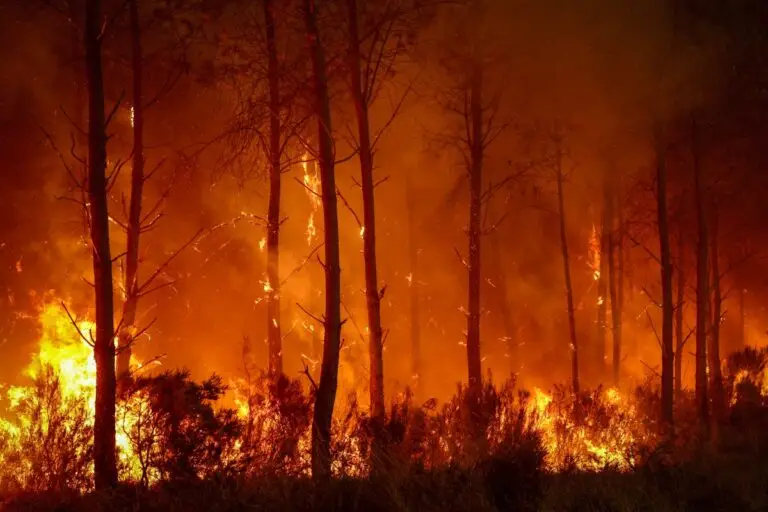
- State of Emergency Declared as Fast-Moving Wildfire Doubles in Size, Forces 20,000 to Flee British Columbia Communities
SUMMERLAND 9 AUGUST 2026 (Agencies) – A provincial state of emergency remains in effect after a fast-moving wildfire in a remote part of western Canada spread rapidly, forcing thousands of people to flee their homes since it was first detected on Friday evening. The Bald Range wildfire has continued to grow overnight and now stands at 10,340 hectares, displaying aggressive and extreme fire behaviour rated Rank 5, according to the BC Wildfire Service.
British Columbia Premier David Eby told a news conference on Saturday that one fire official had likened the fire to “a bomb going off.” The flames were so intense that they created their own weather systems, generating lightning, Eby said. He called the sudden escalation “a remarkable escalation in fire activity.” Homes have been lost and properties destroyed, with some residents becoming trapped as conditions changed rapidly and requiring rescue.
Cliff Chapman, the BC Wildfire Service’s director of operations, described conditions as “explosive” and warned that other communities could face similarly fast-moving fires. More than 100 wildfires were burning across the province, nearly half of them out of control amid hot, windy weather and prolonged drought.
The entire District of Summerland, home to more than 12,000 people, was ordered to evacuate in the early hours of Saturday morning, along with roughly 8,000 additional residents in and around Peachland. In total, more than 20,000 people across British Columbia have evacuated their homes, marking the largest evacuation event of the summer. The fire, which ignited about 15 kilometres northwest of Summerland, jumped Highway 97 overnight, forcing its closure between Peachland and Summerland.
British Columbia’s Emergency Management Minister, Kelly Greene, said the state of emergency grants the province additional powers, including the ability to restrict travel, secure accommodations for evacuees, and guard against price gouging.
Summerland Mayor Doug Holmes said a lot of farms have been affected and the full extent of structural losses remains unknown, as crews are still actively fighting the fire. Officials confirmed “significant structure loss” but said damage could not yet be fully assessed because the area remains an active fire zone. The Royal Canadian Mounted Police said they are investigating a possible fatality after a resident of Meadow Valley, west of Summerland, reported a possible death.
Hundreds of residents from Summerland care facilities, including senior housing, were relocated to safer areas. Evacuees have taken shelter at reception centres in West Kelowna and Penticton, with Penticton Mayor Julius Bloomfield describing a “rush of 10,000 people” arriving in the city overnight. Volunteers with the Central Okanagan Food Bank and the Salvation Army have distributed hundreds of food packages to evacuees sheltering at a hockey arena in West Kelowna.
In nearby Okanagan-area communities, residents have struggled to evacuate horses and other livestock. Some owners unable to relocate their animals left gates open in hopes the animals would find their own way to safety, while others painted identifying markings on their livestock, according to Canadian broadcaster CBC.
Firefighters have established heavy equipment containment lines on the fire’s southern flank, between Shingle Creek Road and Big Valley Road. Ninety-nine structural protection personnel, 108 firefighters, nine helicopters and 13 pieces of heavy equipment have been mobilised to battle the blaze, while utility crews from BC Hydro, Okanagan Power and FortisBC work to restore downed power lines. Power has been partially restored in parts of Summerland, though officials cautioned this does not signal any return to the community, as conditions are still being evaluated.
Citing the wildfire, Interior Health has expanded hours at its Penticton and West Kelowna urgent care centres to accommodate evacuees requiring non-emergency medical care.
Hundreds of wildfires have raged across Canada this summer, with nearly 200 burning in Ontario in July, pushing air quality in Toronto to among the worst levels in the world for several days. Smoke from Canadian wildfires has also drifted into parts of the United States, including Minnesota and New York.