

- By: Rizwan Inayat
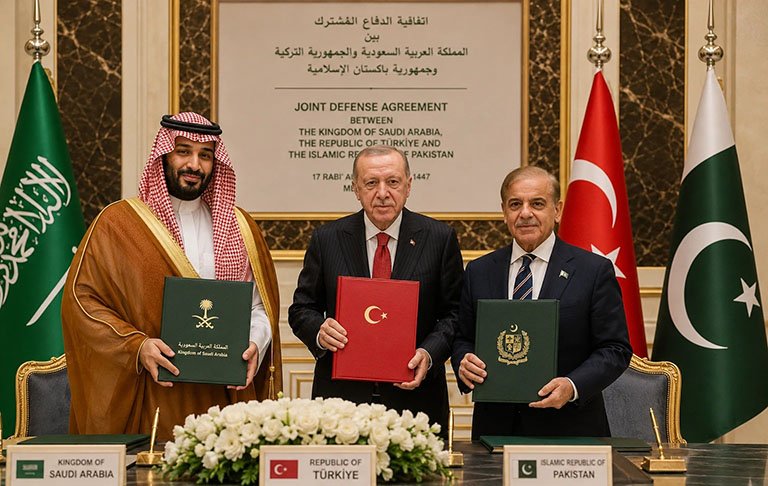
On 7 August 2026, in the holy city of Mecca, three of the Muslim world’s most influential states put their names to a document that analysts are already calling one of the most consequential regional security developments in years. Saudi Crown Prince Mohammed bin Salman, Turkish President Recep Tayyip Erdogan, and Pakistani Prime Minister Shehbaz Sharif signed the Mecca Joint Defence Agreement (also referred to as the Makkah Joint Defence Agreement or Mecca Joint Deterrence Agreement), a pact that treats an armed attack against any one of the three signatories as an attack against all three — language deliberately reminiscent of NATO’s Article 5.
The signing came a day after Sharif, accompanied by army chief Asim Munir, arrived in Saudi Arabia and performed Umrah in Mecca. It concluded nearly a year of negotiations and built directly on the bilateral Strategic Mutual Defence Agreement that Saudi Arabia and Pakistan signed in September 2025 at Al-Yamamah Palace in Riyadh.
This piece pulls together everything worth knowing about the pact — what it says, why it happened now, and how it is being read across the Middle East, South Asia, and beyond.
- What the Pact Actually Says
Pakistan’s Foreign Ministry described the agreement’s core purpose as strengthening “collective deterrence,” stating that an attack on any member would be regarded as an attack on all. The three states declared a shared commitment to “further strengthening their collective security and to promoting peace, security and stability in the region and beyond, in pursuit of a secure and prosperous future.”
Beyond the headline collective-defence clause, the agreement provides for the enhancement of “all aspects of defence cooperation” among the three states, though the joint statement stopped short of detailing specific military commitments or obligations. According to reporting on the endorsed Arabic text published in the official gazette, the pact sets out eleven areas of cooperation, including training, logistics, and intelligence-sharing — areas that fall short of a classic mutual-defence clause in operational detail. Its ninth article reportedly states that the pact does not affect either party’s obligations under other international agreements, insulating it from entanglement elsewhere.
Turkish officials have stressed the agreement is defensive in nature, not directed against any specific actor, open to other regional countries wishing to join, and does not replace any existing bilateral or multilateral arrangements. Pakistan’s Foreign Minister Ishaq Dar reiterated on the Sunday after signing that the deal was “purely defensive in nature.”
- Why Now: The Regional Backdrop
The pact did not emerge in a vacuum. It was signed against the backdrop of a wider regional war involving Iran that began in February 2026, during which Saudi Arabia and other Gulf states came under repeated missile and drone attack from Iran and allied forces, including Houthi fighters in Yemen and Shia militias in Iraq. The conflict disrupted energy shipments, threatened Saudi Arabia’s oil exports and development ambitions, and raised serious questions in Riyadh about the reliability of its long-standing security relationship with Washington.
Turkey and Pakistan, while less directly exposed to the fighting, were reported to be concerned about the risk of wider regional instability affecting their own security and economies. Pakistan itself has been managing a border conflict with Afghanistan’s Taliban-led government since February 2026, and is still facing a hybrid war from India, who despite being beaten up in last year four-day military clash, is active supporting militants in KP and Balouchistan.
- What Each Country Brings to the Table
Analysts describe the pact as combining complementary — if unevenly matched — strengths:
Turkey brings NATO’s second-largest military and an increasingly sophisticated domestic defence industry, including Bayraktar and Akinci combat drones and naval hardware. Saudi Arabia brings substantial financial resources as the world’s top oil exporter, along with religious and diplomatic authority as custodian of Islam’s two holiest sites. Pakistan brings extensive military experience, a large standing army, and the distinction of being the only nuclear-armed nation in the Muslim world.
Pakistan has provided training and technical assistance to Saudi forces for decades. Turkey and Pakistan have separately exchanged warships and training aircraft, and in 2023 Saudi Arabia agreed to purchase Turkish-made drones in what Ankara called its largest defence export contract at the time.
- Impact on the Middle East
- What Saudi Arabia and Turkey Each Gain
Before turning to how outside powers view the pact, it is worth being clear about what its two Middle Eastern signatories are actually getting out of it.
For Saudi Arabia, the pact offers a hedge against an emboldened Iran at a moment its own oil exports, development plans, and long-standing US security relationship have all been shaken by repeated Iranian and Houthi missile and drone strikes since February 2026. It gives Riyadh greater strategic leverage through diversified security partnerships rather than relying primarily on Washington, allowing it to cope with Iran while confronting the limits of US deterrence in the region. It also grants access to Turkish defence-industrial capability, including drones and naval hardware, and to Pakistani military experience, adding density to Saudi Arabia’s own defence posture without having to build all of that capacity domestically. The pact further provides a counterweight to India’s growing regional influence and continued backing from a nuclear-armed Muslim ally Riyadh has supported for decades. There is a diplomatic and religious dimension too: hosting the signing in Mecca itself gives Saudi Arabia symbolic leadership of a unified Sunni-Muslim security response at a moment when both Iran and Israel are widely seen regionally as destabilising forces. One analysis summed up Riyadh’s position bluntly, describing a kingdom “exposed on its southern flank, its western coastline and its economic ambitions” that is essentially buying insurance from every direction at once, rather than signing from a position of confidence.
For Turkey, the pact offers a new regional role and legitimacy Ankara has been actively seeking since the fall of the Assad government opened space in Syria — Erdogan has long wanted Turkey recognised as a Mediterranean and Middle Eastern power in its own right, not merely a NATO member kept at arm’s length by Washington and Brussels. One Turkish-focused analyst described it as a second insurance policy: “Ankara is not trading NATO for Mecca… Turkiye is investing in a second insurance policy in a neighbourhood where the first one has stopped paying out reliably” — a direct reflection of Turkish doubts about NATO’s and Washington’s reliability under the Trump administration.
The pact also sharply enhances Turkey’s deterrence against Israel specifically: adding a nuclear-armed partner in Pakistan and Saudi Arabia’s financial and political weight strengthens Ankara’s hand against a neighbour whose leaders increasingly speak of enmity and potential conflict with Turkey. There is a real commercial upside too — expanded markets for Turkish drones, already sold to Saudi Arabia in 2023 in what Ankara called its largest-ever defence export contract, plus new joint defence-production opportunities partly bankrolled by Saudi capital. More broadly, the pact affirms Turkey’s position within energy and trade networks linking India and Europe, since defence partnerships tend to reinforce and buttress wider business ties. And it builds on and extends an umbrella Turkey already holds with allies such as Qatar, Syria, and Libya, adding significant new resources and density to what functions as a broader Muslim collective-defence mechanism.
In short, Saudi Arabia is buying diversified security insurance and regional prestige at a moment of real exposure, while Turkey is buying strategic relevance, deterrence against Israel, and commercial opportunity at a moment it doubts NATO’s reliability. Both, notably, are negotiating from a position of anxiety rather than strength, according to several analysts — defensive hedging dressed in the language of a historic alliance.
- Iran: Encircled, and Likely to Lean Harder on Russia and China
For Tehran, the pact is widely read as a form of strategic encirclement — a nuclear-armed Pakistan and NATO’s second-largest military now sit on either side of Iran, both backed by a Gulf state that spent the recent war absorbing Iranian and Houthi strikes. Analysts expect Iran’s likely response to be greater reliance on Russia and China, along with continued use of proxy networks to test how seriously the pact’s members take their mutual-defence clause.
Iran’s official reaction has been mixed. An Iranian lawmaker, Ebrahim Rezaei, dismissed the pact on social media, warning that a paper agreement with Turkey and Pakistan would not deliver Saudi Arabia security any more than its dependence on Washington had. Iran’s Foreign Minister Abbas Araqchi, by contrast, struck a more measured tone, stating that Iran’s armed forces had already shown their readiness and capability against “the world’s most expensive military.”
- Israel: Uneasy, and Watching an Alliance It Cannot Fully Influence
Israel’s government had not issued an official public comment on the pact as of the days following the signing, though Prime Minister Benjamin Netanyahu has separately spoken of the dangers of an emerging “Sunni axis,” and — as far back as February 2026 — former Israeli Prime Minister Naftali Bennett described Turkey as “the new Iran,” accusing Ankara of pursuing a “hostile Sunni axis with nuclear Pakistan.”
Israel’s discomfort has layered causes. Normalisation talks with Riyadh have stalled, ties with Ankara have deteriorated badly, and Israel now watches a security architecture built on Islamic solidarity rather than the Abraham Accords framework it invested years in constructing. A security structure that does not run through Washington or Jerusalem is, by definition, one Israel cannot fully monitor or shape. The pact could complicate Israel’s freedom to act militarily against regional neighbours without having to weigh a broader collective response.
Even so, some analysts caution against overreading the anti-Israel angle. Israeli analyst Ahron Bregman argued the pact “reflects a lack of trust in the US and its ability or willingness to protect its Middle Eastern allies,” and is better understood as the three states “holding hands together to confront Iran more than confronting Israel” — while expressing doubt that the signatories would actually come to each other’s aid in a lower-intensity scenario, such as an attack on a Saudi oil tanker.
- The Nuclear Question
Pakistan’s inclusion inevitably raises the question of whether its nuclear arsenal could eventually extend deterrence to Saudi Arabia or Turkey. Nothing in the agreement establishes such a nuclear umbrella. Defence analyst Mansoor Ahmed of the Australian National University’s Strategic and Defence Studies Centre has said Pakistan’s nuclear posture remains oriented toward the perceived threat from India, not toward extending cover to its new Gulf and Turkish partners.
- The United States: Notable Silence
The Trump administration offered no official response in the hours — and into the following day — after the pact was signed, a silence analysts say reflects the still-emerging and multilayered implications of the deal for US strategy. The pact is seen by many as laying the groundwork for one of the most significant regional power shifts in decades, arriving as Gulf states increasingly question Washington’s reliability as a security guarantor after enduring Iran’s missile and drone attacks with limited direct US protection.
On balance, analysts expect Washington to view the pact favourably rather than as a threat, since the Trump administration has been pushing for more burden-sharing from regional allies, and the pact advances collective deterrence against Iran. Pakistan may also be able to cite the agreement to Washington in future as a reminder of its broader utility in the region. At the same time, the pact carries a more uncomfortable undertone for the US: rather than relying primarily on Washington, Saudi Arabia appears to be deliberately broadening its security partnerships and laying groundwork for more intra-regional arrangements — described by one analyst as “arguably the most important takeaway” of the entire agreement.
- Turkey’s NATO Position and Europe
Turkey remains a NATO member with the alliance’s second-largest military, and its pursuit of the Mecca pact is partly rooted in its own doubts about NATO’s reliability, and specifically about the Trump administration’s commitment to the alliance. Analysts are careful to stress that the Mecca pact is not a NATO-style alliance and does not represent a discrete new bloc rivalling NATO — it is better understood as a regional security and defence-cooperation framework. Even so, Turkey’s participation “affirms Turkey’s place in energy and trade networks between India and Europe,” since defence partnerships tend to reinforce broader business and trade ties.
No confirmed on-record reaction from NATO as an institution, the UK government, or the French government had surfaced in coverage as of the days following the signing. Given Turkey’s NATO membership and its sometimes prickly relationship with individual European states — including defence-industrial competition in drone and naval-hardware exports — any formal European response, if it comes, is likely to focus on what the pact means for Turkey’s NATO commitments and interoperability, and on commercial competition in defence exports.
- Does It Challenge the Iran-Russia-China Axis?
The picture here is genuinely mixed, and no serious analysis frames the pact as a clean challenge to the Iran-Russia-China alignment.
On one hand, the pact does squeeze Iran regionally, and could push Tehran toward greater dependence on Moscow and Beijing rather than away from them — reinforcing rather than weakening that axis in practical terms.
On the other hand, Pakistan’s own position undercuts any clean “Sunni bloc versus axis” framing. Pakistan’s growing closeness to Turkey, a NATO member, sits awkwardly against its deepening relationship with China, which is itself a core member of the BRICS grouping alongside Russia and Iran — a contradiction some analysts say leaves the Mecca pact looking more like “a motley grouping” than one with a single coherent strategic aim.
Russia, notably, is often described as an opportunistic beneficiary rather than a target. An autonomous Gulf-region security structure operating outside Western oversight erodes Washington’s historic hegemony over Gulf energy corridors, while Turkey’s independent posture within NATO further weakens the alliance’s internal cohesion — outcomes that arguably serve Russian interests. One sharply argued piece went further, naming the United States as “the definitive loser” from the pact, since it shatters Washington’s long-standing role as the primary arbiter of Middle Eastern security.
China’s position is arguably the most understated but structurally significant.
The pact’s emerging weapons standardisation already includes Chinese-built HQ-9/P air defence systems alongside Turkish drones and Pakistani-built platforms — meaning Chinese military technology is embedded in the alliance’s hardware backbone even though China is not a signatory. One analysis argues China stands to be a major indirect beneficiary, since Saudi financial resources may now help bankroll trilateral defence-production projects built around substantially Chinese-derived technology, given how central China has been to Pakistan’s arms imports in recent years.
- Dedollarization: Not Part of This Story
It is worth being clear-eyed here: there is no substantive link between the Mecca pact and dedollarization efforts. This is a security and defence-cooperation agreement — covering training, logistics, intelligence-sharing, and defence-industrial coordination — with nothing addressing oil trade invoicing, currency swaps, or challenges to the dollar’s role in energy markets. Saudi Arabia’s financial support for Pakistan around the same period, including a rollover of more than five billion dollars in deposits as part of eight billion dollars propping up Pakistan’s external accounts, remained conventionally dollar-denominated. Saudi Arabia has also, just weeks earlier, signed a civilian nuclear cooperation agreement with the United States — a sign Riyadh continues deepening economic and technology ties with Washington even as it diversifies its security partnerships. Any narrative tying this defence pact to a broader dedollarization push would not be supported by the reporting.
- Impact on Pakistan-India Relations
This is where the pact’s implications are sharpest and most immediate for South Asian readers.
India’s official reaction has been deliberately cautious. Ministry of External Affairs spokesperson Randhir Jaiswal said India was “closely following” the development and would “keep you updated” — language echoing India’s earlier, similarly measured response to the September 2025 Saudi-Pakistan bilateral pact, when Jaiswal said New Delhi would “study the implications of this development for our national security as well as for regional and global stability.”
Outside government, Indian commentary has been considerably sharper. Kabir Taneja of the Observer Research Foundation noted that while most coverage views the pact through a Middle East lens, “it impacts other theatres as well,” with “Pakistan’s conflict-laden relationship with India at the top of that list.” Former Indian Foreign Secretary Kanwal Sibal called the pact “a very negative development for Indian interests,” urging India to expand its own strategic options with the UAE, Israel, Greece, Cyprus, and Afghanistan.
More significantly, some Indian defence analysts argue the implications go beyond diplomacy into operational military planning. One assessment suggested that the pact “can strengthen Pakistan’s battlefield capability while adding to the political pressure that ends hostilities early” in any future conflict, which would shorten the window India has to convert military gains into lasting strategic outcomes. Its most pointed line: Pakistani leadership “may now price an escalation as cheaper than earlier” — meaning Islamabad could feel emboldened in a future crisis with India, having wealthier and more powerful backers now diplomatically and materially invested in its security.
India has already shown signs of responding in kind: it has leaned harder on its relationships with Greece and Cyprus in reaction to the deepening Turkey-Pakistan defence relationship, particularly around the flow of Turkish drone technology to Pakistan. India also moved to publicly and firmly deny circulating reports that it had scrambled to approach Israel for an emergency counter-pact, seeking to project measured strategic independence rather than a reactive posture.
That said, there are real limits to how far this rebalances the board.
India retains a substantial economic relationship with Saudi Arabia worth tens of billions of dollars in trade, and is home to millions of Indian expatriate workers — a relationship unlikely to rupture over the pact. And crucially, Pakistan’s nuclear deterrent is not expected to extend to Saudi Arabia or Turkey, meaning the practical, as opposed to diplomatic and reputational, leverage Pakistan gains may be more limited than the sharpest commentary suggests.
- Impact on Pakistan-Afghanistan Relations
Pakistan has been engaged in a border conflict with Afghanistan’s Taliban-led government since February 2026. Analysts note that Saudi Arabia has, in effect, “committed itself to Pakistan’s disputes, notably with India, and potentially with the Taliban-led Afghanistan” by entering this pact — raising the theoretical prospect that Gulf and Turkish backing could extend, diplomatically or materially, to Pakistan’s western border tensions as well. How far that would go in practice remains untested; Turkey in particular has maintained relatively close ties with Kabul historically, which could complicate how forcefully Ankara would back Pakistan in any serious escalation with Afghanistan.
- Does the Pact Give Pakistan an Edge in Middle East Diplomacy?
On balance, yes — though with meaningful caveats. The pact provides Pakistan with several forms of leverage:
Diplomatically, it ties Pakistan more closely to two of the region’s most influential and well-resourced powers at a moment when Pakistan still faces increasing Indian back militancy across country specially in KP and Balouchistan.. It also links Pakistan to a broader trend of declining US and Israeli influence in the Middle East — a dynamic that, by extension, narrows the diplomatic space India has cultivated in the region through its own ties with Washington and Tel Aviv.
Militarily and reputationally, closer integration with Turkish defence technology — including drones already flowing to Pakistan through the existing Ankara-Islamabad relationship — adds a layer Indian strategists are watching closely, even without a formal nuclear-sharing arrangement.
But the leverage has real ceilings. The pact’s specific commitments remain deliberately vague, its collective-defence clause has not been tested in practice, and Pakistan’s nuclear deterrent is expected to stay focused on India rather than extend to its new partners. Whether the pact evolves into a genuinely operational alliance or remains primarily a political and diplomatic framework will depend heavily on how it is implemented — and tested — in the months ahead.
- The Bottom Line
The Mecca Joint Defence Agreement is a significant, symbolically loaded moment in Middle Eastern and South Asian geopolitics — but it is not, by most serious accounts, a fully-fledged NATO-style alliance, an anti-Israel pact, an anti-Iran pact, or a dedollarization vehicle. It is better understood as three states, each negotiating from a position of real anxiety rather than surplus strength, formalising a framework for closer strategic, military, and defence-industrial coordination at a moment when all three have lost confidence in the durability of US-centred security guarantees.
Its long-term significance will be determined less by the text signed in Mecca on 7 August 2026 than by how the three signatories — and the wider region, including Iran, Israel, India, Afghanistan, Russia, China, and the United States — respond to the first real test of its collective-defence clause, whenever that test arrives.