

- By: Dr. Muhammad Tayyab Khan Singhanvi (Ph.D)

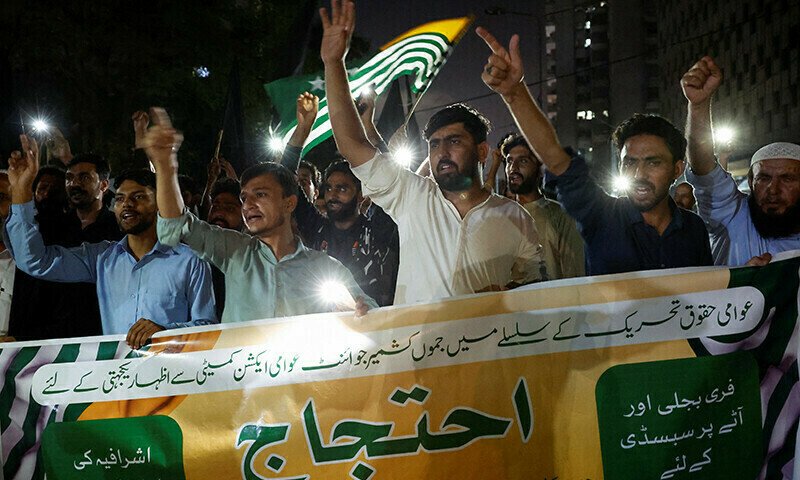
The recent turmoil and protest movement in Azad Jammu & Kashmir (AJK) not only reflects the local conditions but has also raised serious questions for Pakistan’s politics, economy, and diplomacy at large. The five-day-long protests, suspension of internet and mobile services, closure of markets and transport, student absenteeism from schools, and difficulties in accessing medical facilities are not mere temporary disruptions but rather symptoms of a deeper crisis, rooted in economic, political, and administrative deprivations.
The protests under the leadership of the Joint Action Committee are not based on partial or isolated demands; rather, they embody the accumulated resentment of the people against prolonged deprivation, inequality, and inflation. Citizens are voicing their outrage over electricity bills, rising prices of essential commodities, governance failures, and lack of transparency. Initially launched in the form of peaceful sit-ins and gatherings, this movement took a violent turn when the distance between the administration and the public widened, and the use of force aggravated the situation.
Clashes between police and demonstrators not only increased the number of injured but also, according to reports, led to fatalities in some areas. This has generated deep anxiety among the local population. The public asserts that their voices had been ignored for years, and when compelled to protest, they were met with baton charges and tear gas.
The suspension of internet and mobile services has further complicated the crisis. In areas such as Kahuta, Kotli, and several districts of AJK, the network has remained down for five consecutive days, preventing people from contacting their families and friends or accessing reliable information about the situation. While such measures are often employed temporarily to maintain control, in reality, they only amplify public mistrust and fear. In the modern era, restricting information is not merely a technical issue it also constitutes a matter of human rights and freedom of expression.
Recognizing the severity of the situation, Prime Minister Shehbaz Sharif formed a high-level negotiation committee comprising senior leaders including Rana Sanaullah, Ahsan Iqbal, Tariq Fazal Chaudhry, Raja Pervaiz Ashraf, and Qamar Zaman Kaira. The committee reached Muzaffarabad and initiated talks with leaders of the Public Action Committee.
Following the initial round of negotiations, government representatives told the media that the atmosphere was constructive and expressed hope that the issues would be resolved through mutual understanding. However, leaders of the Public Action Committee requested more time for consultation. While the government clearly desires to resolve the issue through dialogue, the question remains whether the people will trust this process since in the past, many promises and declarations remained nothing more than paperwork.
The current turbulence in AJK cannot be viewed in a purely local context. The region holds a highly sensitive geopolitical and political position, where instability can immediately impact relations between Pakistan and India. India will likely attempt to highlight this unrest on the global stage, projecting the impression that Pakistan has failed to maintain stability in its administered territories.
Moreover, at the international level, such situations are assessed through the lens of human rights and democratic values. If public demands are ignored and force is prioritized, this could tarnish Pakistan’s credibility before the global community. For this reason, it is essential that the government promptly initiate transparent investigations and take practical steps, sending the clear message that Pakistan respects the rights of its citizens.
Pakistan’s domestic politics is already engulfed in uncertainty. The economic crisis, inflation, unemployment, and political instability have shaken public confidence. In such circumstances, the crisis emerging in AJK could further intensify this instability. For the federal government, this is a formidable test of how it manages the situation because if the movement prolongs, its effects will be felt across the entire country.
Another significant dimension of this situation is the economic machinery. The suspension of transport, markets, and businesses has not only paralyzed the local economy but may also affect Pakistan’s overall economic health. Particularly at a time when the country is already under the strain of economic reforms and IMF pressure, there is little room for additional unrest.
Historically, AJK has always been a region where political dynamics have remained closely tied to Pakistan’s national politics. The people have consistently sought to strengthen their bond with the federation of Pakistan, while simultaneously reiterating demands for their rights and autonomy. In this context, the present protest movement is part of that historical continuity, repeatedly reminding us that the legitimate demands of the local population cannot be ignored.
If the government fails to take practical measures to resolve the people’s grievances, this movement could intensify further, creating not only local unrest but also posing a threat to national security. On the other hand, if negotiations succeed and relief is provided to the people, it could set a positive precedent that issues can indeed be resolved through dialogue and transparency.
To escape this crisis, certain fundamental steps are indispensable:
- Immediate restoration of communication systems to rebuild public trust.
- Provision of emergency medical aid to the injured and affected.
- Transparent and impartial investigations to hold perpetrators accountable.
- Inclusion of public representatives in decision-making and improvement of governance at the local level.
- Announcement of an economic relief package to provide immediate relief to the people.
These measures, if undertaken promptly, will not only send a positive message for AJK but for Pakistan as a whole. Otherwise, this crisis could evolve into a storm of far greater magnitude.
Ultimately, this is a moment of trial for Pakistan. If the government proceeds with wisdom, transparency, and empathy, this crisis could be transformed into an opportunity where public trust is restored, and the state’s credibility is reinforced. But if reliance is placed solely on force and empty promises, the consequences will prove detrimental not only for AJK but for the entire region.