

- By: Dr Muhammad Tayyab Khan Singhanvi (Ph.D)

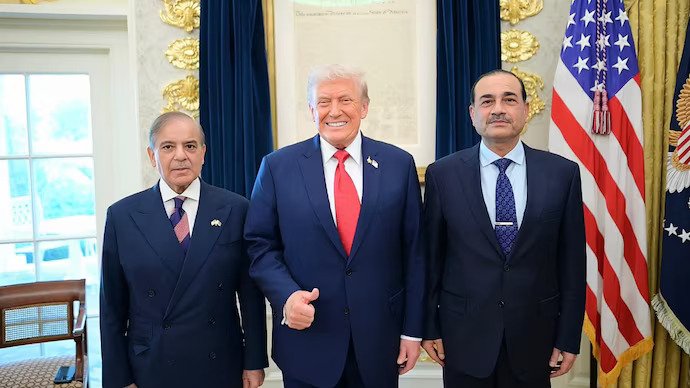
Relations between Pakistan and the United States have always stood at a critical juncture in the theater of international politics. The recent American visit carries exceptional weight in this context, as Prime Minister Shehbaz Sharif and Field Marshal Asim Munir held a detailed meeting with U.S. President Donald Trump in the Oval Office. This encounter has stirred new currents in diplomatic circles, particularly because it marked the third official meeting within just two days an unusual frequency that speaks volumes. The discussion lasted over eighty minutes, characterized by striking warmth and mutual respect. President Trump described the Pakistani Prime Minister as a “remarkable personality” and Field Marshal Asim Munir as a “fine human being” compliments rarely extended in diplomatic settings, suggesting that these were not mere courtesies but signals of a new chapter in bilateral ties.
A review of U.S.–Pakistan relations reveals a history replete with ebbs and flows. Ties were established soon after Pakistan’s independence, and during the Cold War, Pakistan stood firmly by Washington’s side. The 1950s saw agreements such as SEATO and CENTO that firmly embedded Pakistan in the U.S. bloc. Yet the 1971 war and the creation of Bangladesh brought visible cracks to the partnership. By contrast, the 1980s Soviet–Afghan war once again brought the two nations into close alignment, marking a period often remembered as a peak in cooperation. However, the 1990s sanctions left Pakistan isolated, only for the post-9/11 “War on Terror” to bring renewed engagement though mutual distrust persisted. The 2011 Abbottabad operation deepened the gulf further. Today’s developments appear to be the latest episode in this cyclical history, with mutual interests once again compelling rapprochement.
The recent U.S. visit was driven by multiple imperatives. The Taliban’s return to power in Afghanistan has created fresh security challenges, prompting Washington to seek enhanced cooperation with Islamabad. Simultaneously, the four-day war between Pakistan and India in May 2025 shifted the region’s strategic balance. During that conflict, President Trump attempted to assume a mediatory role, and this Oval Office meeting is widely viewed as a continuation of that effort. Economic considerations were also at the forefront. Facing a severe financial crisis, Prime Minister Sharif invited American companies to invest in energy, mineral resources, and agriculture. In return, Washington appears intent on offsetting China’s growing influence in Pakistan.
The presence of Field Marshal Asim Munir added further gravity to the talks. His participation underscored the military’s continued centrality in Pakistan’s foreign policy. Defense Minister Khawaja Asif described it as a “hybrid system partnership,” reflecting the realities of Pakistan’s internal political structure. Historically, U.S. officials have maintained close ties with Pakistan’s military leadership, but this time the Field Marshal’s prominent role points to a new strategic orientation.
Middle Eastern affairs were also discussed at length. President Trump declared that he would not permit Israel to annex the West Bank and expressed optimism about an imminent ceasefire in Gaza. He also voiced hope for a prisoner-exchange agreement. These statements are being read as signs of a shift in U.S. policy toward the Middle East, particularly as Turkish President Recep Tayyab Erdogan has thrown his support behind similar peace efforts. Pakistan reaffirmed its unwavering support for the Palestinian right to self-determination, with Prime Minister Sharif urging President Trump to play a more proactive role in resolving the conflict.
From a regional geopolitical perspective, the meeting assumes even greater significance. Washington’s close ties with India are well known, yet its renewed warmth toward Pakistan suggests a desire to maintain balance in South Asia. Pakistan’s military performance during the May war bolstered its standing as an effective regional force, and the United States now appears to recognize this reality. Meanwhile, Pakistan’s growing closeness with China and projects such as CPEC have long been a source of American concern. Strengthening ties with Islamabad thus seems part of Washington’s strategy to dilute Beijing’s influence.
Looking ahead, both opportunities and challenges lie in wait. Economic cooperation and U.S. investment could open new pathways for Pakistan. Intelligence-sharing and defense collaboration could help mitigate regional terrorist threats. Yet internal political instability, persistent tensions with India, and Afghanistan’s uncertain trajectory all threaten to undermine progress. Moreover, U.S. domestic politics particularly the upcoming elections will also weigh heavily on the future of bilateral relations.
In conclusion, the recent U.S. visit has proven to be of great diplomatic consequence for Pakistan. Prime Minister Shehbaz Sharif and Field Marshal Asim Munir have infused bilateral ties with a new dimension. President Trump’s extraordinary compliments and the warm Oval Office atmosphere point to the possibility of a renewed partnership. However, the success of this process depends not only on the political leadership of the two countries but also on the shifting realities of the region and the interplay of global powers. Should Pakistan manage to preserve its sovereignty while maintaining a balanced relationship with Washington, these diplomatic endeavors could indeed pave the way for peace and stability in the region. Otherwise, like so many encounters of the past, they risk being relegated to the archives of history as little more than symbolic gestures.