

- By: Dr. Muhammad Tayyab Khan Singhanvi

During his tenure on this planet, mankind has accumulated some of the most dangerous evolutionary tools—like inherited tendencies for aggression and ritualism, blind obedience to leaders, and a hostile attitude toward foreigners. These behaviors now threaten our very survival.
If one reflects deeply, it becomes evident that every rational mind fears nuclear war. Yet paradoxically, every technologically advanced state continues to plan for it. Everyone knows it is insanity—yet every nation finds a justification for it. This unending chain of excuses is both futile and disturbing.
For instance, Germany began working on the atomic bomb at the outset of World War II, compelling the United States to race ahead. Once the Americans developed the bomb, how could the Soviets lag behind? Subsequently, Britain, France, China, Israel, India, Pakistan, Iran, and North Korea joined the nuclear arms race. By the dawn of the 21st century, several nations had already stockpiled nuclear weapons. These weapons are no longer difficult to make—fissile materials and radioactive elements are now accessible. In fact, nuclear arms have become akin to handcrafted items—almost a cottage industry of destruction.
During World War II, conventional bombs called “blockbusters”—each carrying 20 tons of TNT—were capable of destroying entire neighborhoods. The total explosive power used in that war amounted to about two megatons of TNT, whether in Ventri, Rotterdam, Dresden, or Tokyo. The death toll from aerial bombings between 1939 and 1945 equated to the impact of a hundred thousand blockbusters.
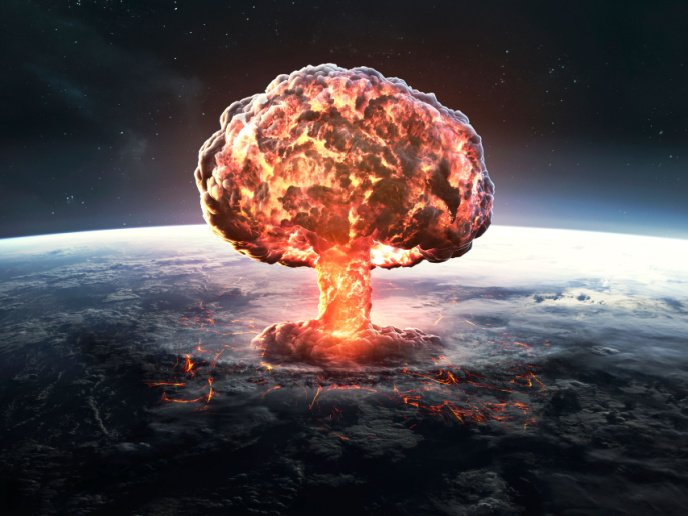
By the late 20th century, a single thermonuclear explosion equaled two megatons of TNT—compressing the destruction of World War II into just one bomb. Now, thousands of such nuclear weapons exist. Since the 21st century began, the U.S. military has maintained 15,000 pre-assigned nuclear targets.
No place on this fragile planet is safe. The genies of death await the rub of the lamp. The collective explosive power exceeds ten thousand megatons, and this fiery arsenal is primed for launch within mere hours. It means: a blockbuster for every family on Earth, and a World War II’s worth of destruction in every passing second of a calm afternoon.
The immediate effects of a nuclear attack include firestorms that flatten even the strongest buildings across kilometers. Additionally, gamma radiation, infernal winds, and neutron blasts incinerate all living beings within their reach.
Currently, it is estimated that one person is murdered every five minutes. Individual killings and mass warfare are, in essence, two sides of the same coin. War is simply a more organized form of mass murder. When our interests are harmed—or perceived to be—when our sense of well-being is shaken, or when our national mythologies collapse, we erupt into violence. The same dynamic applies to nations. The ruling elite weaponize such passions to acquire power or advantage. As the technology of mass killing advances, so too do the horrors of war. It would not be far-fetched to imagine that doomsday may only be a few decades away. With the increasing sophistication of nuclear weapons and their targeting systems, humanity today stands as a hostage to its own atomic creations.
In present times, igniting a conventional war would require mass public outrage, yet the media—largely under state control—can manufacture such fury at will. However, a nuclear war may not need a mass consensus. The rage of just a few powerful individuals might suffice to plunge the world into catastrophe.
Although nuclear and military madness threatens our existence, there remains hope. We have also learned to understand others’ suffering, to love not only our children but their children, to learn from history, and to elevate intelligence to noble heights. These virtues are vital tools for our long-term survival and prosperity. Which side of our nature will prevail? That remains uncertain.
Nations, driven by mutual distrust, race toward devastation with utter disregard for life or this delicate blue planet. Because the game is so terrifying, we avoid thinking about it. And what we refuse to think about, we cannot hope to fix. We claim to have progressed—but have we truly? Have we shackled madness with reason? Have we courageously examined the causes of war? As we sit poised to impose nuclear annihilation on our rising civilization, is it not time to seriously contemplate rebuilding a fractured society?
H.G. Wells once said wisely: “Our choice is either the universe—or nothing.”
A few hundred thousand years ago, humans did not inhabit this Earth. A few hundred thousand years from now—will they still be here? Can we answer that with certainty? Absolutely not.
Our loyalty must lie with this planet and its living beings—not just for ourselves, but for Mother Earth who bore us in her ancient, boundless womb. This planet is a divine blessing. Countless treasures have been bestowed upon mankind here. Let us not poison it with bombs.
- Ghazal: When War Is Over
- By: Dr.Muhammad Tayyab Khan Singhanvi
When war is over, what a wondrous sight it shall become—
A sun of peace will rise anew with hope for everyone.
Let gardens bloom, let calmness float through every breath of air,
Let every face be radiant, let light through vistas run.
The eyes that once wept blood shall laugh, relieved of every scar,
Each lip shall smile, each heart shall swell with courage newly spun.
You’ll come to me in silence, like a dream without a sound—
I’ll sleep within your arms again, aglow with breath as one.
And in a cradle, someday soon, a radiant moon shall rise,
Born from your faithful womb, it will be wrapped in memories won.
The sacrifice of love that blossomed brightly on this Earth—
Let every heart in prayer resound, in reverence be done.
Let not the cannons thunder, let no scent of powder bloom—
Let only songs of humankind rise high beneath the sun?