

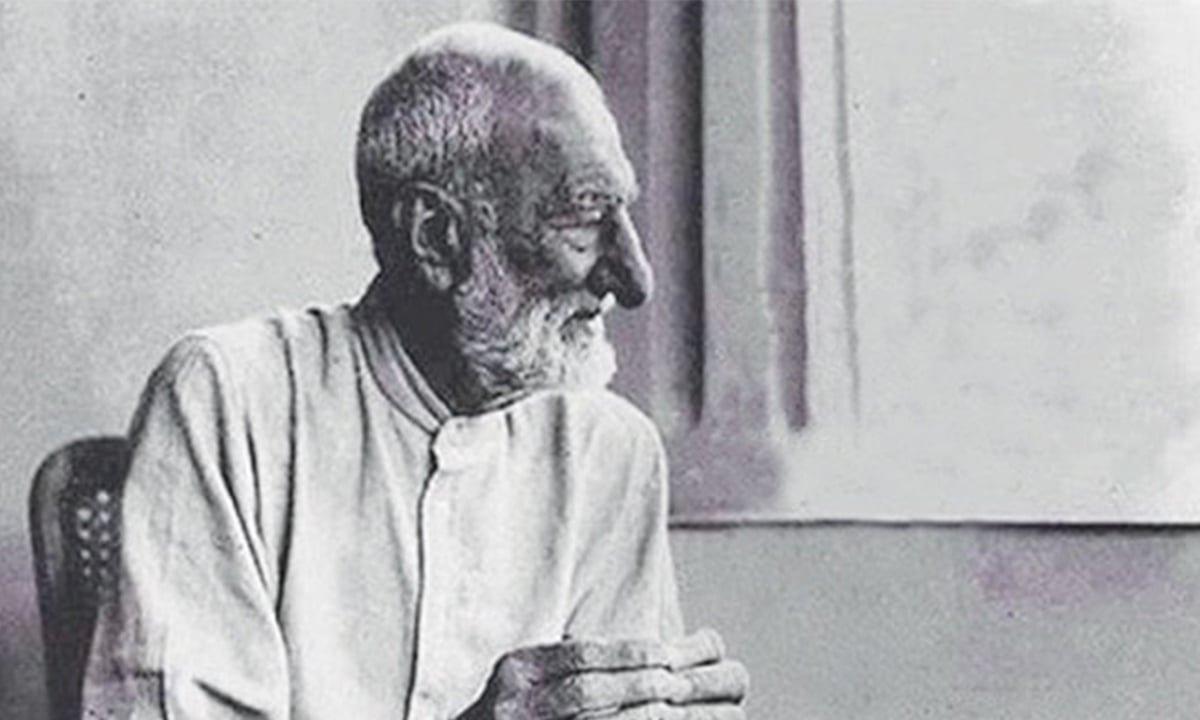
- By: Irfan Khan Sherani
- Student of Sociology, Quaid-e-Azam University, Islamabad
The half of the 20th century was a horrible epoch of human history. There was the world wars on the one hand, murders, and cruelty. On the other hand, individuals expressed the fact that it was possible to attain freedom and justice without violence. These individuals included Khan Abdul Ghaffar Khan also called Bacha Khan.
The struggle that Bacha Khan faced was quite unusual as he employed the aspect of non-violence in a community whereby violence and revenge were the norm. The Pashtun were that society that was known to be courageous, honourable and struggle towards freedom. The Pashtuns operated under a system called Pashtunwali which disapproves the spirit of honour, revenge and hospitality. British Empire utilised this code to assert that Pashtuns were mean and violent and could only be subdued by force. They were brutal to the populace in the borderlands.
Bacha Khan was born in Charsadda, Utmanzai in the year 1890. He was of a rich family, which had been brought up in a different manner. His father, Berham Khan was an educated, kind, and anti-injustice individual. These are the traits that shaped the personality of Bacha Khan.
He was enrolled in Edwardes Memorial Mission School in Peshawar when he was taught by a Christian teacher, Rev. E. F. Wigram, the lesson that he needed to help others. Bacha Khan understood that leadership should be based upon serving the people as opposed to being a powerful person. At a young age, he collaborated with Haji Sahib of Turangzai in order to transform the society as far as education is concerned.
The Haji Sahib of Turangzai was a member of the “Mahmund Agency and he was struggling against the British Empire on behalf of freedom. However, the further course of action changed Bacha Khan when Haji Sahib initiated an armed struggle. He was of the opinion that violence could only lead to temporary outcomes even though it could not initiate a permanent change. It is at this point that his non-violence was evident.
In the case of Bacha Khan, non-violence was not frailty and political gimmick. He interpreted it as an Islamic-based principle and the life of prophet Muhammad (peace be upon him). He always stated that the life of the Prophet can be the most examples of non-violence. In Mecca or during the time in which the Prophet was injured in Ta’if Muslims were treated with a certain level of cruelty, he was not able to react violently. His way of demonstrating the reality of non-violence was at the triumph of Mecca when he forgave his opponents.
The reason why Bacha Khan felt that jihad was not necessarily war alone. The most significant jihad is to conquer oneself, make the society better and perform morally when oppressed. The political freedom, which is not accompanied by the moral change, is meaningless.
The most successful accomplishment of Bacha Khan was to associate non-violence and Pashtunwali. He taught that the greatest honour is self control, the greatest courage the greatest tolerance and the greatest manly duty is to serve the weak. The concept transformed the Pashtun society internally.
He initiated Khudai Khidmatgar Movement in 1929. Initially, it concentrated on social reform, however, it came to be involved in political fight to see freedom. Members were vowed to renounce violence and arms to share by truth, service, simplicity, sacrifice, and non-violence. On their part, non-violence was part of their lifestyle and religious convictions.
The British found this movement threat and attempted to describe it as communistic. They were applying violence to subordinate it. On 23 April 1930, the British opened fire at unarmed Khudai Khidmatgars in the Qissa Khwani Bazaar located in Peshawar. Individuals stood firm and never resisted. This was a best illustration of non-violence.
During the 1930s, Bacha Khan became a member of the All India national congress since all of them were of the same opinion in terms of non-violence. However, Bacha Khan resigned when the Congress stopped being non-violent during the World War II. Non-violence as believed by him was a whole life style rather than a political strategy.
The personal life of Bacha Khan was sacrificed. He not only led the way in protests but he also was usually first to be arrested. Among the 37 years spent by him in gaol was during the Pakistan and earlier days as British subjects. He did not want office, even the presidency of the Congress as he claimed that he was a servant of the people but not a master. He won a number of international awards such as the Bharat Ratna award of India.
Bacha Khan died in 1988. He was interred in the Afghanistan state of Jalalabad, a ceasefire was called temporarily in his honour. This demonstrated that non-violence has more power compared to violence.
Eventually, Bacha Khan showed that the Pashtuns are not inherently violent, and the Islamic religion is not a violent one. He demonstrated how a leader was able to transform a mentality of a nation. Similar to the Prophet Muhammad (PBUH), he made the message of the peace and mercy a reality.
Nowadays, he learned life that the real powerfulness of a life is morality, the true triumph is to be able to win hearts and the true freedom is a non-violent life, faith, love, and service to the humanity.