

- By: Omer Rizwan
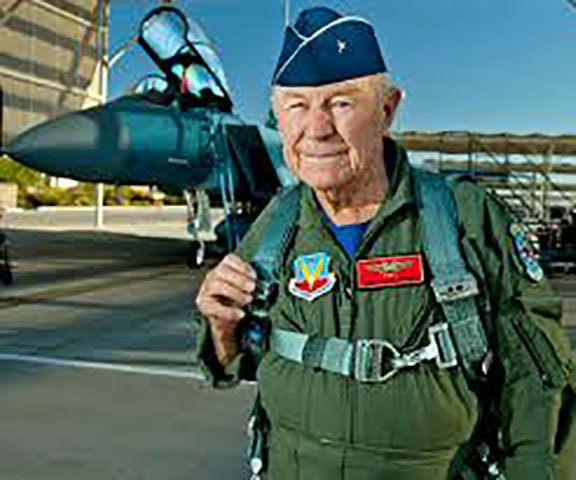
In the annals of aviation history, few names command the reverence that General Chuck Yeager does. The first man to break the sound barrier, a decorated combat pilot, and a living embodiment of aerial excellence, Yeager’s legacy is etched into the very fabric of the United States Air Force. Yet, among the many air forces he observed throughout his storied career, one stood out with particular distinction: the Pakistan Air Force (PAF).
Yeager’s admiration for the PAF was not born of distant reports or diplomatic courtesy—it was forged in the heat of observation, during his tenure as the U.S. Defense Representative in Pakistan. With a front-row seat to the PAF’s operations, Yeager witnessed firsthand the grit, skill, and tactical brilliance of Pakistani pilots, especially during the 1965 Indo-Pak war.
“The air war in 1965 lasted two weeks and the Pakistanis scored a 3-to-1 kill ratio, knocking out 102 Russian-made Indian jets and losing 34 of their own. I’m certain about the figures—I went out several times a day in a chopper and counted the wrecks below.” — Gen. (Retd.) Chuck Yeager, Yeager: An Autobiography (1985)
This wasn’t just a passing remark. It was a testament from a man whose career was built on precision, performance, and an unflinching eye for aerial prowess. Yeager’s words carried weight—not just because of his rank, but because of his reputation for blunt honesty and technical rigor.
Beyond the battlefield, Yeager was equally impressed by the PAF’s institutional excellence. He singled out the Combat Commanders’ School (CCS) in Sargodha, Pakistan’s elite fighter tactics and weapons training institution, as a global benchmark.
“The PAF Combat Commanders’ School (CCS) in Sargodha has been ranked as the best GCI/pilot and fighter tactics and weapons school in the world. It leaves TOPGUN far behind.”
For a U.S. Air Force legend to place CCS above America’s own TOPGUN school was no small praise. It was a recognition of the PAF’s commitment to rigorous training, tactical innovation, and operational discipline. According to Yeager, the Pakistani pilots he met “lived and breathed flying”—a culture of aviation excellence that permeated every level of the force.
His tribute wasn’t just about numbers or accolades—it was about spirit. The PAF, in Yeager’s eyes, embodied the kind of relentless drive and aerial instinct that separates good pilots from great ones. Aggressive in dogfights, precise in gunnery, and tactically astute, they earned his respect not through diplomacy, but through performance.
Today, the Pakistan Air Force continues to build on that legacy. Its reputation as a disciplined, capable, and strategically vital air force remains intact, bolstered by decades of operational success and international recognition. But few endorsements have carried the gravitas of Yeager’s—a salute from one legend to another.
In a world where military alliances shift and geopolitical narratives evolve, the enduring respect of a figure like General Chuck Yeager stands as a timeless tribute. It reminds us that excellence in the skies transcends borders, and that true mastery earns admiration wherever it flies.