

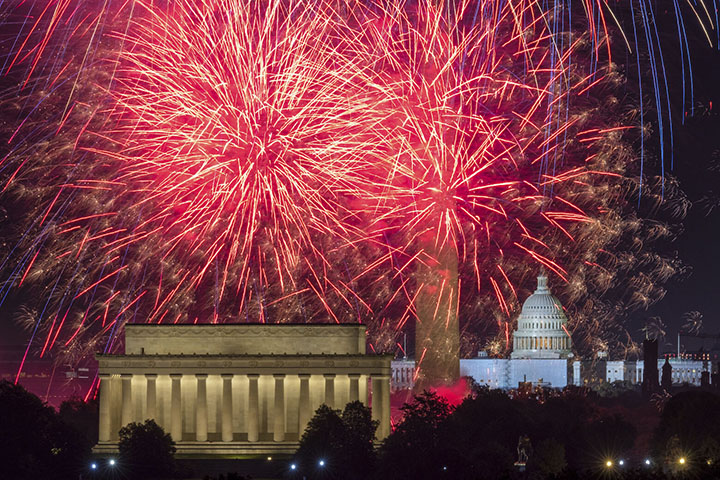
WASHINGTON, 5 July 2026 (Agencies) – The United States marked the 250th anniversary of its Declaration of Independence on Saturday with celebrations spanning the country, even as severe storms, record-breaking heat, and political controversy disrupted parts of the marquee events in the nation’s capital.
The semiquincentennial capped more than a year of official programming under the White House’s “Salute to America 250 Task Force,” known as Freedom 250, a Trump-aligned public-private partnership that ran alongside the separate, congressionally chartered nonpartisan America250 commission. The celebrations officially began on Memorial Day 2025 and continued through the July 4 anniversary.
In Washington, the centerpiece “Salute to America 250 Celebration & Fireworks” on the National Mall was originally scheduled to begin at 7 p.m., but severe thunderstorms forced organizers to delay the event and evacuate attendees, who were later re-screened by the Secret Service before being allowed back in. President Trump did not take the stage until nearly 11 p.m., telling the crowd he refused to let the weather stop the celebration. In his remarks, Trump praised the endurance of the American Republic across two and a half centuries and touched on a range of other topics, including his recent war with Iran, his opposition to communism, and his push for the SAVE America Act, drawing criticism from Democrats who accused him of turning the anniversary into a partisan rally.
The nearly 40-minute speech was followed by a massive military flyover and a record-attempt fireworks finale, with organizers proposing to launch more than 850,000 pyrotechnic effects from 10 sites across the Mall, including barges on the Potomac River — an effort to break the world record for the largest fireworks display in history.
Celebrations extended well beyond Washington. In New York Harbor, dozens of tall ships from around the world took part in “Sail4th 250,” part of the U.S. Navy’s Sail250 International Fleet Review, which organizers said would become the largest maritime gathering in U.S. history. Vice President JD Vance addressed the anniversary in a speech delivered from the USS Kearsarge. In New York City, Mayor Zohran Mamdani lit up the Empire State Building following a flyover by Navy jets, although a fireworks display there was marred by a fire that broke out on the Brooklyn Bridge as the show concluded.
In Philadelphia, where the Declaration of Independence was signed in 1776, extreme heat forced organizers to cancel a Friday parade and postpone a Saturday fireworks show until after midnight. Chicago held its largest-ever fireworks display at Navy Pier, while Boston hosted its traditional fireworks spectacular. Numerous smaller communities across Colorado and New Jersey canceled their own Independence Day festivities altogether, citing wildfire risk and dangerous heat, as roughly 150 million Americans nationwide remained under heat alerts amid record-setting temperatures.
The nationwide festivities were the culmination of a broader, year-long commemorative effort that included a six-night projection-mapping display on the Washington Monument around New Year’s, the “Great American State Fair” on the National Mall, commemorative coinage, mobile “Freedom Truck” museums touring all 48 contiguous states, and a planned Freedom 250 Grand Prix street race through the capital later this year.
The anniversary celebrations were not without controversy. Lawmakers had raised concerns earlier in the year over federal funding disputes between the bipartisan America250 commission and the Trump-administration-backed Freedom 250 initiative, and authorities in Washington reported that a small extremist group marched with Confederate flags near some events during the holiday weekend.