

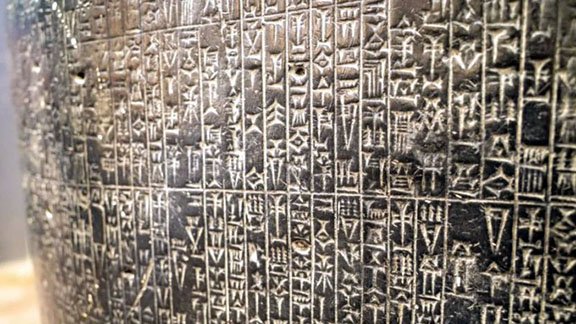
Dubai (Agencies) July 10, 2025 — In a breakthrough at the intersection of archaeology and artificial intelligence, researchers at the University of Dubai have successfully trained a machine learning model to transcribe a 3,700-year-old Babylonian clay tablet with 98% accuracy, marking a major leap forward in the study of ancient Mesopotamian law and language.
The tablet, dating to the reign of King Hammurabi (circa 1754 BCE), contains the opening lines of the Code of Hammurabi, one of the world’s oldest and most influential legal texts. Written in Akkadian using cuneiform script, the code outlines 282 laws governing trade, property, family, and criminal justice—many based on the principle of retributive justice, famously summarized as “an eye for an eye.”
The AI system was trained on over 14,000 high-resolution images representing 235 distinct cuneiform signs, each originally pressed into clay using a stylus. The top-performing model, based on a modified version of EfficientNet, misread only two characters out of every hundred on the actual artifact. A secondary model achieved 89% accuracy.
Lead researchers Shahad Elshehaby, Alavikunhu Panthakkan, Hussain Al-Ahmad, and Mina Al-Saad emphasized the significance of the achievement for museums and universities, many of which house thousands of untranslated tablets from Mesopotamia, Syria, and Anatolia. Manual transcription of these tablets is slow and requires rare expertise, but the AI system offers a scalable and rapid alternative.
Beyond translation, the technology could support historical research by analyzing regional variations in symbols, helping scholars date tablets and trace their geographic origins. The team now plans to refine the model to handle damaged or burned tablets, and eventually expand its capabilities to other ancient writing systems, including Egyptian hieroglyphs, once sufficient image datasets are available.
This development not only accelerates the digitization of ancient texts but also opens new pathways for reconstructing the legal, social, and cultural frameworks of early civilizations. As AI continues to evolve, it may soon become an indispensable tool in decoding the forgotten languages of the ancient world.