

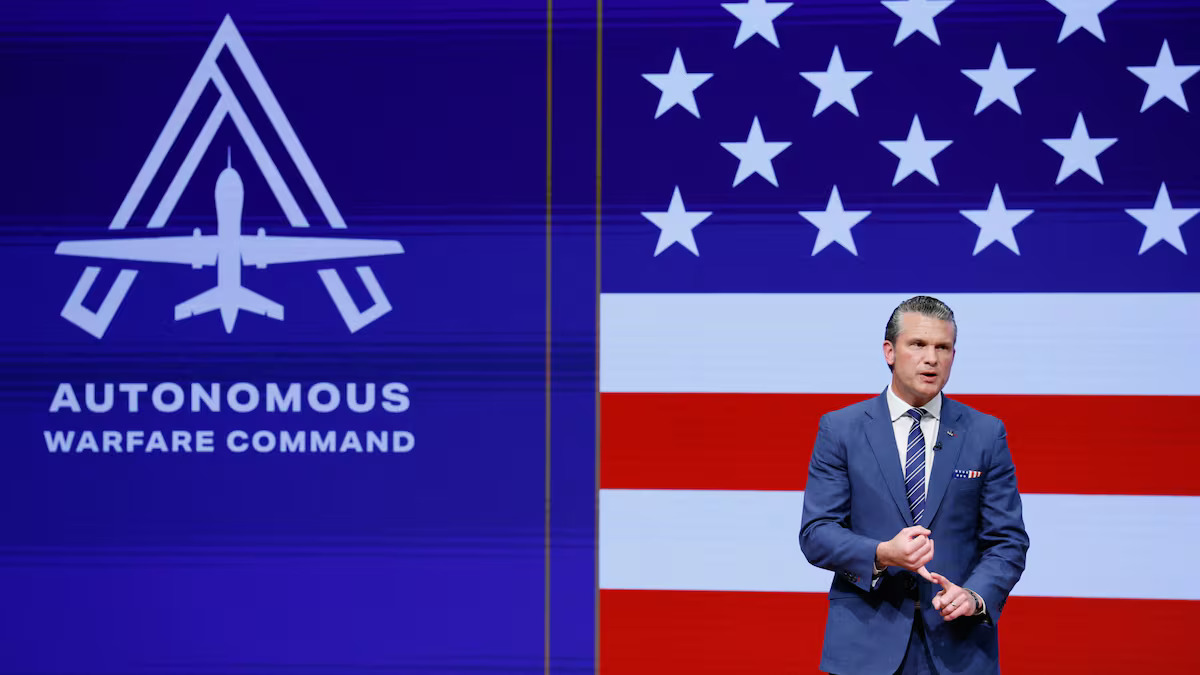
- Defense Secretary unveils a four-star combatant command for robotic weapons among six major initiatives announced during a State of the Force address at Quantico
QUANTICO October 4, 2026 (Agencies) – The Pentagon will create a new combatant command to lead its efforts to develop and deploy robotic weapons, Defense Secretary Pete Hegseth said Wednesday during a State of the Force address to around 600 junior officers and senior enlisted leaders at Marine Corps Base Quantico, Virginia.
The new Autonomous Warfare Command, or AUTOWARCOM, will be a four-star combatant command with service-like authorities built to scale autonomous and robotic capabilities across the joint force, Hegseth said, describing it as the fastest peacetime operational shift in modern military history. According to a memo released after the speech, the command is to stand up by October 1, 2027, pending congressional legislation. In the interim, planning will flow through a fast-moving pathfinder effort called Project Agincourt, intended to work out how such a command should fight and to build toward the new structure over the coming months. The effort will be led by Owen West, who currently heads the Defense Innovation Unit, and Navy Senior Chief Petty Officer Max Strasiser, a SEAL and test pilot. Hegseth said the department would also work with the armed service branches to phase in new military occupational specialty frameworks to support the shift to autonomy, saying the military needed institutional knowledge and career paths for a new generation of autonomous warfighters.
Hegseth separately announced Project Meridian, a committee with a four-month deadline tasked with identifying the domains the US military must master in future warfare. The committee will be led by defence contractors Elon Musk, Palmer Luckey and former House Speaker Newt Gingrich.
Among a further set of initiatives, Hegseth announced a readiness programme called FORTRESS America, an acronym for Federal Operations for Resilience, Troop Resources, Energy, Supply, and Survivability. He said the US military had become dependent on foreign mines for rare earths, overseas factories for microchips, foreign supply chains for weapons, and the civilian power grid to keep the lights on at its bases, and announced an effort to have every US military base eventually generate its own electrical power, without providing a timeline or cost estimate. He said the military would also increase its stockpiles of munitions, critical supply-chain materials, medicine and blood, describing it as part of a national insurance policy for the American homeland. As part of the same effort, the Pentagon will build a new base, to be sited in whichever state makes the best pitch for hosting it, which a Department of War statement said would serve as a hub for integrated defence operations, distributed command and control, and resilient cyber and technological capabilities. Hegseth said the base would cover hundreds of thousands of acres, house between 15,000 and 25,000 troops, and be built in a “timeless classical architecture” style in line with an executive order issued in August.
Hegseth also announced a new Office of Religious Affairs that will report to him directly. A Department of War statement said the office would ensure religious affairs are no longer dispersed across bureaucratic layers, giving senior leaders a dedicated capability to protect free exercise, remove policy barriers, identify unmet requirements, and support the service chaplaincies. During the speech, Hegseth quoted the Bible on several occasions and described children as “precious souls made in the image and likeness of God.”
Hegseth also criticised media coverage of the military during the address, including reporting on the depletion of munitions stockpiles during the war against Iran, and said that activism he characterised as intentionally smearing the troops amounted to “treason, actually.” Wednesday’s address came on the first anniversary of a September 30, 2025 speech Hegseth delivered at Quantico to the military’s generals and admirals, which focused on fitness and culture.
Peter Feaver, a scholar of civil-military relations, wrote a day before Wednesday’s speech that the matter was not a trifling one of decorum, arguing that the safety of the American republic and its constitutional order depend on elected political leaders trusting that the military will serve in a nonpartisan fashion.