

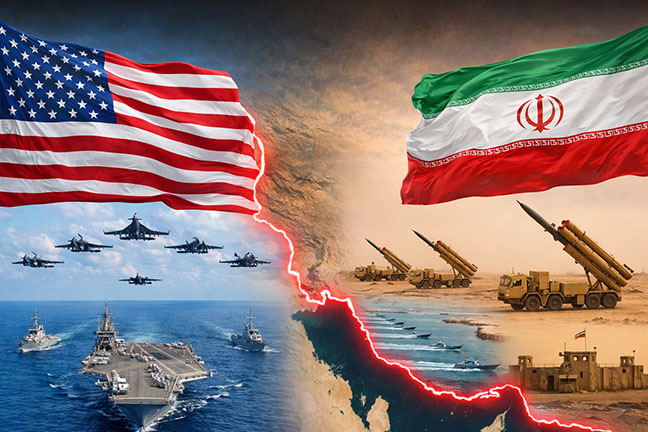
- Warning comes as Houthi missile debris injures a Saudi resident and the USS Theodore Roosevelt heads toward the Middle East, with the conflict between Washington and Tehran now in its 217th day
TEHRAN 4 OCTOBER 2026 (Agencies) – Iran’s Revolutionary Guard Corps has warned the United States of a “more lethal” response, as the eight-month conflict between the two countries continued to escalate alongside a major US naval build-up in the region.
The warning came as debris from a Houthi missile injured a Saudi resident, underscoring how the confrontation has drawn in regional actors beyond the direct US-Iran standoff. It follows a period officials have referred to as Operation True Promise II, a reference to Iran’s October 2024 ballistic missile attack on Israel, in which Tehran launched around 200 missiles, and comes amid warnings from Iranian officials of further retaliation against US and Israeli assets and positions.
The IRGC’s warning coincides with the US deployment of the USS Theodore Roosevelt and the Makin Island Amphibious Ready Group toward the Middle East, a build-up that could bring three US carrier strike groups and two Amphibious Ready Groups into the region by the end of November. The Nimitz-class Theodore Roosevelt, deploying with Carrier Air Wing 11, which includes F-35C Lightning II and F/A-18E/F Super Hornet fighters, EA-18G Growler electronic warfare aircraft and E-2D Advanced Hawkeye surveillance assets, is expected to relieve the USS George Washington, a Japan-based carrier that has been in the region since August after replacing the USS Abraham Lincoln. By relieving the Washington, the Roosevelt would keep fighters, electronic warfare assets and naval strike capabilities available in the Arabian Sea near the Gulf of Oman and the approaches to the Strait of Hormuz, as the US military campaign against Iranian assets, tracked by officials as Operation Epic Fury, continues.
A running tally of the conflict places Thursday’s deployment announcement on day 217 of the war. Other recent entries in the same tracker include Iran saying it had received a US response to its proposal to end the war, Iran threatening strikes while awaiting a response to its plan for reopening the Strait of Hormuz, a statement from Iran’s Supreme Leader that the US would be forced out of the Middle East, Trump saying he expected talks with Iran to resume in the coming week, a surge in US military activity around the Strait of Hormuz, and a reported discussion between Trump and Chinese President Xi Jinping on the Iran conflict.
Iran has separately claimed to have captured a US Navy MK 18 Mod 2 Kingfish mine-hunting underwater drone, a claim that, if accurate, would mark a direct incident between US and Iranian forces at sea distinct from the broader carrier build-up. President Trump said Thursday that Iran’s nuclear threat had been “obliterated in one night,” and that this had happened well ahead of schedule, even as his administration continues to expand both its military presence in the region and its sanctions campaign against Tehran. The US Treasury has announced new sanctions targeting what it described as a shadow banking network used by Iran to evade sanctions, along with companies tied to Iran’s automotive, rail, manufacturing and steel sectors.
Oil markets have continued to reflect the rising geopolitical risk, with Brent crude trading around 102 dollars a barrel on October 2, and maritime insurers reportedly considering higher war-risk surcharges for tankers transiting the Strait of Hormuz. China has also suspended oil product exports, according to reporting, adding to concerns that global fuel shortages could worsen.
No US official has stated that military action against Iran is imminent or has been decided upon, and the Roosevelt’s eventual arrival in the northern Arabian Sea is being described by analysts as the first public milestone to watch for signs of further escalation, rather than confirmation that new strikes are planned.