

- By: Ibn-e-Taha
- khan_adnan040@yahoo.com
Pakistan Air Force is a national culture of values, human resource and ingenuity. Its’ personnel are groomed to be the best amongst the international air forces. PAF pilots are trained to master the flying machines with SWOT (Strengths, Weaknesses, Opportunities and Threats) analysis of own as well as other air forces of the world. They are aware about parameters like rate of climb, manoeuvrability, radius of turn, rate of turn, ceiling, acceleration, drag produced, aerodynamics efficiency, thrust vs energy and speed limit of own and other aircraft. They also know unbeatable aircraft performance is dependent upon giving 100% with full commitment.
Though IAF and PAF inherited pilots who were trained together, yet the will to fight was greater in PAF pilots even in 1947. On 4 Nov, 1948 one of the PAF air dropping Dakotas was challenged by Indian Tempests over Chilas valley. The Indian Tempests first asked the PAF Dakota to land at nearest Indian airfield, however captain of the flight Flying Officer Mukhtar Dogar refused. Indians opened fire wounding Naik Mohammd Din (Pak Army) and injuring under training navigator Flying Officer Alfred Jagjivan. Despite their shelling, Flg Off Dogar managed to land back in Pakistan and did not surrender to IAF pilots.
On Eid-ul-Fiter of 10 April, 1959, PAF radar operator Pilot Officer Rab Nawaz, intercepted an Bharati intruder—a Canberra reconnaissance aircraft—over Gujar Khan. He asked Flt Lt Younus of No 15 squadron at Peshawar to scramble. On seeing the PAF F-86 in pursuit, Canberra tried to evade and run back but Flight Lieutenant Younus opened the account for PAF by having the first kill in air. Bharati pilot Sqn Ldr Sen JC Gupta and navigator Flt Lt SN Rampal of No 106 Sqn of IAF ejected and were taken a POW. Both were later repatriated to India by Govt of Pakistan.
Well before the start of the war in 1965, PAF pilots knew the merits and de-merits of Indian aircraft inventory. Indian Gnat had an advantage being difficult to sight because of its small size, but it could not carry heavy loads. HF-24 Marut had teething problems, much like their Tejas has experienced in more recent times. The HF-24 was planned to be made ineffective against PAF attacking aircraft by several tactics. The Indian MiG-21 had a complicated delta-wing design that caused a high drag rise during turns. The Mystère was considered a capable fighter, and was to be neutralized owing to its’ limitations. Su-7’s heavily loaded wings resulted in poor manoeuvrability. The Vampire’s poor thrust-to-weight ratio and low-speed performance were grave liabilities.
On 24 June 1965, an Indian Ouragan fighter aircraft, while on an armed reconnaissance mission near Badin, was forced to land in Pakistan by PAF. Indian pilot, Flight Lieutenant Rana L C Sidda, was taken prisoner but was later repatriated to
India on 14 August 1965 as a goodwill gesture.
On 1 September 1965, a formation of four Vampires from Pathankot Air Base, led by Squadron Leader Dahar, was tasked with attacking Pakistan Army positions in the Chamb area. However, it bombed their own troops. Indian Major General Sandhu recounts the incident in his book History of Indian Cavalry, by stating “They destroyed three AMX-13 tanks of India’s own Lancers… the only recovery vehicles and only ammunition vehicle available…. Second formation attacked Indian infantry and gun positions, blowing up several ammunition vehicles.”
One Vampire was also hit by friendly fire. PAF, on the other hand, avoided attacking its own troops through careful assessment of the air situation and 100% confirmation of friend and foe, even when doing so placed the pilot at a considerable risk.
On the same date, Squadron Leader Sarfraz Rafiqi and Flight Lieutenant Imtiaz Bhatti opened the PAF’s shooting account by downing four Vampires. The effect was so significant that India withdrew all of its Vampires from the battlefield.
At the same time, same day, Air Marshal Nur Khan, PAF Commander-in-Chief, despite the risk to his life, decided to obtain a first-hand assessment of the area while flying in a slow-moving Army L-19 aircraft. He observed that Pakistan Army troops, tanks, guns, and vehicles were dangerously exposed and presented tempting targets that the IAF would be unlikely to ignore for long. Indian senior commanders, on the other hand, were occupied with planning in their command rooms.
On 3 September 1965, a formation of six Gnats attempted to penetrate Pakistani air space. On encountering the PAF fighters, the six Gnats panicked and broke off the engagement, retreating toward India. PAF pilot Squadron Leader Hakimullah, (who later became Chief of Air Staff, PAF), forced Indian pilot Squadron Leader Brijpal Singh to surrender and land at Pasrur airfield.
Two days before the war, while flying a reconnaissance mission over Jammu, Flight Lieutenant M M Alam’s aircraft canopy was shattered by ground fire. Undaunted, the fearless Alam continued the mission and subsequently destroyed Indian heavy artillery in the Sialkot sector with his canopy open.
On 7 September 1965, the IAF planned a mass raid on Sargodha Air Base involving twelve aircraft of No 1 Squadron, led by Wing Commander O P Taneja, and an eight-aircraft formation from No 8 Squadron, led by Squadron Leader Mickey Jattar. The twelve formation of No 1 Sqn proved a futile exercise and Eight-aircraft formation strafed Bhagtanwala, short of Sargodha, where the Indian aircraft expended their ammunition over the landing strip. The formation’s principal achievement was its safe withdrawal from the area.
The evading Mystères were chased by a PAF Star-fighter flown by Flight Lieutenant Amjad, who fired upon one of the escaping aircraft. In the ensuing high-speed engagement, he collided with the debris of the downed Mystère, damaging his own F-104 aircraft and forcing him to eject. The body of the Indian pilot, Squadron Leader Ajjamada Bopayya Devayya, was found near the village of Nakka and was buried by local villagers. In April 1988, India declared Indian pilot Squadron Leader Devayya a war hero who had allegedly shot down the PAF F-104. He was awarded the Maha Vir Chakra by the Government of India for this feat.
Same day, six Indian Mystères slipped through Pakistan’s air defences and suddenly appeared over Sargodha Air Base. Had they pulled up to gain altitude and acquire their targets—which were plentiful—they could have inflicted extensive damage. From their attack pattern, however, it was apparent that their hearts and minds were not fully committed to the mission they had been assigned. Their objective was to reach Sargodha Air Base, which they succeeded in doing, but their weapons delivery was totally unprofessional. They sprayed bullets indiscriminately during a single high-speed pass. They missed the F-86s positioned on the Operational Readiness Platform (ORP), apparently due to sheer panic, and left Sargodha base unscathed.
PAF pilots knew that the Indian Hunter was superior in the fighter role, but they believed it could be subdued through better tactics. Squadron Leader M M Alam had also flown the aircraft during one of his training courses in the UK. Knowing that he might face these Hunters in combat, he devised strategies during training sorties in the UK for shooting down a Hunter.
He shared his plans with other pilots on how to overcome the superior Hunter. In later day on 7 September, he put his strategy into practice when he chased two different formations of Hunters and shot down five out of them within two minutes over Sargodha, an achievement widely described as a world record. Alam is also credited with nine confirmed aerial kills and two probable victories during the 1965 India-Pakistan War.
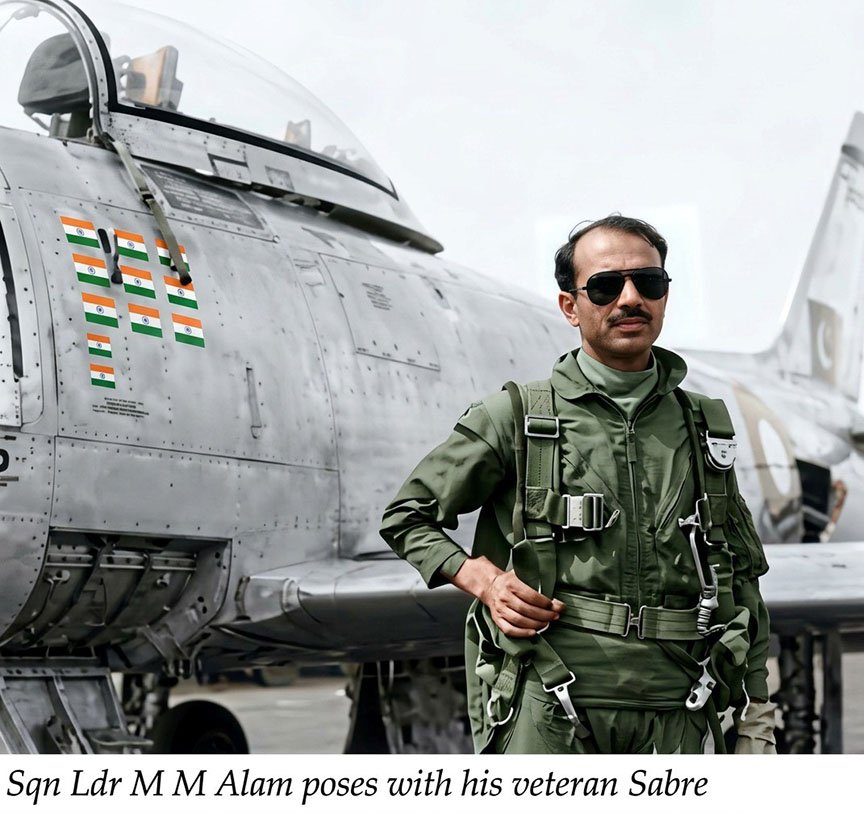
- Sqn Ldr MM Alam with his F-86 aircraft. Nine kills in form of none Indian flags and two damaged aircraft are mentioned on the aircraft.
After suffering severe blows during the first two days, the IAF stopped conducting daytime raids against PAF airfields. IAF pilots became reluctant to engage PAF pilots in aerial combat, thereby leaving the battle area virtually under PAF control. The IAF subsequently resorted to night bombing and employed its Canberras for this task.
For bombing missions, IAF had 80 Canberras bombers, compared to PAF’s 17 Martin B-57 bombers. Indian bombers struck areas around airfields but often failed to hit the actual runways. At Sargodha, they dropped approximately 90 tons of ordnance, but only about 1,000 pounds landed within 100 feet of the runway intersection, causing no significant damage during their offensives. Lack of results was attributed to a lack of determination on the part of some IAF pilots, who appeared more intent on releasing their loads somewhere around the airfields than on striking critical targets.
IAF pilots generally opted to release their payloads from higher altitudes, keeping clear of anti-aircraft fire. PAF pilots, on the other hand, preferred to release their bombs from lower altitudes, placing themselves at greater risk of being hit but achieving greater accuracy. Decades later, Indian accounts acknowledged losses of aircraft on the ground, with 13 reportedly credited to Pakistani B-57 raids.
PAF’s Flt Lt Altaf Sheikh and his navigator Flt Lt Bashir Chodhry attacked Adampur airfield in India for bombing on 14/15 Sep, 1965. During the first attack the automatic bomb release system malfunctioned bombs were not released. Altaf switched over to manual release system and went into second attack facing flakes of Indian heavy ack ack fire. This time the four internal bombs got released and hit the target, but the four external bombs remained stuck. He and navigator again went through a hail of fire for the third time. Nothing happened and they both could still see bombs hanging with the wings. They both decided to jettison the bombs on the enemy’s airfield in any case. Unfortunately during the fourth attempt the B-57 got hit, both ejected, landed in enemy’s territory and were taken Prisoners of war. Putting in four attacks in a single mission is a testimony of PAF pilots who make the difference between victory and defeat.
In another mission in September 1965, Squadron Leader M Akhtar Bokhari flew over India in a B-57 to test its night-interception capability. It was a daring mission, knowing that the aircraft would likely be detected by Indian radars and that India possessed fighter aircraft such as the Hunter and MiG-21. Nevertheless, he undertook the mission with the attitude, “Shoot if you can.” He successfully completed the task and landed safely without being challenged.
Another war hero Flt Lt Shamsuddin was a bomber pilot on B-57 aircraft. During the war days of 1965 he developed a kidney pain but did not let his officer commanding know about it, he instead volunteered for the bombing mission against Halwara accompanied by navigator Sqn Ldr Shaoib Alam Khan. During the bombing mission he develped an unbearable pain, preventing him to fly and land back. Flt Lt Shamsuddin persisted dropping the eight bombs over Halwara airfield. After the cease fire Flt Lt Shamsuddin was admitted to hospital where 28 stones were found in his lacerated kidney, which were removed.
B-57 had a limited payload capacity of only eight bombs. In an ingenious adaptation, the PAF converted one of its C-130 transport aircraft for the bomber role, informally referred to as the B-130. On 12 September 1965, the PAF conducted its first bombing mission using the C-130, targeting a bridge at Kathua. During the daring mission, the PAF C-130 encountered an Indian fighter heading toward it but did not turn back. The Indian fighter failed to intercept the transport. After completing the bombing run, the C-130 was chased by another fighter aircraft, but the C-130 pilot, Wing Commander Zahid Butt, executed tight manoeuvres and successfully evaded the Indian fighter. The C-130 had not yet cleared the area when the anti-aircraft guns of Pathankot Air Base opened fire. The captain nevertheless managed to make a safe exit toward Pakistan. The following day, All India Radio reported that the PAF was using a four-engine bomber of Chinese origin—a mistaken identification apparently made by the IAF fighter crew.
Later, while searching for PAF C-130s, Indian pilots reportedly shot down one of their own AN-12 aircraft.
On the night of 13/14 September, an Indian Canberra penetrated the airspace over Peshawar and released its bombs near the runway, but on the bitumen shoulder rather than directly on the target. Had the Indian pilot released the approximately 4,000-pound bomb load more accurately, the PAF could potentially have suffered significant losses, including a substantial proportion of the F-86s of No. 19 Squadron and B-57 aircraft in the inventory. All India Radio, however, reportedly claimed the destruction of 40 PAF aircraft during the raid.
Why the Indians did not launch more effective attacks against Pakistani airfields at the beginning of the 1965 war remains a question best known to the Indian High Command. They failed to strike the PAF at a point where it could have suffered its most damaging losses.
In addition to fighter aircraft, PAF also employed its T-33, a slow-moving trainer, for reconnaissance and bombing missions against enemy. During one such mission, an unarmed, slow-moving, obsolescent, and vulnerable T-33 identified Indian Hunters over Halwara. Despite the Pakistani aircraft’s vulnerability, the Indian pilots reportedly did not engage it.
On 9 September 1965, Flight Lieutenant Aftab Alam Khan viisted Halwara Airfield three times during daylight hours for a photographic reconnaissance mission, but he was not challenged by any Indian aircraft. The rear seat of the aircraft was occupied by Squadron Leader Middlecoat, who held a camera in his hands to take photographs. This innovative reconnaissance technique proved highly successful for the PAF in identifying terrain features and determining the positions of enemy aircraft at the Indian airbase.
Flight Lieutenant Aftab Alam Khan also refused any war decorations. According to him, he had simply been trained to perform this job.
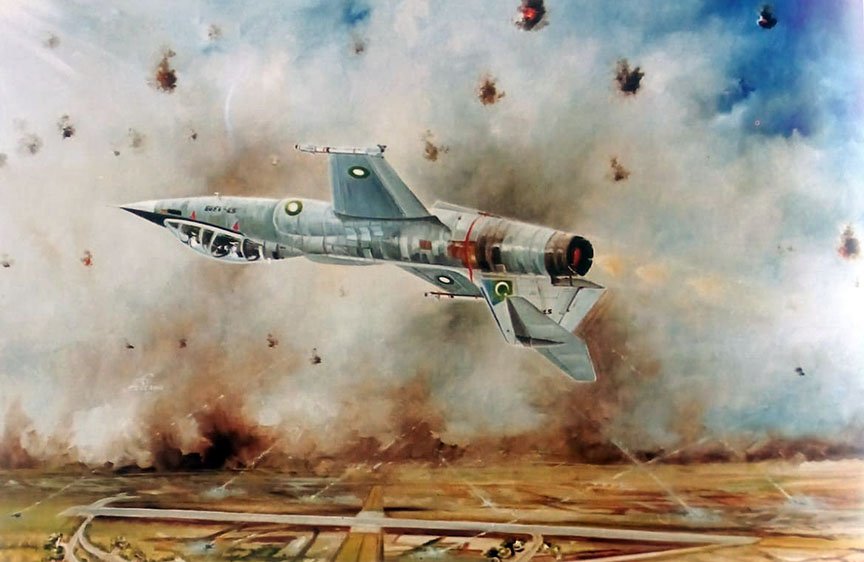
- Flt Lt Aftab Alam Khan and Sqn Ldr Middlecoat busy on a photographic reconnaissance mission over Halwara.
In the Eastern Wing, India launched aerial attacks on 7 September 1965, targeting airfields at Chittagong, Jessore, Lalmonirhat, Shibganj, Thakurgaon, and Kurmitola, as well as the Pakistan Army headquarters at Rangpur. However, they failed to locate the PAF’s Dhaka airfield, from where F-86s were operating.
The PAF struck Kalai-kunda Air Base the same day at 0630 hours under the command of Squadron Leader Shabbir H. Syed, the Officer Commanding No. 14 Squadron. The other four pilots were Flight Lieutenant Tariq Habib, Flight Lieutenant Baseer Khan, Flight Lieutenant Abdul Haleem, and Flying Officer Afzal Khan. The strike claimed the destruction of 10 aircraft and damage to several other aircraft and installations.
Not content with the results of the first strike, the squadron commander decided to conduct another attack at 1030 hours under the command of Flight Lieutenant Tariq Habib. The formation encountered Indian aircraft in the air but reportedly managed to shoot down four to six Canberras.
The day was considered a major success for the PAF, with claims of 14–16 Indian aircraft destroyed and another 6–8 damaged. No. 14 Squadron earned the nickname “Tail Choppers” because of its claimed success in striking and destroying IAF aircraft in the Eastern Wing.
PAF bomber squad again proved equal to the task in the war of 1971. On 3 Dec, 1971, Flt Lt Abdul Basit along-with a team of another three B-57 bombers were detailed to drop 8000 lbs bombs over Jammu airfield which was heavily defended. The four ship formation approached the Jammu runway and dropped the load of 8000 lbs each. On turning back, he was informed by the navigator that two of the bombs have failed to be released from his aircraft. Other formation members have successfully delivered the payload. Basit pulled up orbited over the target and had another attempt by dodging the enemys’ ack ack guns. He ensured dropping of the hung bombs in another attack and then successfully exited safe.
On 5 Dec, 1971, Flt Lt Israr Ahmed was tasked to attack Indian army troops in the Chamb area with his slow moving aircraft T-6G trainer aircraft having slow speed of 145 miles per hour. He carried out the dangerous mission with full zeal even he was fired upon by the Indian ground fire hitting his right arm. On landing back, it was revealed his right arm bone got shattered badly but he persisted along with the mission and landed back safe.
On 4 December 1971, a pair of Hunters attacked Mianwali (MM Alam) Air Base. Flight Lieutenant Ehsan and Flight Lieutenant Qazi Javed intercepted the intruders, and Qazi shot down one Hunter. The Indian pilot, Flying Officer Vidyadhar Chati, ejected and was taken prisoner of war. During interrogation, he revealed that the aircraft belonged to No. 27 Squadron of the IAF, which had been declared the “Top Guns” of the IAF’s Western Air Command during a gunnery meet held before the war.
On 7 December 1971, PAF radar controller Squadron Leader Farooq Haider noticed an Indian Gnat approaching Tarn Taran, near Amritsar. Fortunately, Farooq Haider managed to establish radio contact with the Indian pilot and suddenly developed a unique idea. He warned the Indian pilot about PAF aircraft operating in the vicinity and asked him to continue listening without acknowledging the transmission.
Squadron Leader Farooq Haider then continued guiding the Indian Gnat pilot with simulated calls about approaching PAF interceptors. He eventually transmitted a panic call of “Break,” instructing the pilot to take immediate evasive action. The Indian pilot, Flight Lieutenant Mohan, reacted as a fighter pilot normally would, pulling into a very tight turn in an attempt to shake off his supposed pursuers. The aircraft subsequently crashed.
On 8th Dec, 1971, Sqn Ldr Iftikhar Naqvi and his navigator Flt Lt M Irfan carried out bombing over Sirsa airfield. The base remained unusable for two days as confirmed by an Indian pilot shot and taken POW. According to him, Officer Commanding Flying Wing Sirsa base, took them to the damaged runway and remarked “This is how an attack should be”.
During one of the nights of the 1971 war, a C-130 was flying back from the Chor area to Chaklala (Nur Khan) Air Base. The PAF Command and Operations Centre (COC) detected an enemy MiG-21 night fighter moving toward the C-130. Immediate calls were transmitted to the C-130 crew instructing them to take evasive action, but contact could not be established. Strangely enough, the MiG-21 kept groping in the darkness, manoeuvring up and down behind the C-130 and attempting to obtain a radar lock, but it could not do so. Eventually, losing hope, the MiG-21 broke away.
During the later stages of the 1971 war, two PAF Mirages were engaged in a photographic reconnaissance mission when two Indian MiG-21s suddenly appeared from Pathankot Air Base. The No. 2 Indian pilot fired at one of the PAF Mirages and exclaimed, “Splash,” indicating that he believed he had shot down a PAF Mirage. He continued transmitting, “I saw him exploding… Leader, Leader, this is No. 2… Come on, Lead,” but received no response.
After landing, he discovered that he had mistakenly shot down his own formation leader (No. 1) rather than the PAF Mirage.
The PAF knew that its F-86s were subsonic aircraft operating against India’s supersonic Su-7s and MiG-21s. Nevertheless, PAF pilots were prepared to counter this technological disparity through appropriate tactics.
On 11 December 1971, Wing Commander Ali Imam Bukhari, Officer Commanding No. 18 Squadron, while leading a formation of three F-86s, conducted a strafing attack against a cluster of vehicles near Nainakot. On their return, the formation encountered a group of supersonic Indian Su-7s. Wing Commander Bukhari kept his composure and shot down one Su-7, flown by Flight Lieutenant K. K. Mohan of No. 26 Squadron, based at Ambala.
Again, on 17 December 1971, PAF pilot Flight Lieutenant Maqsood Amir shot down a MiG-21 over Pasrur while flying a subsonic F-86. The Indian pilot, Flight Lieutenant Tejwant Singh, was taken prisoner of war.
The PAF was also able to mount Combat Air Patrols (CAPs) over the battlefronts to prevent the IAF from providing meaningful support to the Indian Army in both the wars of 1965 and 1971. PAF pilots not only shot down IA aircraft providing close air support to Indian army bur also destroyed Indian advancing tanks, guns, mortars, vehicles and troops over the borders.
The 1971 war resulted in a ceasefire on 16 December 1971. Nevertheless, on 17 December, the IAF attacked the unmanned airfield at Skardu. A Canberra and an An-12 attacked the runway, but the raid caused no significant loss to the PAF.
During both the wars, PAF pilots saw the Indian troops jumping out of their tanks and vehicles on seeing PAF aircraft in air. PAF airmen on the other hand came out of their trenches and shelters to fire at the Indian planes.
On 7 Sep, 1965, Corporal Technician Sher Muhammad opened fire on six intruding Indian Mysteres aircraft attacking with their lethal canons and rockets fire. The approaching Mystere got a direct hit from his rifle fire and crashed nearby.
On 8 Dec, 1971, Leading Aircraftsman, Azam Nasir opened fire from his G-3 rifle on the attacking Indian aircraft. A bomb fell hardly a few yards from him and made a huge crater. His colleagues in the trench got buried under the rubble and Azam Nasir removed the gravel, showel after showel, saving his comrades. He again started firing at the low level flying Indian jets. This time a bomb dropped by enemy aircraft exploded near him and he embraced shahadat.
On the same day(8 Dec, 1971) Senior technician Asghar Ali fired at an Indian Mystere over his check post at Bhawalnagar border. Asghar also ordered his under command men to open fire as well. They were lucky with their precise and accurate fire got the Mystere a direct hit.
The Pakistani nation feels proud of its Air Force, which has repeatedly defended the country against aerial attacks, including during the events of 27 February 2019. On that occasion, the Pakistani Officer Commanding of No. 9 Squadron led from the front and shot down an Indian aircraft over Pakistani territory.
The mass raid of 7 May 2025, involving approximately 80 Indian aircraft, including Rafales, Mirage 2000s, Su-30s, and MiG-29s, was also professionally countered, with Pakistan claiming a score of 8-0. Hats off to brave leadership from Air Marshal Asghar Khan till Air Chief Marshal Zaheer Ahmed Sidhu.
Ahmed Faraz, while visiting India, was asked by his hosts to write a ghazal similar to:
“Ranjish hi sahi, dil hi dukhane ke liye aa.”
Faraz responded spontaneously, “I will write a hundred ghazals like this for you people, but where will you find Mehdi Hassan to sing them?”
These Pakistani sentiment can be summarized in one line:
India may acquire Hunters, Mirage 2000s, Su-30s, or Rafales from around the world, but where from will it find the courage, determination, and professionalism required to apply their capabilities?