

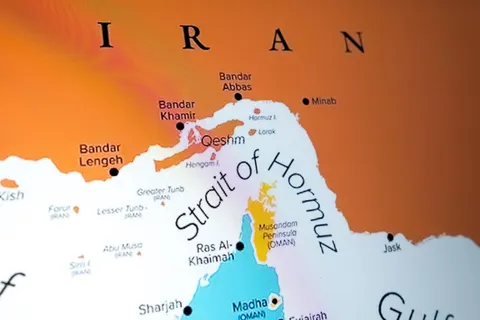
WASHINGTON, August 12, 2026 (Agencies) — The United States and its Gulf allies are exploring major infrastructure projects aimed at reducing their dependence on two critical energy chokepoints — the Strait of Hormuz and the Bab el-Mandeb — amid growing concerns over Iran’s influence over regional oil and gas shipments.
One proposal involves a planned $5 billion integrated refinery and export hub outside the Strait of Hormuz. The project, being developed by the private MERA Oil consortium, is expected to include a refinery with capacity of around 200,000 barrels per day, crude and refined-product storage facilities, and deepwater export infrastructure.
The consortium, comprising US-based MWG Enterprises, the Patel Family Office and PWS, an associate of Saudi-headquartered AHQ Group, has reportedly been assessing potential locations for the project for several years. A final site has yet to be announced, with locations offering direct access to the Arabian Sea or Gulf of Oman seen as strategically advantageous.
The proposed facility is intended to provide an alternative export platform that would remain accessible to international shipping without requiring tankers to pass through the Strait of Hormuz. Phase One is reportedly targeted for completion by the end of 2029.
A wider strategy under discussion involves strengthening land and maritime trade links connecting India, the Middle East and Europe. The India-Middle East-Europe Economic Corridor, or IMEC, was announced at the 2023 G20 summit and is designed to combine maritime connections with rail and other overland infrastructure.
Under potential new arrangements, Oman could play a larger role as a maritime entry point, allowing cargo from India to reach the Arabian Peninsula without passing through the Strait of Hormuz before continuing overland toward Saudi Arabia, Jordan and Israel.
Another proposal would involve constructing an oil pipeline across Saudi Arabia to Israel, where existing infrastructure could transport crude toward Mediterranean ports. Such a system could potentially allow Gulf producers to bypass both Hormuz and the Bab el-Mandeb.
Israel’s Energy Minister Eli Cohen has expressed support for developing land routes that would reduce Gulf countries’ dependence on Iran and the Iran-backed Houthi movement for energy exports.
Israeli Prime Minister Benjamin Netanyahu has also backed the concept of pipelines running westward across the Arabian Peninsula to Mediterranean ports, arguing that such infrastructure could provide an alternative to the region’s maritime chokepoints.
One potential component of such a system is the Eilat-Ashkelon oil pipeline, an existing 42-inch crude pipeline connecting Israel’s Red Sea port of Eilat with its Mediterranean port of Ashkelon. The pipeline was originally developed in the late 1960s as part of a secret cooperation arrangement between Israel and Iran under the Shah.
The proposed infrastructure would face substantial financial, technical and political challenges. Any Saudi-Israeli pipeline would also depend on the wider state of relations between the two countries and the security situation across the region.
The proposals reflect broader efforts by Washington and regional partners to diversify energy transportation routes and reduce exposure to disruptions around Hormuz and Bab el-Mandeb. The Strait of Hormuz is a crucial route for oil and LNG shipments from the Persian Gulf, while Bab el-Mandeb provides a maritime gateway between the Red Sea and the Gulf of Aden.
Supporters of alternative corridors argue that pipelines, railways, ports and inland logistics networks could make regional energy exports more resilient and reduce the strategic leverage of Iran and its regional allies.
However, the proposed projects remain at different stages of planning and discussion. There is currently no indication that a comprehensive US-Israel-Gulf system bypassing both chokepoints has been formally approved or financed.