

- By: Ibn-e-Taha
- Khan_adnan040@yahoo.com
PAF has been entrusted with national responsibilities in addition to the sacred duty of defending the country’s aerial frontiers. It has left no stone unturned in rendering national service during floods, earthquakes, droughts, insurgencies, and the provision of food, medical aid, and shelter supplies. It would not be out of place to say, “The people of Pakistan have complete trust in their Air Force and hold this organization in the highest esteem.”
PAF was requested to support the civil government and security forces in counter-insurgency operations against militants, including the followers of the Faqir of Ipi and other extremist elements. The legacy continues even today and PAF is constantly supporting the Govt in Waziristan, Swat, Balochistan and KPK areas. In 2009, a large number of civilians were internally displaced. The PAF played a vital humanitarian role by establishing supply chains for food, shelter, and medical assistance. PAF Academy Risalpur served as the central hub for relief operations supporting five camps established at Mardan and Mingora. Drawing upon the experience gained during these operations, the PAF further refined its counter-terrorism doctrine and continued to support the Pakistan Army in operations such as Rah-e-Raast (May 2009) in the Swat Valley and Rah-e-Nijat (October 2009) in South Waziristan.
Kashmir War, which began in late 1947, continued until a ceasefire was declared in December 1948. Owing to restrictions imposed by British commanders, the PAF was initially limited to establishing supply lines for the stranded Army troops in the Kashmir region during 1948. By the end of the conflict, air-drop operations alone had involved 437 sorties, delivering 1,036,470 pounds of essential supplies to Bunji, Astore, Burzil, Gilgit, Chilas, and Skardu.
PAF also carried out large-scale food-dropping operations in the affected areas. In addition, it conducted Operation Snow Drop in the Northern Areas from 15 to 30 November 1953 and in 1989.
PAF was also entrusted with operating its first VIP aircraft, the Viking, which was formally inducted into the RPAF on 18 June 1948. It was designated as the Governor-General’s aircraft and was used exclusively for his official travel. No. 12 Squadron of the PAF was also assigned the additional responsibility of operating the Viking and Dakota VIP transport aircraft. For the travel of the President, Prime Minister, and other dignitaries, the PAF maintained a British-built Viscount aircraft at Chaklala Air Base (now PAF Base Nur Khan). In 1965, the Viscount was replaced by an F-27 passenger aircraft. During the mid-1960s, a need was felt for a long-range aircraft for the President of Pakistan, and the Trident was acquired by the PAF. It was later transferred to Pakistan International Airlines (PIA) to maximize its benefit for public use.
At the time of independence, Pakistan had three small airlines: Crescent Airways, Orient Airways, and Pak Air. Crescent Airways did not survive for long because its aging aircraft were decommissioned. The latter two airlines were beset with numerous problems, including avoidable accidents. One such incident was the crash of a Dakota aircraft near Jang Shahi in 1959, which claimed many lives. The Government of Pakistan subsequently merged Orient Airways and Pak Air to form Pakistan International Airlines (PIA) and entrusted the PAF with the responsibility of putting the new airline on a sound footing.
Government of Pakistan also established Pakistan Aviation Limited (PAL) as a joint venture to address the shortage of aviation industry management and technical expertise. In support of this initiative, technical facilities were provided by Airwork Ltd. (UK), which were established in an airship hangar at RPAF Station Drigh Road (now PAF Base Faisal). Technical operations commenced there in 1948, and the first contract undertaken was the overhaul of Dakota aircraft.
In early 1961, the Government of Sindh requested the PAF’s assistance in controlling a locust infestation through aerial spraying. Demonstrating innovation and resourcefulness, the PAF modified a Bristol Freighter cargo aircraft into an aerial sprayer and provided spraying support to the Government of Sindh and the agricultural authorities.
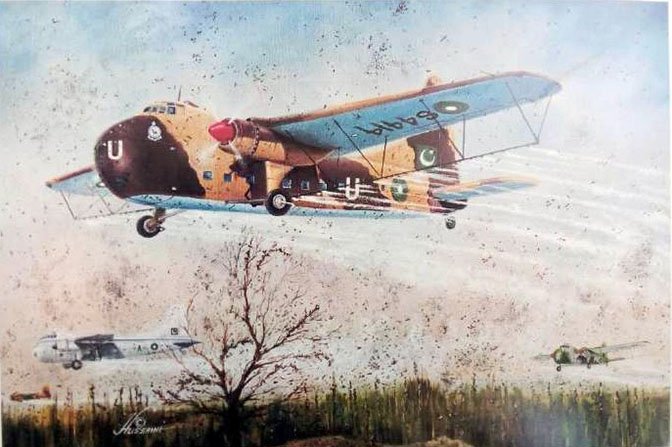
- PAF Bristol Freighter modified as an aerial sprayer for locust-control operations in support of the Government of Sindh on 14 May 1961.
In 1963, the PAF contributed to the amicable demarcation of the Pakistan–China boundary by providing detailed and accurate aerial photographic data. In 1964, it conducted aerial photography of the major river basin, facilitating the World Bank’s Indus Basin Project. The PAF also contributed to the selection of the sites for the Mangla and Tarbela dams through aerial reconnaissance. In the same year, a PAF H-43 helicopter assisted Pakistan International Airlines (PIA) in recovering survivors and the bodies of those who perished in the crash of a DC-3 aircraft in the snowbound Lowari Top Pass region.
One of the PAF’s most notable characteristics has been its consistent participation in flood relief operations. It provided extensive assistance during the floods of 1952, 1954, December 1955, 1970 in East Pakistan (now Bangladesh), 1973 in West Pakistan, and more recently during the floods of 2010, 2012, and 2022.
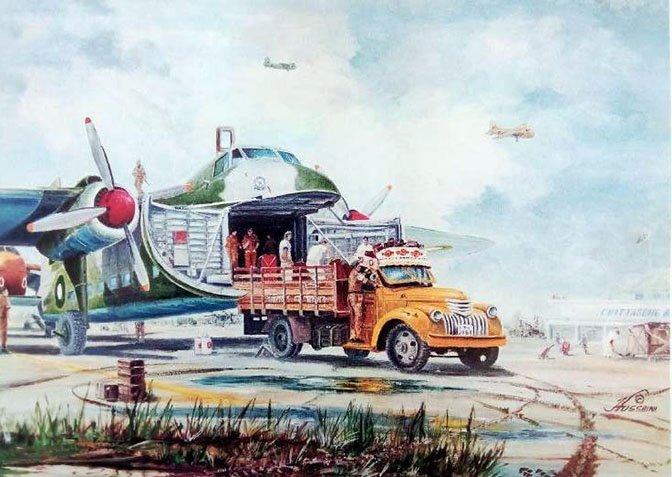
- Relief goods being unloaded at Chittagong (East Pakistan), July 1954.
PAF has also remained at the forefront of relief efforts during major earthquakes, including those of 1974 and 2005. It delivered relief supplies, rescued stranded people, donated millions of rupees in cash, provided free medical facilities, and established a field hospital and an effective supply chain at Muzaffarabad.
PAF not only delivers food, shelter, and relief supplies but also provides medical treatment and financial assistance to affected communities. It has constructed houses for displaced families in the aftermath of natural disasters. Severe floods often disrupt road and railway links across the country, making air operations the only viable means of providing timely assistance. Under such circumstances, the PAF undertakes hazardous missions, frequently at considerable personal risk. These missions include the air-dropping of medicines, food, logistics, and other essential supplies, facilitating VIP visits to flood-affected areas, transporting vital equipment, and evacuating stranded people from danger zones to safer locations, particularly during the devastating floods in the former East Pakistan (now Bangladesh). The Pakistan Air Force Women Association (PAFWA) has always stood shoulder to shoulder with PAF personnel in these humanitarian efforts.
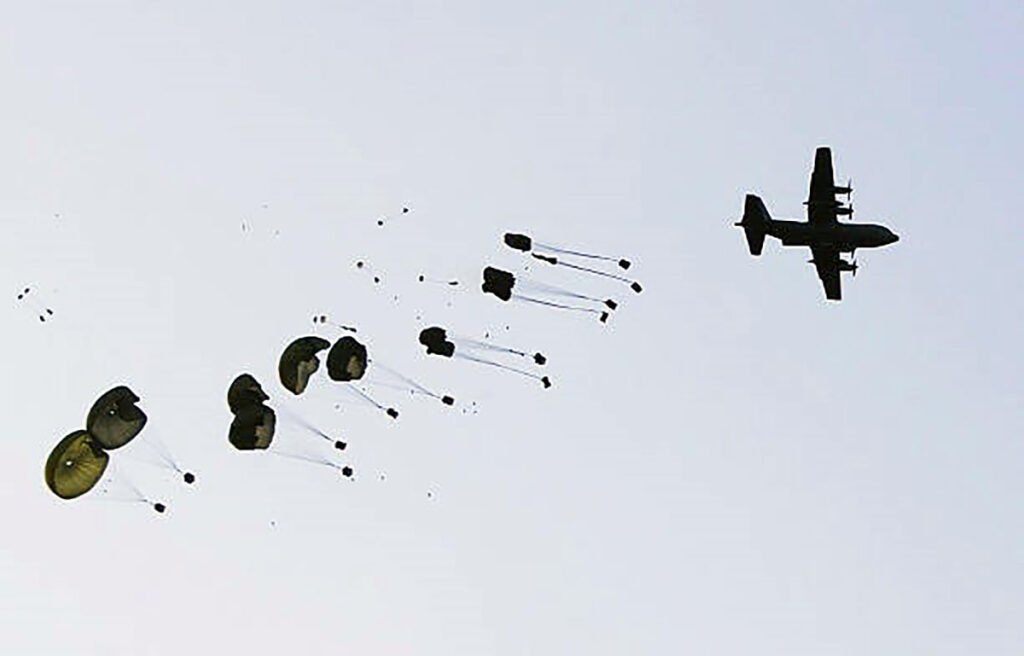
- PAF C-130 proving successful supply lines by dropping supplies to the calamity hot area Source: PAF Website
Owing to the PAF’s exemplary flight safety standards and professional excellence, the Government of Pakistan appointed Air Marshal Nur Khan as the Managing Director of Pakistan International Airlines (PIA) in 1964 and again in 1978. In 1978, he was also appointed President of the Pakistan Hockey Federation. The PAF has also contributed significantly to research and development initiatives undertaken by SUPARCO. Among its distinguished officers was Air Commodore W?adys?aw Turowicz, who acquired Pakistani citizenship and played a pioneering role in Pakistan’s space programme through his work with SUPARCO.
In 1976, the PAF provided airlift support to a Canadian survey team at Dalbandin Airstrip. The team was tasked with surveying the Dalbandin region to assess its mineral potential. The airstrip, originally constructed during the Second World War, had become buried under sand over time. The PAF cleared and restored the airstrip to operational status and ensured uninterrupted airlift support for the Canadian team throughout the survey mission.
In 1979, Shaheen Builders introduced the concept of Binishells in Pakistan for the first time. The concept was based on the rapid construction of dome-shaped shelters using an innovative pneumatic forming technique. Owing to their speed of construction and durability, Binishells gained popularity in Punjab and Sindh, particularly for the storage of wheat and rice.
Pakistan’s Kahuta nuclear complex is located only a few minutes’ flying time from the international border. In the event of an aerial attack, the PAF’s response time would have been approximately eight minutes, which was considered inadequate for ensuring the security of this strategic national asset. To counter this threat, the PAF maintained a round-the-clock Air Defence Alert (ADA) over the Kahuta complex to deter any hostile aerial activity. An attempt to threaten the facility was reportedly made in 1984 through a planned operation involving Israel in collaboration with India. In response, the PAF immediately scrambled its aircraft. Sensing the heightened state of readiness, the hostile aircraft reportedly turned back without entering Pakistan’s airspace.
In 2001, Pakistan International Airlines (PIA) contracted the purchase of eight Boeing 777 aircraft. The agreement included an offset clause requiring Boeing to invest in Pakistan’s aerospace industry. Following a comprehensive evaluation by a Boeing team, the Pakistan Aeronautical Complex (PAC), Kamra, was selected in 2007 to receive advanced machinery and technical training for the manufacture of aircraft components.
In December 2007, the Air Force Strategic Command (AFSC) was established to provide aerial security for strategic national assets, ensure the protection of senior nuclear scientists, and oversee the development of the PAF’s strategic capabilities. The Command formulates operational and training policies, promotes awareness and safety related to Chemical, Biological, Radiological, and Nuclear (CBRN) defence, and develops strategic support plans. It also serves as the PAF’s focal organization for coordinating strategic tasks, including the testing, trials, and transportation of sensitive equipment in close coordination with the other armed services.
On 6 June 2014, terrorists attacked Karachi Airport and the Airport Security Force (ASF) facility, claiming 36 lives. The PAF identified the foreign-sponsored perpetrators and, on 9 June, launched air strikes against their hideouts in the Tirah Valley, killing several foreign militants. On 16 June, PAF aircraft conducted further strikes in Shawal and Mir Ali, eliminating additional terrorist hideouts. Simultaneously, air operations were carried out in the Khyber Valley. These operations significantly reduced Army casualties and forced the remaining insurgents to flee across the border into Afghanistan.
PAF also contributes to the development of Pakistan’s aviation sector by training aeronautical engineers through self-financed programmes, under which trainee cadets and officers pay for their education at the College of Aeronautical Engineering. In addition, the PAF has supported Pakistan International Airlines (PIA) by transferring aircraft after their operational service. Following its useful service with the PAF, a Boeing A-310 aircraft was transferred to PIA in 2013.
PAF has also established the National Aerospace Science and Technology Park (NASTP) to promote indigenous research, innovation, and development in the aerospace sector. Recent developments affecting the strategic waterways of the Strait of Hormuz and the Bab el-Mandeb Strait have underscored the importance of maintaining uninterrupted access to seaports, which are vital to a nation’s economy. A strong air force plays a critical role in safeguarding maritime approaches and ensuring the continued operation of key ports. In this regard, the PAF remains prepared at all times to contribute to the defence of Pakistan’s maritime interests, including the security of the ports of Karachi and Gwadar.
People of Pakistan also deserve special recognition for standing shoulder to shoulder with the PAF throughout its history. On 9 July 1949, the Wali of Swat donated an amount equivalent to the cost of a Fury fighter aircraft. In recognition of this generous contribution, the aircraft was painted in a silver livery bearing the inscription “Crown Prince Jehanzeb.” The aircraft was formally presented to the Royal Pakistan Air Force (RPAF) during a ceremony attended by Begum Rana Liaquat Ali Khan.
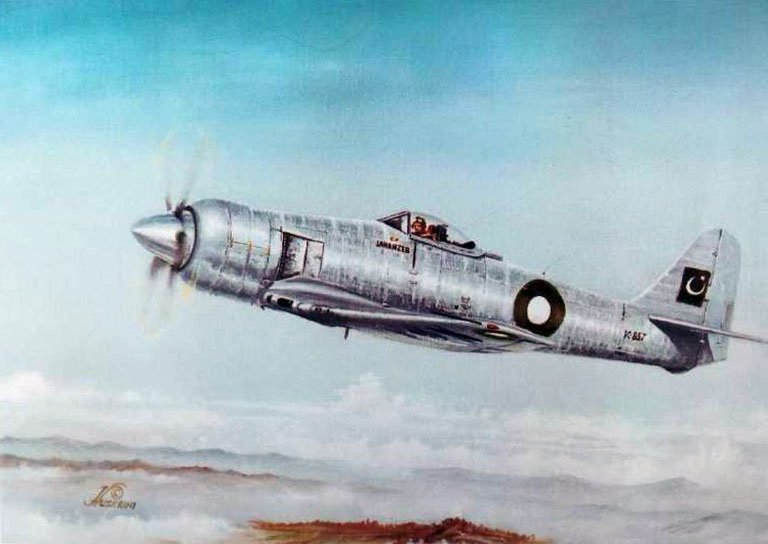
- In recognition of the affiliations of Wali of Swat, Fury aircraft was painted with name of crown prince Jehanzeb on it.
On 7 September 1965, Squadron Leader M. M. Alam shot down five Indian Air Force Hunter aircraft. One of the Indian pilots, Squadron Leader Onkar Nath Kacker, ejected over Pakistani territory. After landing, he immediately removed all insignia and flying badges that could reveal his identity. When local villagers reached him, he introduced himself as a PAF pilot and requested a horse so that he could ride to PAF Base Sargodha to rejoin his unit. However, a vigilant villager, Mr. Imdad Hussain, noticed the pilot’s unusual behaviour and became suspicious. On closer inspection, he observed the words “Made in India” on the pilot’s flying suit and convinced the villagers that the airman was not Pakistani. The Indian pilot was subsequently handed over to the Pakistani authorities, taken into police custody, and later treated as a prisoner of war (POW).
In recognition of the outstanding services rendered by the PAF during the 1965 War, the nation conferred the Hilal-e-Istiqlal upon the city of Sargodha. Across Pakistan, numerous roads have also been named in honour of PAF martyrs and war heroes. These include Sarfraz Rafiqui Road in Lahore, Karachi, and Peshawar; Rashid Minhas Road in Karachi and Rawalpindi; Zahid Butt Road in Chaklala (Rawalpindi); and M. M. Alam Road in Lahore.
Pakistan Post has issued 34 commemorative postage stamps honouring the Pakistan Air Force (PAF), celebrating its history, aircraft, distinguished personalities, and national heroes. These include stamps depicting Quaid-e-Azam and the PAF, the JF-17 Thunder, Air Marshal Nur Khan, legendary fighter pilot M. M. Alam, and martyrs such as Pilot Officer Rashid Minhas Shaheed, Squadron Leader Sarfraz Rafiqui Shaheed, and others. Several stamps also commemorate the PAF’s operations during the 1965 and 1971 wars.
One may say, PAF is one of those organizations which have earned confidence of Pakistani nation as envisioned by Quaid-e-Azam on 14 Aug, 1947.