

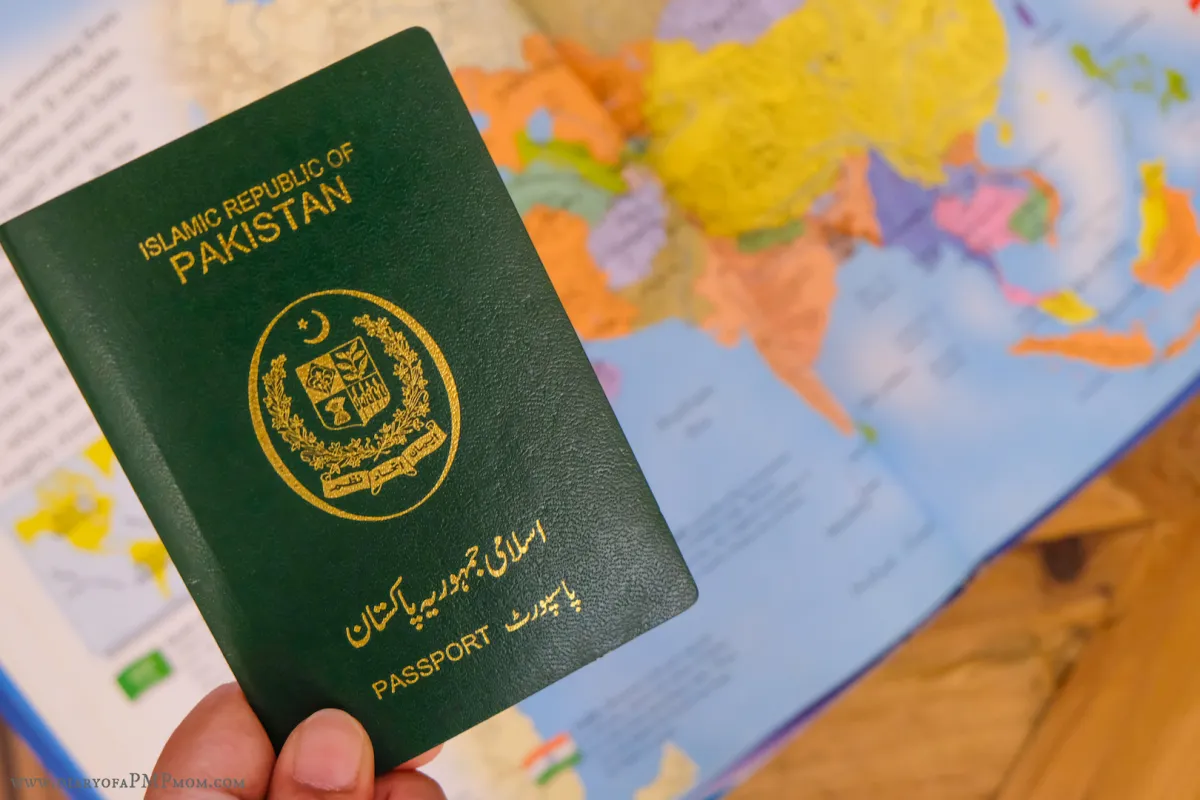
ISLAMABAD 13 July 2026 (Agencies) – The Pakistani passport has climbed the ranks on the Henley index this year to the 100th spot, after stumbling to the 103rd position in 2025, giving travellers access to 30 visa-free destinations. Since 2015, the passport has ranked below the 100th position, fluctuating between 101st and 113th over the past decade, with this year’s ranking marking its best position since 2016.
The rank moved around considerably within 2026 itself. It improved to 98th in January, then reportedly touched 97th in February with access to 32 destinations after Gambia was reinstated, before sliding back down to 100th by the latest update as accessible destinations dropped to 30, reflecting shifting bilateral visa arrangements rather than a single clean upward trend. Only Iraq, Syria and Afghanistan rank lower than Pakistan in the current index, with Afghanistan remaining the world’s weakest passport. By contrast, India’s passport dipped from 75th to 78th this year, while Bangladesh’s ranking improved to around 95th to 96th.
The Henley Passport Index is the original, authoritative ranking of the world’s passports by the number of destinations their holders can access without a prior visa, covering 199 passports across 227 travel destinations. It was created by Christian Kälin and launched in 2005 as the Henley & Partners Visa Restrictions Index, before being renamed the Henley Passport Index in January 2018. The index draws on data from the International Air Transport Association, supplemented by in-house research from Henley & Partners, a global citizenship and residence advisory firm, and is updated quarterly, typically in January, April, July and October, meaning a country’s rank can shift meaningfully within a single year.
At the top of the current index, Singapore retains its position as the world’s most powerful passport, with visa-free or visa-on-arrival access to around 192 destinations. Japan, South Korea and the United Arab Emirates are tied in second place, followed by Sweden in third. A cluster of a dozen European countries, including Belgium, Germany, France, Italy, the Netherlands and Switzerland, share fourth place, while the United States sits in 10th, having only narrowly returned to the top 10 after briefly dropping out in late 2025 for the first time in the index’s history.
The UAE’s rise is described as the strongest performance in the index’s 20-year history, climbing 57 places and adding 149 visa-free destinations since 2006 to become the first Middle Eastern passport to break into the top tier. China has also nearly doubled its visa-free destination count over the past five years, reflecting a deliberate diplomatic push, while the US and UK both posted their steepest annual losses on record this year amid tightening reciprocal visa arrangements.
This year’s edition highlighted one of the widest mobility gaps in the index’s history, with roughly 168 to 170 destinations separating the top-ranked passport from the bottom-ranked one. Henley & Partners frames the index as more than a travel-convenience measure, arguing that passport power reflects a country’s political stability, diplomatic credibility, and its ability to help shape international rules.
Henley also compiles a companion measure, the Henley Openness Index, which tracks how many nationalities a given country admits without requiring a visa. The disparity between the two measures is widest for the United States, which ranks in the global top 10 for outbound passport power but sits far lower, around 78th, for inbound openness, admitting only a relatively small number of nationalities visa-free.
Henley is not the only firm ranking passports in this way. Arton Capital publishes a competing Passport Index that scores the same set of countries differently, crediting electronic travel authorizations and e-visas more generously than Henley does and factoring in a country’s standing on the UN Human Development Index. The differing methodologies explain why the UAE, for instance, tops Arton’s list while sitting further down Henley’s.
Of the 30 destinations accessible to Pakistani passport holders, 11 offer completely visa-free entry: Barbados, Cook Islands, Dominica, Haiti, Micronesia, Montserrat, Rwanda, St Vincent and the Grenadines, The Gambia, Trinidad and Tobago, and Vanuatu. A further 16 grant a visa on arrival: Burundi, Cambodia, Cape Verde Islands, Comoro Islands, Djibouti, Guinea-Bissau, Madagascar, Maldives, Nepal, Niue, Palau Islands, Samoa, Senegal, Sierra Leone, Timor-Leste, and Tuvalu. The remaining three, Kenya, Seychelles and Sri Lanka, require an electronic travel authorization to be obtained before departure. The list skews heavily toward small island nations in the Caribbean and Pacific alongside a handful of African and South and Southeast Asian countries, with very limited access to Europe, North America, or the wealthier Gulf states. Major GCC countries including Saudi Arabia, Bahrain, Kuwait and Oman still require Pakistani ordinary passport holders to arrange a visa in advance.
Officials in Islamabad point to recent bilateral agreements, including a pre-immigration clearance arrangement being finalized with the UAE, negotiated by Pakistan’s Interior Minister Mohsin Naqvi, along with an ongoing e-passport rollout, as factors that could support further gains for Pakistan’s ranking. Analysts note, however, that the ranking could just as easily slip if partner countries tighten entry rules for Pakistani travellers.