

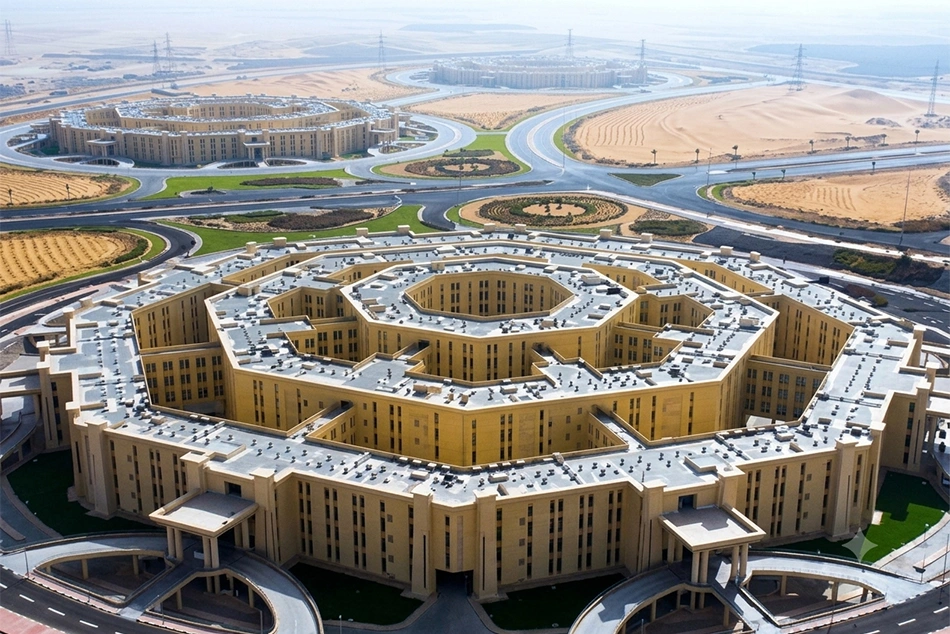
CAIRO, 5 July 2026 (Agencies) – Egypt has officially inaugurated its new Ministry of Defense headquarters, the State Strategic Command Center — popularly known as “The Octagon” — now recognized as the world’s largest defense headquarters complex, surpassing the US Pentagon in both land area and total floor space.
President Abdel Fattah el-Sisi formally inaugurated the facility on Saturday, July 4, in a ceremony rich with military symbolism at Egypt’s New Administrative Capital, roughly 45 kilometers east of Cairo. Sisi, who also serves as Supreme Commander of the Armed Forces, arrived via motorcade accompanied by an artillery salute and Apache helicopter flyovers, and toured the site in an open-top vehicle alongside Defense Minister Lt. Gen. Ashraf Salem Zaher and Chief of Staff Lt. Gen. Ahmed Khalifa, inspecting military vehicles and equipment lined along the route.
“[The Octagon] represents a significant leap in our command, control, and operations management systems,” Sisi said at the ceremony, according to Egypt’s State Information Service. Defense Minister Zaher said the facility “forms the core of the state’s command system, relocating the Armed Forces General Command to achieve unified control through continuous development.”
The Octagon spans approximately 22,000 acres — around 89 square kilometers — compared to the Pentagon’s 583 acres. Its total floor area reaches roughly 50.5 million square feet, nearly eight times the Pentagon’s approximately 6.5 million square feet. Egyptian officials describe the complex as the largest such facility in the Middle East and, by these measures, the world.
The complex takes its name from its architecture: eight external octagon-shaped buildings, each representing one of the eight branches of Egypt’s armed forces, connected via corridors to two central buildings housing top command functions. The design draws on ancient Egyptian architectural influences, incorporating monumental pillars in its structural style. The facility is organized into 13 distinct operational zones and is protected by two dedicated Republican Guard units alongside additional defensive measures.
Officials describe the Octagon as far more than a traditional military headquarters — positioning it as an integrated national command center combining military command, intelligence fusion, and crisis-management functions in a single, unified structure. According to state media, the facility hosts a unified strategic data center and a closed-network crisis control hub linked directly to crisis management centers across all of Egypt’s governorates and ministries. It also includes a dedicated weather forecasting center to monitor sudden climate events, storage depots for strategic civilian goods, high-speed fiber optic networks, and fortified underground facilities designed to ensure continuity of government operations under extreme scenarios. Lawmaker Mohamed Radi said the digital integration is essential to counter emerging fourth- and fifth-generation warfare threats.
Beyond its core military functions, the broader complex also includes residential zones, hospitals, schools, hotels, and commercial centers, reflecting its role within Egypt’s larger effort to relocate government institutions from overcrowded Cairo to the New Administrative Capital.
Construction of the Octagon began around 2018 as a flagship component of Egypt’s New Administrative Capital project, with Sisi personally overseeing its progress through multiple site visits over the years, underscoring its status as a national priority.
During the inauguration, Sisi also expressed appreciation for US President Donald Trump, crediting his efforts in brokering the Sharm el-Sheikh agreement that ended the war in Gaza, as well as a separate agreement reached to end the conflict between the US, Israel and Iran.
The inauguration has drawn attention from foreign military observers, with Chinese defense commentators describing the Octagon’s scale and integrated AI-enabled command systems as a significant addition to Middle Eastern command-and-control capabilities, while Israeli media coverage of the development has remained measured, framing it as a reflection of Egypt’s expanding regional influence rather than a direct military threat.