

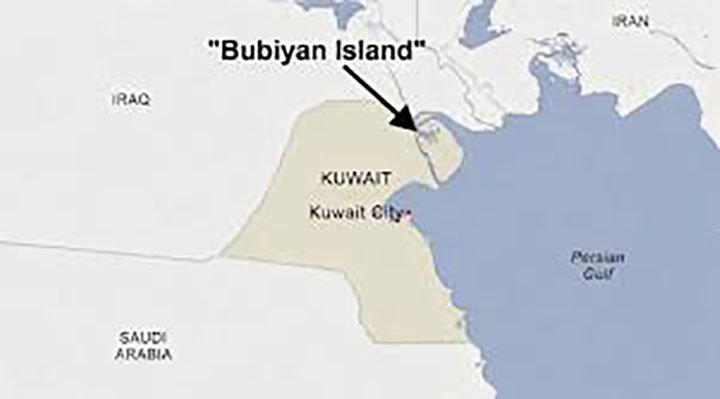
- How a remote, uninhabited Kuwaiti island became the unlikely epicenter of a global geopolitical storm involving America, China, Iran, Iraq and Pakistan
- Bubiyan Island’s planned trade linkage with Gwadar Port makes its stability a matter of direct national interest for Pakistan.
- By: Rizwan Inayat
If you were to look at Bubiyan Island on a map, you would be forgiven for dismissing it entirely. A flat, largely featureless expanse of tidal mudflats and salt marshes in the northwestern corner of the Persian Gulf, it has no mountains, no cities, no permanent population to speak of. It is, in the most literal sense, a mudflat — low-lying, waterlogged, and seemingly unremarkable.
And yet, in the spring of 2026, this obscure Kuwaiti island finds itself at the center of a geopolitical storm of genuinely historic proportions. American marines are stationed on it. Chinese engineers are building a mega-port on it. Iranian commandos tried to storm it by fishing boat in the dead of night. Iraq covets the waterway it controls. Pakistan has staked part of its economic future on it. And all of this is happening as a live regional war between the United States, Israel and Iran rages in the skies above the Persian Gulf.
Bubiyan Island — 863 square kilometres of land larger than Bahrain and Singapore combined — has become the most consequential piece of territory that most of the world has never heard of. This is the story of how it got there, why it matters, and what happens next.
- A Island Born from Great Rivers
Bubiyan did not emerge from the sea fully formed. It was built, grain by grain, over thousands of years by the sediment carried down from the Tigris and Euphrates rivers — the same great waterways that nurtured the world’s earliest civilizations in ancient Mesopotamia. Geologically it is what scientists call a deltaic accretion island, shaped by the slow, relentless accumulation of river sediment at the point where those waters meet the Gulf.
Archaeological evidence suggests that humans have known about Bubiyan for a very long time. Pottery sherds discovered on its beach ridges date to the Sassanian period — roughly 300 to 650 AD — and the early Islamic era that followed. Traders, fishermen and travelers passing through the northern Gulf would have known the island as a landmark, a waypoint, a place where the great rivers finally surrendered themselves to the sea.
For most of recorded history, however, Bubiyan was left largely to itself and to the extraordinary wildlife that makes it home. The island is a designated Ramsar Wetland of International Importance — one of the most ecologically significant wetlands on the planet. Its shallow salt marshes and tidal lagoons host the world’s largest breeding colony of crab-plover birds, with over 5,000 pairs nesting there. It sits at the intersection of two major global bird migration routes — Turkey to India and Eurasia to Africa — making it a critical stopover for millions of birds every year. The surrounding sea is a major nursery for commercially important fish species across the entire Gulf. In a different world, Bubiyan might be celebrated primarily as a wildlife sanctuary of global importance. In this one, it is something else entirely.
- The Dispute That Never Went Away
Modern Bubiyan’s troubles began with the drawing of borders in the aftermath of the Ottoman Empire’s collapse and the emergence of Kuwait as a distinct political entity under British protection. Iraq, which inherited Ottoman claims to the region, never fully accepted that Bubiyan — sitting just off the mouth of the Shatt al-Arab river that divides Iraq and Iran — belonged to Kuwait rather than to Baghdad.
The reason for Iraq’s obsession with Bubiyan is straightforward and economic. The island sits beside the Khor Abdullah waterway, one of only two deep maritime channels through which Iraq can access the Persian Gulf. The navigable portion of this waterway runs closest to the Kuwaiti side — meaning that whoever controls Bubiyan effectively controls Iraq’s ability to move goods, oil and military vessels in and out of its southern ports. Umm Qasr, Iraq’s main deepwater port, depends entirely on freedom of navigation through waters that Bubiyan overlooks. When Saddam Hussein ordered the invasion of Kuwait in August 1990, Bubiyan was among the stated justifications — Baghdad claimed sovereignty over the island and demanded Kuwait cede it. The world rejected that claim through force, but the underlying anxiety in Baghdad about Kuwaiti control of the Khor Abdullah waterway has never fully dissolved. As recently as the past decade, Iraq has formally protested Kuwait’s port construction on Bubiyan, fearing that a massive Chinese-backed Kuwaiti facility could permanently overshadow Iraq’s own Grand Faw port ambitions and give Kuwait permanent leverage over Iraqi trade flows. The dispute was formally laid to rest on paper when Iraq accepted UN-demarcated borders in 1994. In practice, it simmers on.
- China Arrives with Concrete and Cash
For decades after the 1990-91 Gulf War, Bubiyan remained largely undeveloped — a place of strategic sensitivity but limited practical use. That began to change when Kuwait, flush with oil revenues but increasingly anxious about its long-term economic future, decided to build something transformative on its largest island.
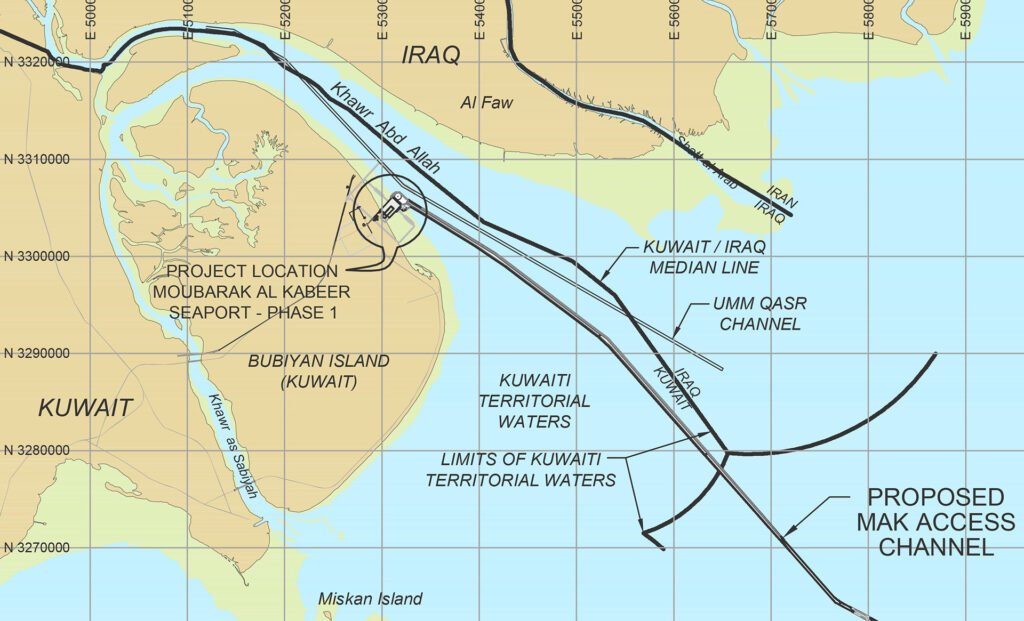
The Mubarak Al-Kabeer Port project was conceived as the centerpiece of Kuwait Vision 2035 — the country’s ambitious plan to diversify its economy away from oil and position itself as a major regional trade and logistics hub. The vision was straightforward but audacious: build a world-class deepwater port on Bubiyan capable of handling more cargo than all of Kuwait’s existing ports combined, connect it to overland transport networks stretching into Iraq and beyond, and transform Kuwait from an oil exporter into a genuine commercial crossroads between East and West.
To build it, Kuwait turned to China. The Mubarak Al-Kabeer Port became a flagship project of Beijing’s Belt and Road Initiative — China’s globe-spanning infrastructure investment strategy designed to build trade corridors, port networks and transport links connecting Asia, the Middle East, Africa and Europe into a web of Chinese-influenced commerce. The port was designed to serve as a vital node in China’s maritime Silk Road, giving Chinese shipping faster and more reliable access to Gulf markets while deepening Beijing’s strategic footprint in the region.
Construction began in phases. Phase One was completed in 2014 at a cost of $1.2 billion. Subsequent phases have added container terminals, quay walls, berths, navigational facilities and administrative infrastructure. A 5,000-megawatt power plant has been built in the neighboring Subiya region to provide the enormous energy the port will require. Kuwait and China recently signed a major new engineering, procurement and construction contract for the project’s final phases, with full operational handover now scheduled for the end of 2026. Development spending in Kuwait’s 2025-2026 fiscal year is expected to surpass all previous records as the government accelerates completion.
When fully operational, the Mubarak Al-Kabeer Port will not merely be Kuwait’s largest port. It will be one of the most strategically significant maritime facilities in the entire Gulf — a deepwater hub capable of connecting Central Asian trade flows, Iraqi oil exports, Gulf commercial shipping and Chinese Belt and Road networks into a single, integrated logistics system. For Kuwait, it is the economic foundation of a post-oil future. For China, it is another strand in a web of global commercial influence. And for everyone watching from outside — Iran, the United States, Iraq — it is a development that fundamentally alters the balance of power in the northern Gulf.
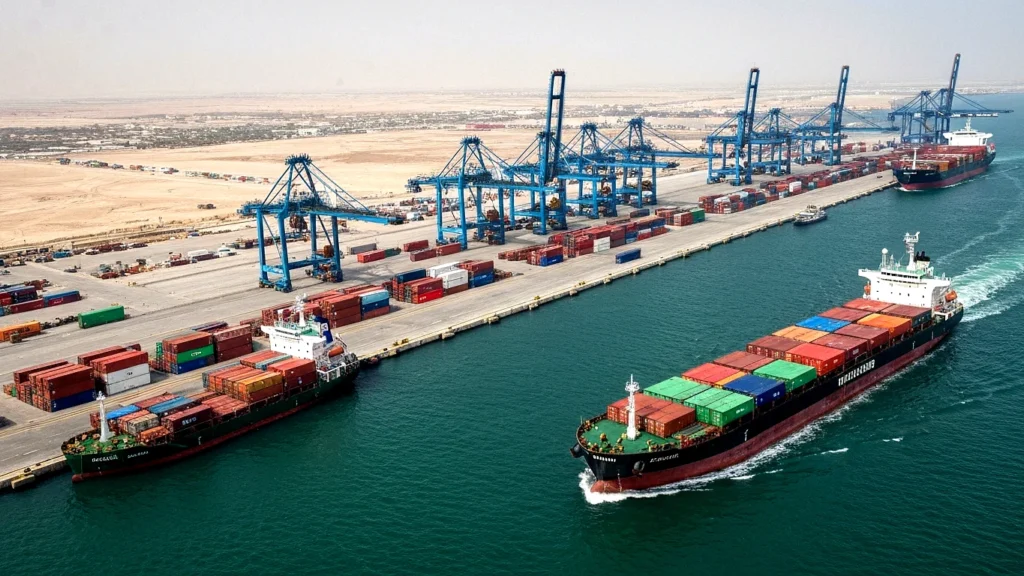
In a development of particular significance for Pakistan, Kuwait and Islamabad formally announced in March 2021 their intention to develop direct linkages between the Mubarak Al-Kabeer Port on Bubiyan and Gwadar Port on Pakistan’s Baluchistan coast. The vision is of a continuous maritime corridor connecting the northern Gulf through Kuwaiti waters and onward through Pakistani territory into Central Asia — a route that would elevate both ports and give landlocked Central Asian nations a new southern gateway to global markets. For Pakistan, whose Gwadar project has long sought to realize its potential as a regional trade hub, the Bubiyan connection represents a significant strategic opportunity. Any prolonged instability on Bubiyan directly threatens that vision.
- The Americans Move In
While China was building its port, the United States was doing what it has done across the Gulf for decades — quietly but firmly establishing a military presence. American forces have been stationed in Kuwait since the liberation of 1991, and Bubiyan’s strategic location in the northern Gulf — overlooking the approaches to Iraq and Iran simultaneously — made it a natural location for surveillance, logistical infrastructure and forward-deployed military assets.
The US Marine contingent stationed on Bubiyan gives Washington a forward operating position unlike almost any other in the Gulf. From Bubiyan, American forces can monitor Iranian naval movements in the northern Gulf, observe Iraqi port activity, and project military power toward the Shatt al-Arab and the approaches to Basra and Abadan with far greater proximity than from bases further south. In the context of the broader US military architecture in Kuwait — which includes the Ali Al Salem Air Base, Camp Arifjan and other facilities — Bubiyan represents the northernmost point of American military reach in the country.
Iranian military planners have been acutely aware of this. From Tehran’s perspective, the US presence on Bubiyan transforms a neutral Kuwaiti island into an American forward base from which Iran can be surveilled, targeted and struck. That perception became explosive in February 2026 when US and Israeli forces launched coordinated airstrikes against Iranian nuclear and military facilities, triggering a regional war. Iranian state-linked media subsequently claimed that HIMARS rocket systems had been operated from Bubiyan to strike Iranian targets during the conflict — a claim that neither Kuwait nor the United States has confirmed but which Iran has used to justify treating the island as a legitimate military objective rather than sovereign Kuwaiti territory.
- The War Comes to the Gulf
To understand what happened on Bubiyan on the night of May 1, 2026, it is necessary to understand the catastrophic regional context in which it occurred.
On February 28, 2026, the Middle East was transformed overnight. US and Israeli forces, in a coordinated operation that had been anticipated but not definitively predicted, launched a sweeping campaign of airstrikes against Iranian nuclear enrichment facilities, missile production sites and Islamic Revolutionary Guard Corps infrastructure across Iran. The strikes were the most significant direct military action against Iran since the Islamic Revolution of 1979 and represented a fundamental rupture in the regional order that had — however uneasily — held for decades.
Iran’s response was immediate, sustained and deliberately broad. Tehran launched waves of retaliatory drone and missile strikes against American military bases across Iraq, Syria, Jordan and the Gulf states. Kuwait, which hosts thousands of American troops and provided logistical support for the initial strikes, was specifically targeted. Iranian drones repeatedly struck Kuwait International Airport in the weeks that followed. The Gulf descended into a state of active warfare, with the Strait of Hormuz either closed or severely disrupted, triggering a global energy crisis that sent oil prices to historic highs, stranded dozens of commercial vessels and sent shockwaves through economies from Tokyo to London.
It was in this context — a live regional war, a ceasefire that both sides had accepted but neither fully trusted, a Gulf seething with tension and suspicion — that six IRGC operatives climbed aboard a rented fishing boat and set course for Bubiyan Island.
- The Night of May 1
According to Kuwait’s Ministry of Interior, the six men approached Bubiyan Island in the darkness of May 1, 2026 with what authorities described as hostile intent. Kuwaiti security forces intercepted the vessel before the group could reach the island. A firefight broke out. One Kuwaiti soldier was wounded. Four of the Iranians were captured and taken into custody. Two managed to escape back into Gulf waters.
Kuwait did not immediately reveal the Iranian connection when it first announced the incident on May 3. The full details — including the IRGC identities of the captured men and their alleged mission — were disclosed only later, in a carefully timed announcement that landed just days before US President Donald Trump was due to travel to Beijing for a summit with Chinese President Xi Jinping at which Iran was expected to be the dominant topic.
The detained men, Kuwait said, had confessed to being members of the IRGC. The group included two naval captains, a naval lieutenant and an army lieutenant. They admitted infiltrating Kuwaiti waters aboard a fishing boat to carry out hostile acts against Kuwait. Kuwait’s foreign ministry condemned the incursion as a flagrant violation of Kuwaiti sovereignty and a grave breach of international law, demanded Iran immediately and unconditionally cease unlawful hostile acts, and formally reserved Kuwait’s right to self-defense under international law.
The regional response was swift. Bahrain condemned the infiltration and affirmed Kuwait’s full right to take all necessary measures to safeguard its sovereignty. Saudi Arabia and the UAE backed Kuwait publicly. The Iranian ambassador in Kuwait City was summoned. The Iranian foreign ministry issued its denial — navigation system failure, accidental entry, absolutely baseless allegations. Iranian Foreign Minister Abbas Araghchi condemned what he called an illegal Kuwaiti attack on Iranian citizens and described the island as one used by the United States to attack Iran, reserving Tehran’s right to respond.
The confrontation — diplomatic on the surface, potentially military underneath — was far from over.
- Why Everyone Is Watching
The significance of the Bubiyan crisis transcends the immediate Kuwait-Iran bilateral dispute and touches every major power with interests in the Gulf.
For the United States, Bubiyan is a military asset it cannot afford to lose. The forward position it provides in the northern Gulf is operationally irreplaceable, and any Iranian success in degrading or neutralizing American infrastructure on the island would represent a significant strategic setback. Washington has backed Kuwait publicly and firmly, but the involvement of American forces in the island’s military value creates an uncomfortable question — to what extent has Kuwait been drawn into the US-Iran war by hosting American troops on its territory?
For China, Bubiyan is billions of dollars of investment and a flagship Belt and Road project on the verge of completion. Beijing cannot afford to see it destroyed or destabilized, but it also cannot afford to publicly confront Iran — a major oil supplier and strategic partner — over the incident. China finds itself trapped between its Gulf Arab infrastructure investments and its Iranian energy relationship, a contradiction that the Bubiyan crisis has forced into the open in the most uncomfortable way possible. The timing of the crisis coinciding with Trump’s Beijing summit added a layer of geopolitical theater that no one in Beijing welcomed.
For Iran, Bubiyan is simultaneously a threat to be neutralized and a pressure point to be exploited. By attacking — or attempting to attack — an island that hosts both American forces and Chinese infrastructure, Tehran sends a message to Washington that no corner of the Gulf is safe, while simultaneously putting Beijing in an impossible position. It is a tactically clever if enormously risky move.
For Iraq, the crisis is an unwanted reminder of its fundamental vulnerability. Its trade lifeline runs through waters controlled by a neighbor with whom its relations have historically been hostile, now further complicated by the presence of Iranian, American and Chinese interests converging on the same small stretch of water. Baghdad watches Bubiyan nervously, knowing that whoever ultimately dominates that island dominates Iraq’s economic access to the world.
For Pakistan, the stakes are quieter but no less real. The Gwadar-Bubiyan corridor — that vision of a continuous maritime trade route from the northern Gulf through Pakistani waters into Central Asia — depends entirely on a stable, functional, open Bubiyan. Every Iranian drone strike on Kuwait, every IRGC infiltration attempt, every week that the Strait of Hormuz remains disrupted, chips away at the feasibility of that vision.
- The Island at the Crossroads
There is a strange irony at the heart of the Bubiyan story. An island that for most of its existence has been valued precisely for its wildness — its teeming bird colonies, its fish nurseries, its pristine wetlands — has become the most militarized, contested and strategically fraught piece of territory in the Gulf. The same mudflats that give crab-plovers a place to nest in their tens of thousands now host marine commandos, port cranes and surveillance equipment.
Kuwait’s master plan for the island attempted to thread this needle — confining development to three specific zones in the south while preserving the ecologically critical northern areas. Whether that balance can be maintained as security pressures mount, construction accelerates and the island becomes ever more deeply entangled in great power competition is an open question. Climate change adds another dimension — the island is classified as at significant risk of inundation from sea level rise by 2100, meaning that everything being built and fought over today may face an existential environmental threat within the lifetimes of children alive right now.
For now, the ceasefire in the 2026 Iran war holds — tenuously, anxiously, with both sides trading accusations and positioning forces for whatever comes next. The Mubarak Al-Kabeer Port continues to rise from the mudflats, crane by crane and berth by berth, toward its scheduled 2026 completion. Kuwaiti security forces have reinforced the island’s perimeter. American forces remain in place. Chinese engineers continue their work. And somewhere in the northern Gulf, two IRGC operatives who escaped from a fishing boat on the night of May 1 are still out there.
The world’s most dangerous mudflat is not done making history.