

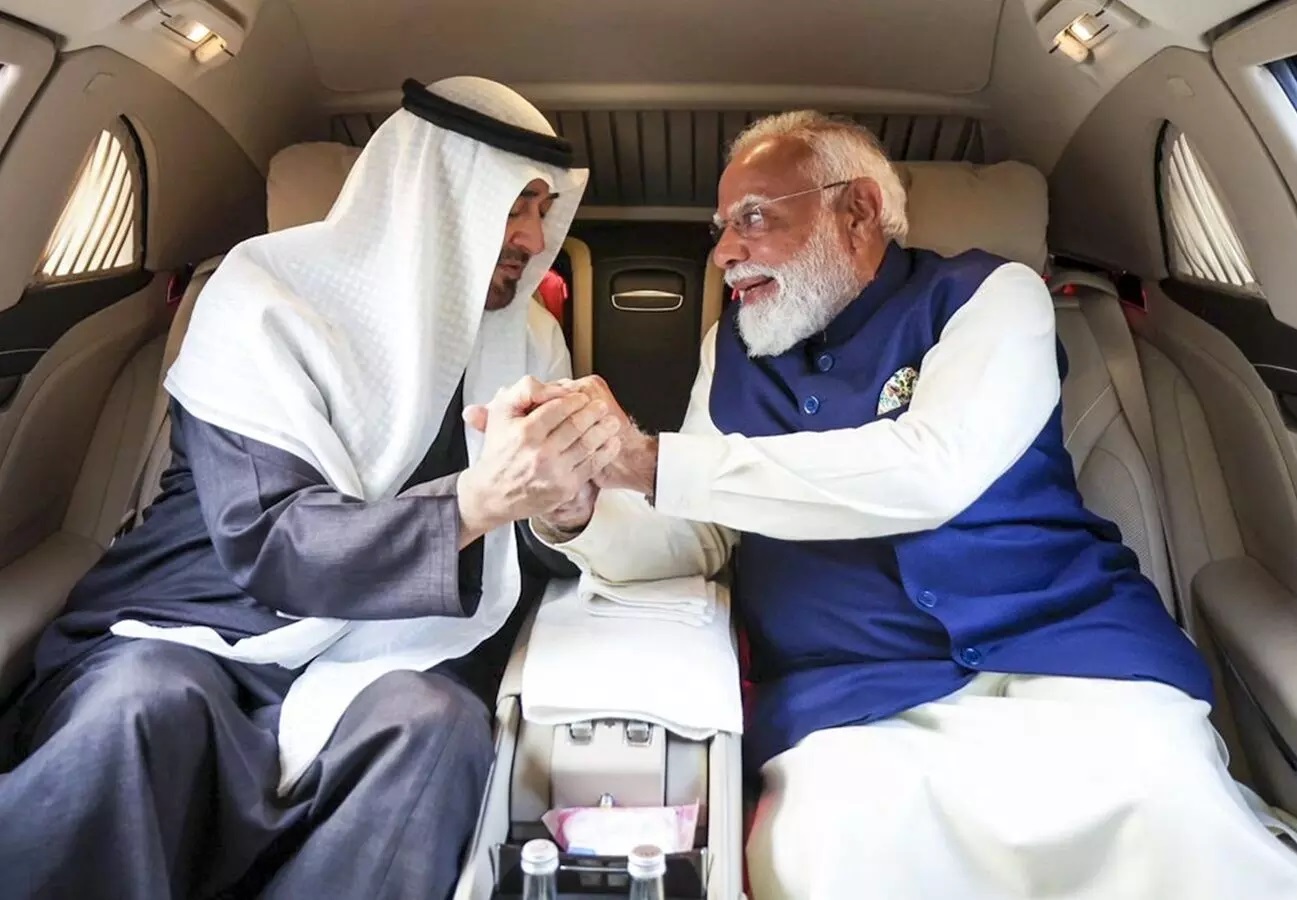
- India and UAE sign six landmark agreements covering defence, energy, infrastructure and shipping
- UAE pledges $5 billion in investments including $3 billion in RBL Bank and $1 billion in infrastructure
- Strategic Defence Partnership framework signed — paving way for joint military hardware development
- Modi condemns Iranian attacks on UAE, calls for keeping Strait of Hormuz “free and safe”
- Modi’s aircraft escorted by UAE F-16 fighter jets on arrival — a rare mark of honour
- Visit described as “brief yet extraordinarily fruitful” — first stop on Modi’s five-nation tour
Abu Dhabi, May 16, 2026 (Agencies) – Indian Prime Minister Narendra Modi held wide-ranging talks with UAE President Sheikh Mohammed bin Zayed Al Nahyan in Abu Dhabi on Friday, producing six landmark agreements covering defence, energy security, infrastructure and investment — along with a $5 billion UAE investment commitment in India — during what Modi described as a “brief yet extraordinarily fruitful” visit.
Modi arrived in Abu Dhabi to a ceremonial guard of honour, with his aircraft escorted into UAE airspace by UAE Air Force F-16 fighter jets — a rare diplomatic gesture reflecting the depth of bilateral ties. It was Modi’s eighth visit to the UAE in 12 years.
The visit was the first stop on a five-nation tour that will take Modi to the Netherlands, Sweden, Norway and Italy in the coming days.
The centrepiece of the agreements was a framework for a Strategic Defence Partnership between the two countries, covering defence industrial collaboration, technology sharing, intelligence sharing, maritime security, joint military exercises and regional security cooperation. The pact marks a significant step in transforming what has historically been a primarily economic relationship into a broader strategic partnership with strong security dimensions. Under the framework, the two countries are set to explore the joint development of military hardware — a potentially significant development given India’s push for domestic defence manufacturing and the UAE’s growing regional military ambitions.
On energy, the two sides signed an MoU on strategic petroleum reserves and a long-term LPG supply agreement, with potential collaboration extended to liquefied natural gas storage facilities in India. The agreements come as volatility in global oil and gas markets following the Iran conflict has heightened energy security concerns for import-dependent nations like India. The UAE is already among India’s most important energy suppliers and has played a key role in India’s strategic petroleum storage programme.
A memorandum of understanding was also signed to establish a ship repair cluster at Vadinar in Gujarat, aimed at strengthening India’s maritime infrastructure, boosting domestic ship repair capabilities and supporting India’s ambitions to become a major global logistics hub. An understanding was also reached to establish a supercomputer cluster, signalling growing cooperation in advanced technologies.
On investment, the UAE pledged a total of $5 billion. The Abu Dhabi Investment Authority (ADIA) and India’s National Infrastructure and Investment Fund (NIIF) agreed to explore investments of up to $1 billion in priority infrastructure projects. Emirates New Development Bank committed $3 billion to RBL Bank of India, while the International Holding Company (IHC) pledged $1 billion to Sammaan Capital, a large Indian non-banking financial company. Modi said the investment commitments would “further deepen economic ties” and help generate jobs.
The West Asia conflict loomed large over the meeting. The UAE, which hosts a major US military base, has faced Iranian strikes since the US-Israeli campaign began on February 28 — including attacks on critical infrastructure. Modi offered unambiguous solidarity, telling Sheikh Mohammed: “We strongly condemn the attacks on the UAE and denounce the way the UAE has been targeted. This is unacceptable in any form.”
Modi also called for restraint and a diplomatic resolution to the broader conflict. “India has always vouched for dialogue and diplomacy,” he said. “Our priority is to keep Hormuz free and safe. We have to follow international laws.” He praised the UAE leadership for handling the crisis “with restraint and maturity” and said India stood ready to extend “all possible support” toward peace in West Asia.
The Strait of Hormuz — through which a fifth of the world’s crude oil supplies were routed before the conflict began — has become a central flashpoint, with the US enforcing a blockade of the waterway amid the broader confrontation with Iran. India, as one of the world’s largest oil importers, has a direct strategic interest in keeping the strait open.
Modi described the pacts as “pivotal” across vital sectors and said he was confident the outcomes would “further solidify the bonds of friendship” between the two nations. The UAE is currently India’s third-largest trading partner and the seventh-largest source of investment into the country over the last 25 years.