

Key Points:
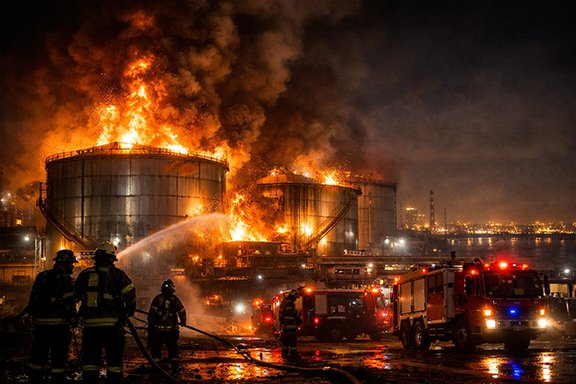
- Iran launched retaliatory strikes on Gulf energy facilities after Israel hit its South Pars gasfield.
- Qatar’s Ras Laffan LNG hub suffered “extensive damage”; Iranian attaches expelled.
- Kuwait, Saudi Arabia, and UAE reported refinery and gas facility attacks.
- Oil prices surged above $115 per barrel; Middle Eastern benchmarks crossed $150.
- Israel claimed destruction of an Iranian helicopter; missiles triggered sirens in Tel Aviv.
- U.S. considering troop deployments and $200bn war funding request.
- China and Oman condemned escalation; Gulf states warned of catastrophic fallout.
Doha, March 19 2026 (Agencies) – Iranian retaliatory strikes have hit multiple energy facilities across the Gulf following Israel’s attack on Iran’s South Pars gasfield, sparking fears of a wider regional conflict and severe disruption to global energy supplies.
Qatar reported “extensive damage” at its Ras Laffan gas facility, one of the world’s largest liquefied natural gas (LNG) hubs, and expelled Iranian military and security attaches within 24 hours. QatarEnergy confirmed “sizeable fires” at several LNG plants, underscoring the global economic impact, as the country supplies about 20 percent of the world’s LNG.
Kuwait’s Fire Force said six teams battled simultaneous blazes at the Mina Al-Ahmadi and Mina Abdullah refineries after drone strikes. The Kuwait Petroleum Corporation confirmed a second refinery was hit, while Saudi Aramco reported damage at its Samref refinery in Yanbu. The UAE condemned attacks on its Habshan gas facility and Bab oilfield as “terrorist acts” and violations of international law.
Oil and gas markets reacted sharply. Brent crude surged past $115 per barrel, while Middle Eastern benchmarks Oman and Dubai crossed $150. Analysts warn prices could approach $200 if the Strait of Hormuz remains closed. Gas prices have already spiked by 30 percent.
Israel, meanwhile, claimed to have destroyed an Iranian Mi-17 helicopter at Sanandaj airport in Hamadan province, citing “real-time intelligence.” Iranian missiles triggered sirens in Tel Aviv, with preliminary reports of damage to buildings.
The conflict has drawn international condemnation. China denounced Israel’s killing of Iranian security chief Ali Larijani as “unacceptable.” Oman’s foreign minister Badr Albusaidi warned that “America has lost control of its own foreign policy,” criticizing Washington’s entanglement in the war.
In Lebanon, Sheikh Ragheb Harb University Hospital reported damage to its intensive care unit after an Israeli strike on an adjacent building, calling it a “flagrant violation of international law.” In Gaza, Israeli drone strikes killed at least two Palestinians in separate attacks.
The United States has temporarily waived the Jones Act, allowing foreign-flagged vessels to transport oil and gas between U.S. ports for 60 days to ease domestic supply pressures. The Pentagon is considering deploying thousands of troops to secure tanker routes through the Strait of Hormuz and has requested over $200 billion in war funding.
Iran’s UN envoy has demanded compensation from the UAE, accusing it of complicity in U.S. attacks by hosting American bases. Saudi Arabia has warned it reserves the right to take military action against Iran if necessary.
With Gulf states bearing the brunt of Iranian retaliation and energy infrastructure under sustained attack, regional leaders warn of catastrophic consequences for global markets and security.