

- By: Ibn-e-Taha
- Khan_adnan040@yahoo.com
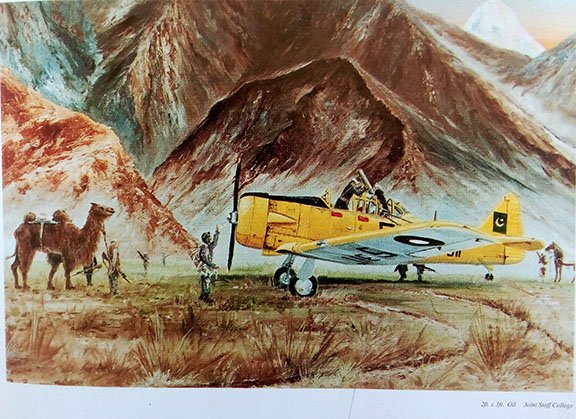
The painting was fascinating. It depicted a two-seater aircraft landing with its rear canopy open and a protruding mortar sticking out of the canopy of the rear seat. Was it real or fiction?
The painter smiled and said it was based on a real incident. On 14 April 1948, the Pakistan Air Force provided support to the freedom fighters of Gilgit–Skardu. The PAF was still in its infancy, and the civil administration requested assistance in delivering a mortar gun to the area. There was no runway or landing facility in Skardu or Gilgit. The nearby grassy lands leading to Skardu were connected to Gilgit only by a mule track, which remained blocked for most of the year. The Station Commander at PAF Station Risalpur, Wing Commander Asghar Khan (later Commander-in-Chief), tasked Flight Lieutenant Khyber Khan with the mission.
Khyber Khan removed the rear seat of the Harvard aircraft in order to fit the mortar inside the aircraft. However, it still could not fit completely and remained protruding out. The lion-hearted Khyber Khan took off from Risalpur with the mortar still protruding and the rear canopy open. The stability and balance of the aircraft became even more difficult to maintain due to the squeezed flight path between the lofty, curling mountains over the narrow Indus River. Constant winds and turbulence made it extremely difficult for such a small aircraft to remain balanced on a straight flight route with a heavy load on board. However, the courageous Flight Lieutenant Khyber Khan, managed to fly through the dangerous route and landed on a grassy field in Gilgit. He accomplished the risky mission at the cost of his life, proving the vision of Quaid-e-Azam that Pakistan’s Air Force would be “Second to None.” This slogan was envisioned by Quaid-e-Azam only a day earlier (13 April) during his first visit to RPAF school. The school was also upgraded to college level a day before. It was the spirit infused in the personnel of RPAF station Risalpur that that Khyber Khan completed a daunting task.
Retired Group Captain Masood Hussaini, also wrote a brief description of the event below the painting. During the exhibition, he displayed several other classic events from the history of the Pakistan Air Force, both in military and civil spheres. The archival records served as a testimony to the rich history and professionalism of PAF.

Group Captain Masood Hussaini (Retired) was born to Syed Ahmed Ali Hussaini and Saeeda Khanum in Rawalpindi on 13 January 1951. His grandfather, Syed Intezam Ali Hussaini, was a Sunni Syed who migrated from Gurgaon in United India to Pakistan. Syed Intezam Ali Hussaini was among the nobles of Gurgaon.
Masood Hussaini Saheb had three brothers and a sister. Masood’s eldest brother, Saeed Akhtar Hussaini, joined the Pakistan Army in the 27th Long Course and fought in the 1965 war in the Bedian sector. He also fought in forefront at Hussainiwala sector in 1971 war. He passed away in1979. Masood Hussaini is the second among the brothers. His younger brothers included Jawad Hussaini and Mobeen Hussaini. Jawad also passed away in 2001. Their only sister is Zohra Hussaini.
Masood’s father, Syed Ahmed Ali Hussaini, got a job at the Wah Cement Factory and admitted Masood Hussaini to a local school in Wah Cantt. Later, Masood was transferred to a co-educational convent school in Hassan Abdal. Masood Hussaini proudly recalls writing Urdu on wooden planks (takhti), which helped him develop good handwriting. During those days, every school had a drawing master. He remembers Mr. Mehboob as his first drawing teacher at Wah Cantt. Hussaini recalls, “We would use a ‘Z’ nib for writing in our copies, while a ‘G’ nib was exclusively used for English writing.”
His father used to take him along to the hilltops around Wah Cantt and ask to make sketches of the area’s topography. His father would then proudly show these sketches to his friends. One of the sketches made by Masood saheb was of “Darbar Panja Sahib”, the holy place of the Sikhs located below a hilltop in Hasan Abdal.
Despite meagre resources, his father ensured his continued education at Public School Abbottabad now Abbotabad Public School (APS) , established by Pakistan Railways. He studied there from 1960 to 1963. During this time, he also met several international students from Indonesia and South Africa. He was fortunate to have another drawing teacher, Mr. Azam at this shool, who further polished his drawing skills.
The school had the motto “Character is Destiny.” The school houses were named Sir Syed, Jinnah, Iqbal, and Tipu. These religio-cultural legacies influenced the young mind of Masood Hussaini. He also actively participated in sports such as hockey and gymnastics, remaining physically very fit.
In 1963, he joined PAF Public School Sargodha in the 14th entry. During the induction process, he was personally interviewed by the principal, Mr. Hugh Catchpole, along with a team of other Pakistan Air Force officers. Out of the 40 boys selected for the course, 10 were from East Pakistan (now Bangladesh). He was fortunate to have Mr Sarfaraz as a drawing teacher here. At PAF Public School Sargodha, he qualified for the Senior Cambridge examinations. After clearing the ISSB, he was sent to the PAF Academy Risalpur in the 51st General Duty Pilots’ Course.
Here he met course mates such as Kaleem Sa’adat (later Air Chief Marshal of the Pakistan Air Force), Fakhar-ul-Azam, and Rafiq-ul-Islam (both of whom later rose to become Chiefs of the Bangladesh Air Force). He also met Rashid Minhas (Nishan-e-Haider) for the first time as a course mate at Risalpur.
After qualifying for initial flying training at Risalpur, Masood Hussaini and his colleagues were sent to PAF Base Masroor for further conversion to jet flying. His close friend Rashid Minhas happily agreed to be his room-mate at Masroor. Masood Hussaini came from a cultural mix of Urdu, Punjabi, and Potohari, and Rashid would often help correct his Urdu speaking skills. Masood Hussaini was the last person to see Rashid Minhas before his final flight. On 20 August 1971, Rashid was sitting in the cockpit of a T-33 aircraft when Hussaini came to see him off. Hussaini recalls that Rashid asked for his comb, which he had earlier given to Hussaini a few days before. Hussaini was astonished that Rashid, already seated in the cockpit and ready for take-off, was asking for the comb he had previously handed over. Nevertheless, Hussaini gave him his own comb.

Masood Hussaini was later sent to Saudi Arabia on deputation from 1980 to 1983. During this period, an F-5 aircraft crashed in Saudi Arabia, and the incident was investigated. Knowing Hussaini’s sketching skills, the investigating officer, Colonel Saleh, took him along on a flight and asked him to illustrate the sequence of events—from 40,000 feet down to the attempted ejection, the circling maneuver, and finally the crash. Hussaini produced detailed diagrams depicting the different stages of the incident in an impressive style. These drawings enabled everyone involved in the investigation to clearly understand the sequence of events that led to the crash.
During his stay in Saudi Arabia, Hussaini was deployed at the Saudi Air Force base in Khamis Mushait (King Khalid Air Base), which had originally been established in 1968 with the assistance of a Pakistani contingent. The base commander requested Hussaini to produce several paintings of the base. These paintings were highly appreciated and were later presented to His Royal Highness King Abdullah bin Abdulaziz.
Upon his return to Pakistan, he was asked by the Chief of the Air Staff, Air Chief Marshal Anwar Shamim, to record the history of the Pakistan Air Force through paintings with a short brief accompanying the artwork, something that had never been done before. He was granted special permission to visit any PAF base or installation, meet aircrew or any personnel he wished, physically visit flying squadrons, and even take rides on aircraft in order to experience them firsthand.
He was also provided with an exclusive studio at PAF Base Nur Khan, where he could conceive historical events and bring them to life on canvas with rich historical detail. Hussaini has been managing the same studio for the last forty-five years. He remains thankful to the fourteen Air Chiefs (since 1983) who have supported and encouraged him in painting and preserving the rich history of the Pakistan Air Force. During this time period he has painted about 350 historical paintings and plenty of pencil sketches on PAF.
The beauty of his work lies in its depiction of aerial combat, real war scenarios, and the surroundings in which the events took place, accompanied by a historical narration written below each painting. In this way, a complete historical chapter is captured on a single page, endorsing the famous saying, “A picture is worth a thousand words.” This artistic work not only attracts the viewers but also the youth of Pakistan to join Pakistan Air Force.
His work depicts numerous historic moments of the Pakistan Air Force. These include servicemen and families of the Royal Pakistan Air Force (RPAF) arriving at PAF Base Chaklala (now Nur Khan) in service Dakota aircraft in August 1947; Quaid-e-Azam’s visit to RPAF Station Risalpur; and Flight Lieutenant Mukhtar Dogar and Alfred Jagjivan defending a cargo aircraft (Dakota) and avoiding a forced landing by Indian Tempest aircraft over the Kashmir area.
Other paintings portray the PAF shooting down an Indian intruder on 10 April 1959; PAF aircraft carrying out locust-spraying operations in support of the Government of Sindh on 14 May 1961; and the role of the PAF during the wars of 1965 and 1971. His work also illustrates PAF pilots shooting down Israeli aircraft during the Arab–Israel wars of 1967 and 1973, PAF rescue missions in the Arabian Sea, PAF assistance in building the Zimbabwe Air Force, and PAF operations during the Afghan War (1979–88). His artistic skills capture landscapes from many regions and seasons, both international and local. These include the deserts and terrain of Saudi Arabia, Egypt, Jordan, Iraq, and Zimbabwe; the snow-covered mountains of Siachen; the deserts of Sindh; the waterways and agricultural landscape of Punjab; the rugged mountains of Balochistan; the beaches of the Arabian Sea along Karachi; and the mountainous ranges of Khyber Pakhtunkhwa, along with bridges, roads, and various military and civil installations across the country.
In addition, his paintings depict PAF participation in joint international exercises both within the country and abroad, as well as Pakistan Post issuing commemorative stamps marking important PAF events, each accompanied by a short historical brief.

His published books include Air Warriors of Pakistan (1989), Air Warriors of Pakistan (1992), PAF Over the Years (2002), and Flying High (2013 and 2016). He is also a life member and artist fellow of the American Society of Aviation Artists and a pioneer member of the Artists’ Association of Punjab (Pakistan).
He also met several national and international personalities, including the Art Director of the United States Air Force, Keith Ferris. Ferris had also been a mentor of Hussaini saheb; the U.S. adviser Brigadier General Charles Elwood Yeager, the U.S. Defence Representative to Pakistan; Yeager holds the world record of being the first supersonic (breaking sound barrier) pilot; the Chiefs of the Air Staff of the Royal Jordanian Air Force, the Turkish Air Force, and the Royal Saudi Air Force; as well as King Khalid bin Abdul Aziz of Saudi Arabia and the Indian historian Pushpindar Singh.
His admirers have also included prominent national figures such as Mir Zafarullah Jamali, President Zia-ul-Haq, President Farooq Leghari, Mahmood Khan Achakzai, President Pervez Musharraf, Air Marshal Asghar Khan, Air Marshal Nur Khan, Air Marshal Zafar Chaudhry, Air Chief Marshal Anwar Shamim, Group Captain Zafar Masood, Air Commodore M. M. Alam, and the present Chief of the Air Staff, Air Chief Marshal Zaheer Ahmad Babar.
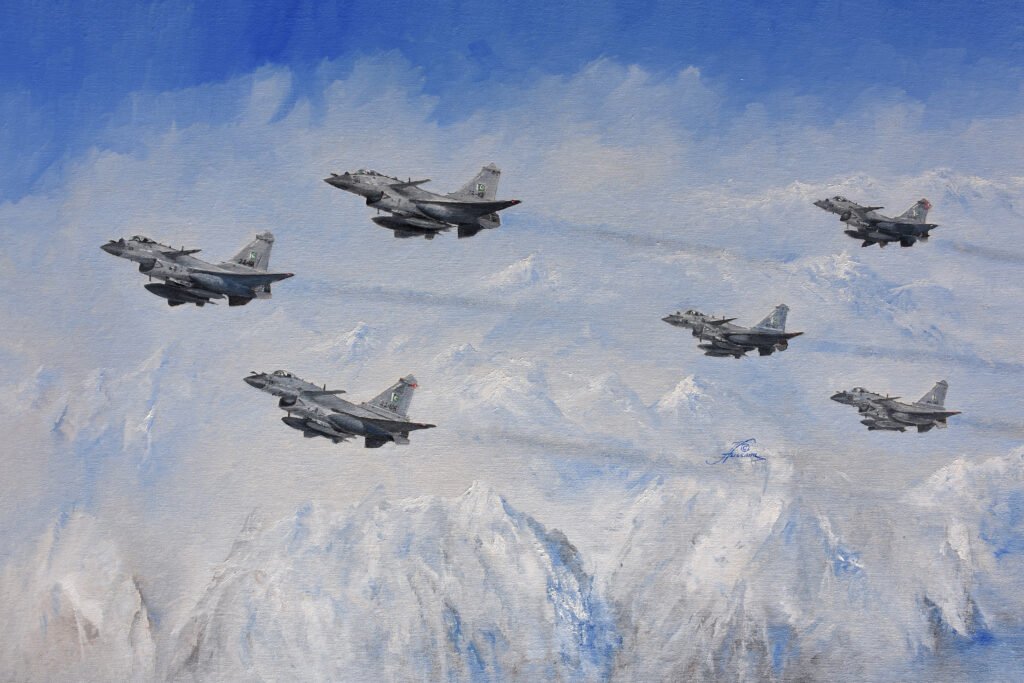
- Officer Commanding No.15 Squadron, Wing Commander Imtiaz Rahim Shahzada, Wing Commander Bilal Raza, Squdron Leader Jibran Rashid, Squadron Leader Hasan Anees, Squadron Leader Zeeshan Mohammad, and Squadron Leader Ali Qasim farrying first batch of J-10 from china to Pakistan.
Hussaini Sahib’s exhibitions have been held in USA, Britain, Turkey, Islamabad, Karachi, Quetta, Peshawar, and Lahore. Undoubtedly these exhibitions attracted Pakistani Gen “Z” to join an illustriuos career in country. He is the only Pakistan Air Force officer to have been decorated with the “President’s Gold Medal for Pride of Performance” by the Government of Pakistan. The Pakistan Air Force has also honoured him with the “Lifetime Achievement Award” and the “Tamgha-e-Basalat.” Hussaini Sahib also completed his latest painting prepared for 23 March 2026, depicting the arrival of the J-10C aircraft in Pakistan on 4 March, 2022. He has aptly captioned this latest work “ENTER THE DRAGON.”Names of the six pilots are also mentioned below the painting. They include Officer Commanding No.15 Squadron, Wing Commander Imtiaz Rahim Shahzada, Wing Commander Bilal Raza, Squdron Leader Jibran Rashid, Squadron Leader Hasan Anees, Squadron Leader Zeeshan Mohammad, and Squadron Leader Ali Qasim.
Hussaini Sahib married Nighat Hussaini in 1975, who is also his cousin. The couple is blessed with three children. Their eldest son, Syed Ahad Hussaini, is a commercial pilot with Pakistan International Airlines (PIA). Their daughter, Ayesha Junaid, is a dental surgeon and is married to a banker, Junaid. Their youngest son, Fahad Hussaini, is settled in the United States.
Hussaini, I am so proud that I have the privilege of being your class fellow. Keep up the good work. May be you could get little grandson of Fakhrul as your on-line apprentice for now.
Personally met sir hussaini he is a brilliant artist and a wonderful person . May Allah bless him with long healthy life ameen. He is an assets for this nation. A living great legend