

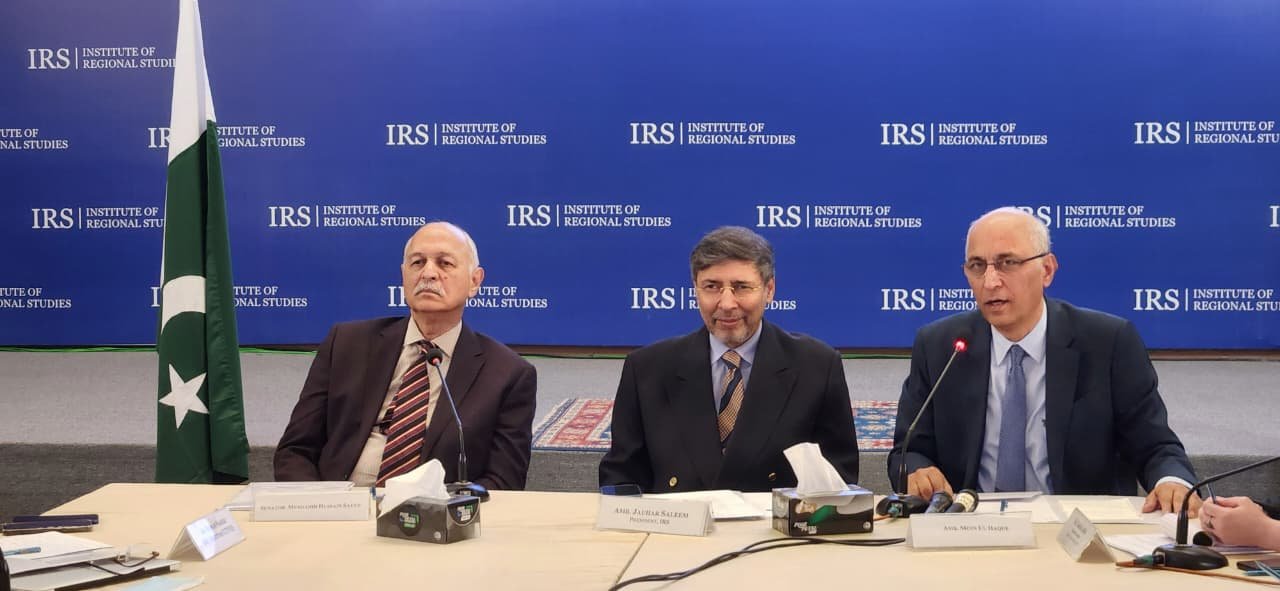
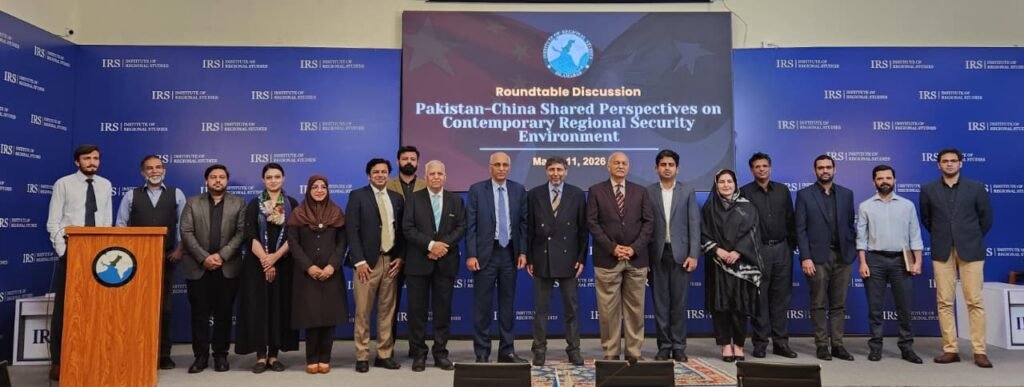
Islamabad, March 12, 2026 (Agencies) — The Institute of Regional Studies (IRS) hosted a roundtable discussion titled “Pakistan and China: Shared Perspectives on the Contemporary Regional Security Environment”, bringing together senior policymakers and diplomats to examine evolving geopolitical challenges and the convergence of Pakistani and Chinese positions on regional security.
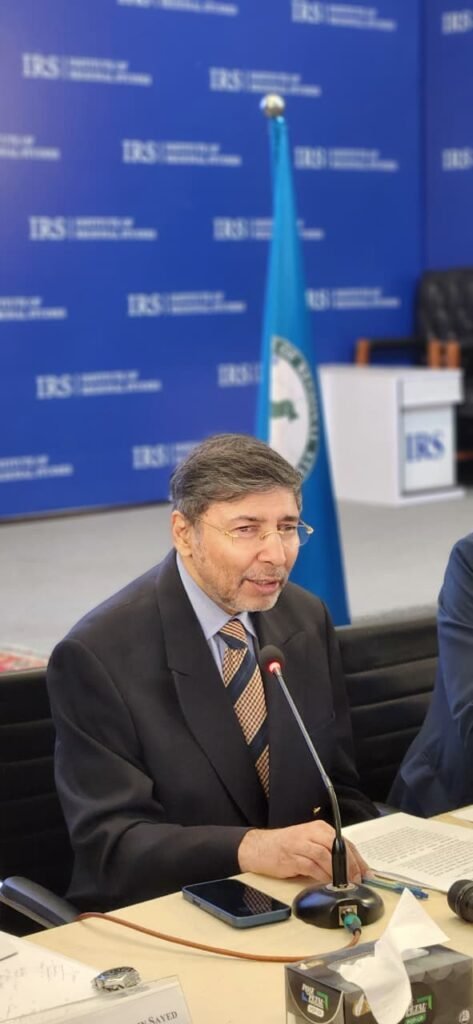
The event featured Senator Mushahid Hussain Sayed, Ambassador Moin ul Haque, and IRS President Ambassador Jauhar Saleem, with opening remarks by Ms. Nabila Jaffer, Lead of the China Program at IRS. Speakers underscored the far-reaching consequences of escalating conflicts in West Asia and the importance of Pakistan–China cooperation in promoting dialogue and stability.
Ambassador Saleem warned that the confrontation involving the United States, Israel, and Iran has already sent shockwaves across global politics and economics, cautioning that further escalation could trigger a significant economic shock. He reiterated Pakistan’s principled position of resolving disputes through peaceful dialogue and criticized Kabul’s lack of constructive response to Pakistan’s diplomatic initiatives. He also accused India of fomenting terrorism in Pakistan, obstructing regional peace efforts. Stressing the enduring importance of the Pakistan–China partnership, he described it as a “pillar of regional stability.”
Senator Mushahid Hussain Sayed characterized the current geopolitical landscape as an “arc of conflict stretching from Israel to India.” Drawing parallels between Zionism and Hindutva, he argued that both Israel and India have acted as violators of international law and human rights. He warned that U.S. and Israeli actions against Iran were based on miscalculations that risk prolonging conflict. Highlighting Iran and China as civilizational states with deep historical resilience, he emphasized that Pakistan and China share a consistent commitment to diplomatic solutions across interconnected theatres of conflict in the Middle East, South Asia, and Afghanistan.
Ambassador Moin ul Haque focused on the economic and humanitarian dimensions of the crisis, noting its impact on energy markets, trade routes, and livelihoods. He described Israel and India as “expansionist, revisionist, and occupying powers” with serious implications for Pakistan’s security environment. He praised China’s steadfast support for Pakistan, emphasizing that defence and security cooperation between the two countries plays a critical role in maintaining strategic balance. Stressing adherence to international law and the UN Charter, he said both countries advocate “dialogue over confrontation, partnerships over alliances, multilateralism over unilateralism, and an equal and orderly international system.” He cautioned that the conflict could escalate into wider regional involvement if not contained.
The roundtable concluded with consensus that Pakistan and China’s shared perspectives on regional conflicts remain vital for promoting peace, stability, and multilateral cooperation in an increasingly volatile security environment.