

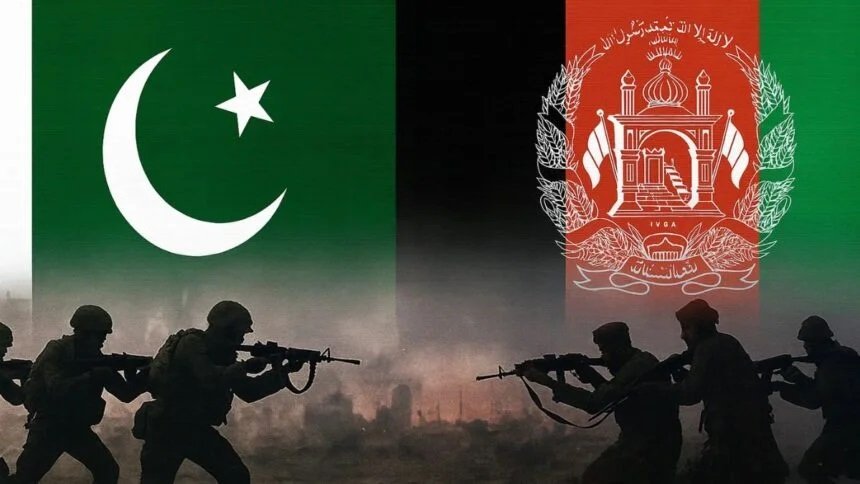
Peshawar/Islamabad/Kabul, Feb 27, 2026 (Khyber Mail): Tensions between Pakistan and Afghanistan have dramatically escalated into widespread military clashes and cross-border operations, marking one of the most serious confrontations since the long-running conflict along the Durand Line resumed.
Pakistan launched Operation Ghazab lil-Haq in response to sustained and what Islamabad describes as “unprovoked firing” by Afghan Taliban forces along multiple points on the Pakistan–Afghanistan border. Pakistani authorities have reported heavy engagements in frontier regions including Chitral, Khyber, Mohmand, Kurram and Bajaur.
According to official statements from Pakistan’s information ministry and security sources, Pakistan’s armed forces have conducted precision strikes and counter-offensives, inflicting significant losses on Afghan Taliban fighters. The Islamabad government claims:
- At least 133 Afghan Taliban operatives killed and more than 200 injured during the operation.
- Twenty-seven militant posts destroyed and nine captured.
- Key Taliban command infrastructure, including Corps and Brigade headquarters, ammunition depots and logistics bases, have been targeted and destroyed.
- Over 80 tanks, artillery guns and armored personnel carriers of Taliban forces were reportedly taken out.
Pakistan’s Foreign Media Spokesperson described the counter-strikes as ongoing and authorised “to respond effectively and decisively to any aggression.”
Multiple international news sources report that Pakistani air strikes have hit areas inside Afghanistan, including the capital Kabul, and major provincial cities such as Kandahar and Paktia Province. Explosions and anti-aircraft fire have been reported amid the escalation.
Some Afghan sources and state media assert that Afghanistan launched a large-scale offensive against Pakistani forces and claimed to have overrun several Pakistani positions and inflicted heavy casualties on Pakistani troops, including capturing border posts; Islamabad has rejected these assertions.
The conflict has produced competing casualty figures as Pakistani authorities maintain that two of its security personnel were killed in earlier border exchanges, while many Taliban fighters were neutralized. Afghan and Taliban sources claim significant Pakistani military losses and control of certain frontier outposts.
Clashes have disrupted movement across key border crossings such as Torkham, with reports of displaced families and security restrictions in adjacent districts. Diplomatic channels have been strained, and no definitive de-escalation agreement is in place.
Although Pakistan frames its actions as defensive measures to protect national territory and citizens, international observers have expressed concern over the rapidly intensifying hostilities. Regional mediators previously attempted to broker ceasefires — including Qatar and Turkey-led talks in late 2025 — but recent diplomatic efforts have not yielded sustained peace agreements.
The conflict, initially provoked by cross-border firing and Taliban attacks according to Islamabad, has escalated into multi-front military operations involving both artillery and air power. Civilian areas near the border have reported impacts, and both sides continue to issue conflicting accounts of battlefield outcomes and territorial control.
According to the Ministry of Information, Afghan Taliban elements opened fire on several Pakistani border posts and civilian areas on Thursday evening in Khyber Pakhtunkhwa’s Chitral, Khyber, Mohmand, Kurram and Bajaur districts. Security sources said two Pakistani security personnel were martyred in the initial exchange of fire.
In response, Pakistan launched what officials termed a “calibrated but decisive” counteroffensive involving artillery, ground forces and air power. Security sources claimed that 133 Afghan Taliban operatives were killed in retaliatory strikes, though these figures have not been independently verified.
State broadcaster Pakistan Television Corporation reported that the Pakistan Air Force conducted precision air strikes targeting what it described as key Taliban military installations inside Afghanistan. Among the reported targets was an ammunition depot in Nangarhar province, allegedly used for storing heavy weapons and logistics supplies.
According to PTV News, additional air strikes were carried out in Kabul, Kandahar and Paktia. Two brigade headquarters were reportedly destroyed in Kabul, while in Kandahar one corps headquarters and one brigade headquarters were targeted. An ammunition depot and a logistics base were also destroyed in Kandahar. In Paktia, a corps headquarters was reportedly hit in what officials described as a coordinated aerial campaign aimed at degrading command-and-control infrastructure.
Military analysts suggest that the scale of reported targets indicates a broader strategic objective beyond immediate retaliation, potentially aimed at disrupting cross-border militant coordination networks and dismantling staging grounds allegedly used for infiltration into Pakistani territory.
The escalation has also affected civilian movement along the border. Reports from Khyber district indicate that Afghan families scheduled for repatriation through the Torkham crossing were redirected to a holding centre in Landi Kotal due to security concerns. Border operations have reportedly been tightened, with heightened military deployment on both sides.
No official confirmation has yet been issued by the Afghan Taliban authorities regarding the extent of damage to military installations or casualty figures. Diplomatic channels between Islamabad and Kabul are believed to be under strain, as both sides accuse each other of violating border understandings.
The Pak-Afghan border region has long remained volatile, particularly in areas adjoining Khyber Pakhtunkhwa, where security forces have conducted counterterrorism operations against militant networks. The current confrontation marks one of the most serious escalations in recent years and raises concerns about a broader cross-border conflict if hostilities persist.
Officials in Islamabad have stated that Operation Ghazab lil-Haq will continue “until hostile fire and cross-border aggression are fully neutralized,” while emphasizing that Pakistan seeks stability and security along its western frontier. Security has been heightened nationwide, especially in border districts, amid fears of retaliatory actions or spillover violence.
The Taliban, using drones, are using their own homemade makeshift bombs in border clashes with Pakistan.