

- By: Memoona Memon
An earthquake is when the ground shakes because the earth’s plates move under the surface. This movement happens suddenly and cannot be stopped. Some earthquakes are small, and people hardly feel them. But strong earthquakes can break houses, destroy roads, and take many lives in just a few seconds. They are very dangerous because they come without warning and leave behind a lot of damage.
- A Midnight Disaster
On the night of 31 August 2025, life in Afghanistan changed forever. At 11:47 PM, when most families were asleep, the ground suddenly shook with terrible force. The earthquake measured between 6.0 and 7.1 magnitude, and because it was very shallow — only about 8 kilometers underground — it caused massive destruction.
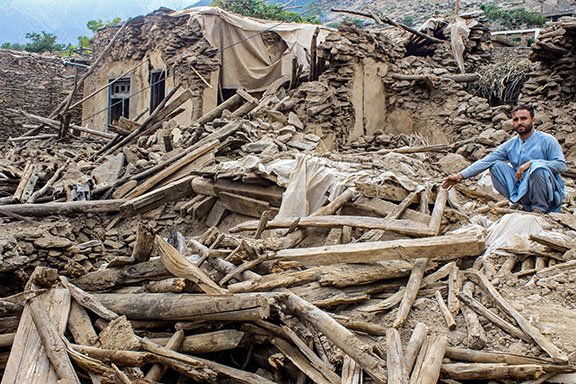
Houses made of mud and stone broke apart within seconds. Villages turned into piles of rubble. Families were buried under their own homes. In a few moments, peaceful sleep became a nightmare. Reports later confirmed that more than 2,200 people died, over 3,600 were injured, and almost 6,800 houses were destroyed. In some villages, 90% of buildings collapsed. This was one of the worst disasters Afghanistan has faced in many years.
- Human Loss and Suffering
The earthquake did not only break buildings; it also broke lives. Families lost parents, children, and relatives. Survivors searched for loved ones under piles of stone and mud. Children cried beside the ruins of their homes. The elderly, unable to run, were trapped under falling walls.
Hospitals quickly filled with injured people. Many lay on floors and in hallways because there were not enough beds. Doctors and nurses worked day and night, but they had very little medicine and equipment. The World Health Organization (WHO) reported that more than 12,000 people were badly affected and needed urgent help.
Life after the quake was very hard. People had to sleep in the open or in small tents. Nights were cold, food was scarce, and there was little clean water. Diseases became a new danger because toilets and sanitation systems were destroyed.
- Nature Made It Worse
Heavy rain had fallen before the earthquake. This made the soil loose and unstable. When the quake struck, many slopes collapsed, creating landslides. These landslides buried parts of villages and blocked roads. Rescue teams could not reach many areas for days. Some communities were left completely alone, relying only on neighbors to save lives.
- Isolation and Weak Response
Help was slow to arrive. Trucks carrying food, medicine, and blankets could not pass because the roads were broken. Communication lines were cut. International agencies like the United Nations and WHO sent medical teams, tents, and trauma kits. Neighboring countries, including Pakistan and Iran, also sent aid. But scientists from the United Nations University (UNU) explained that Afghanistan’s political isolation since 2021 made everything worse. Many countries had reduced aid to Afghanistan. With less money and fewer partnerships, the Afghan government had little capacity to prepare for or respond to such a disaster. This isolation cost lives.
Women and girls suffered more than others. Restrictions on women’s movement meant many could not reach hospitals quickly. The ban on many female health workers also made the situation worse. Some women were not allowed to see male doctors without a female companion, which delayed treatment. These rules turned a natural disaster into an even deeper human crisis.
- Courage and Humanity
Even in tragedy, Afghans showed courage. In one village, neighbors dug with their bare hands to rescue children trapped in a collapsed school. In another, families who lost everything shared bread and water with others. Doctors performed operations without proper tools, trying their best to save lives. Aid workers carried supplies on foot through blocked mountain paths when vehicles could not pass.
These small acts of humanity gave people hope. They proved that even in the darkest hours, the human spirit can survive.
- Understanding Through IR Theories
International Relations theories give us simple ways to understand this disaster. Realism says survival and power are most important. From this view, Afghanistan was too weak to handle the earthquake. Its fragile government and poor resources meant it had to depend on others. Realists would say this is why weak states suffer the most.
Liberalism believes that cooperation and institutions are the key. From this view, help from WHO, the UN, and neighboring countries shows how teamwork can save lives. Liberals argue that only by working together can the world solve big problems like disasters.
Constructivism focuses on values and identity. From this view, the courage of Afghan people — neighbors rescuing each other, doctors working without rest, families sharing food — shows that human values like solidarity and kindness are powerful. Even when states are weak, these values help communities survive.
- Lessons for the Future
This earthquake teaches many lessons. First, Afghanistan needs stronger houses. Most homes are made from mud and stone, which cannot survive strong shaking. Building earthquake-resistant homes and schools can save thousands of lives.
Second, infrastructure must improve. Roads, bridges, and communication systems must be stronger so that aid can reach people quickly. Early warning systems are also needed to prepare communities.
Third, health care needs more investment. Hospitals must be better equipped, and mental health care is very important. Many survivors carry trauma after losing loved ones and homes. Healing their minds is just as important as rebuilding walls.
Finally, the world must not leave Afghanistan alone. Isolating the country only makes disasters worse. Politics should not block humanitarian aid. Disasters do not stop at borders, and people’s suffering should not be ignored. Global solidarity is a responsibility, not a choice.
- Wider Reflections
Looking at other countries helps us see the picture more clearly. The 2005 Pakistan earthquake killed over 80,000 people, but international aid and cooperation helped rebuild schools and hospitals. The 2010 Haiti earthquake showed the need for global solidarity, though poor coordination slowed recovery. Afghanistan’s 2025 earthquake gives the same lesson: weak states suffer most, but with cooperation and solidarity, recovery is possible.
- Conclusion
The 31 August 2025 earthquake will always be remembered as one of Afghanistan’s darkest nights. Thousands of lives were lost, thousands more were injured, and villages were destroyed. Yet even in the rubble, there were moments of strength — neighbors risking their lives for each other, doctors saving patients with limited tools, and aid workers walking for hours to deliver supplies.
International Relations theories help us see this more clearly. Realism shows the dangers of weak state capacity. Liberalism shows the importance of global cooperation. Constructivism highlights the power of human values. Together, these lessons show one truth: Afghanistan’s people are strong, but they cannot rebuild alone. With stronger homes, better hospitals, safer roads, mental health support, and international solidarity, Afghanistan can rise again. The Afghan people deserve not only sympathy but also real support to build a safer, more hopeful tomorrow.