

- By: Rizwan Inayat
On May 7, the skies over South Asia witnessed one of the most intense air battles of the modern era — Operation Zarb-e-Karrar — an engagement that defense analysts now call the largest Beyond-Visual-Range (BVR) air combat in history. With 114+ fighter aircraft engaged — 72 from the Indian Air Force (IAF) and 42 from the Pakistan Air Force (PAF) — the battle raged for 52 minutes, setting a new benchmark in aerial warfare.
This wasn’t just another border skirmish. It was a complex, large-scale air campaign involving cutting-edge jets, networked sensors, and some of the most advanced air-to-air missiles in the world.
- The Build-Up: Six Days of Watchful Waiting
According to senior PAF officers, the air force had been anticipating a major strike. For six days, PAF surveillance assets and intelligence units closely monitored the build-up:
IAF mobilized nearly 400 aircraft by late April, transporting weapons, logistics, and personnel through 500+ sorties by its transport fleet.
Eight strike formations were lined up along India’s western border — each comprising four Su-30MKIs, two Rafales, and two Mirage 2000s, backed by additional fighter cover.
The PAF knew what was coming. The traps were being set.
- Weapons of the Sky: Missiles From Four Nations
When the battle began, both sides deployed some of the most sophisticated weapons available:
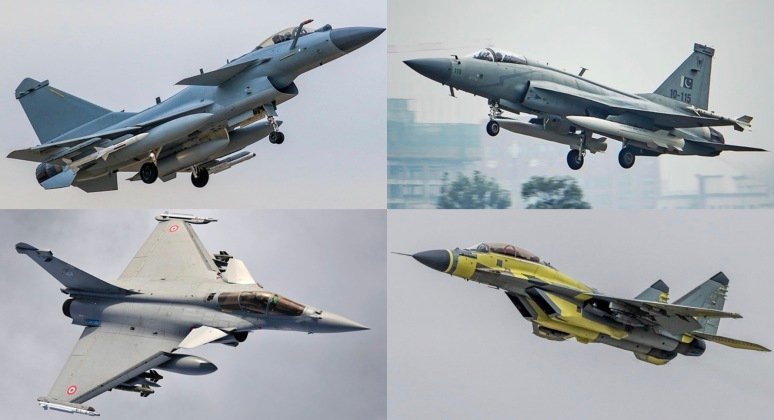
IAF Rafales flew in offensive mode armed with Meteor BVRAAMs, backed by Su-30MKI Flankers carrying Israeli Derby missiles and Spice 2000 precision-guided munitions.
PAF J-10Cs and JF-17Cs waited with PL-15 and PL-10 air-to-air missiles, while F-16C Block 52s were loaded with AIM-120C AMRAAMs.
PAF also deployed mobile electronic warfare (EW) units — indigenously designed by NASTP (National Aerospace Science & Technology Park) — to jam IAF radars and communication nodes.
It was a battle of radar locks, jamming, and split-second missile launches.
- The Ambush: Turning the Tide
As soon as the IAF released its bombs, the sky was already crowded with 72 aircraft, their numbers rapidly climbing. That’s when the PAF sprung its trap.
“We ambushed them, we trapped them in our kill chain and created chaos,”
— Senior PAF Officer, as quoted by Key Aero Magazine.
The PL-15E long-range missiles streaked towards their targets. Rafale pilots likely never saw what hit them until the missiles were just three seconds away.
By the end of the 52-minute air battle, PAF claimed six confirmed aerial kills — a decisive defensive victory.
- Holding Back From the Brink
Interestingly, senior PAF officers revealed that they could have shot down more IAF aircraft, including additional Rafales, but deliberately held back. The fear was clear: pushing too far could have escalated the skirmish into a full-scale war between two nuclear-armed nations.
- Lessons Learned: A New Era of Aerial Combat
Operation Zarb-e-Karrar is likely to be studied in military academies worldwide. It highlighted:
- The dominance of BVR (Beyond Visual Range) missile combat over traditional dogfighting.
- The importance of networked warfare, electronic jamming, and pre-battle intelligence.
- How careful escalation management can prevent a limited air battle from spiraling into war.
As aviation expert Alan Warnes noted in Key Aero Magazine, the battle showed how modern air combat is evolving — and why preparation, timing, and technology remain the ultimate force multipliers.
- Source: “UNDERSTANDING THE RAFALE KILLS” by Alan Warnes. Published in Key Aero Magazine.
- https://key.aero/article/understanding-rafale-kills