

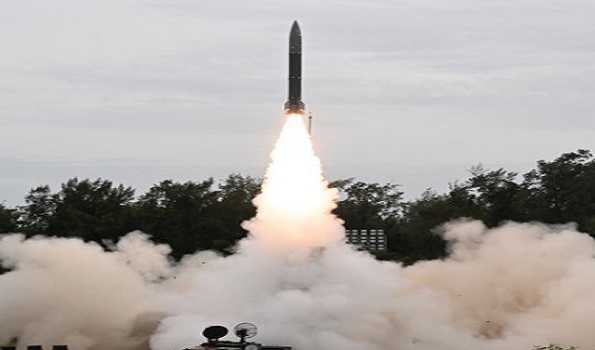
New Delhi (Agencies) July 31, 2025 – India’s Defence Research & Development Organisation (DRDO) has conducted successful flight trials of the indigenously developed Pralay surface-to-surface missile, marking a key milestone ahead of its deployment by the Indian Army and Air Force. The Ministry of Defence (MoD) confirmed the tests took place on July 28 and 29 at the Integrated Test Range (ITR) in Chandipur, located on India’s eastern coast.
The trials, conducted as part of user evaluation exercises, validated the missile’s operational range parameters. “The missiles precisely followed the intended trajectory and reached the target point with pin-point accuracy, meeting all the test objectives,” said a statement from the MoD. The performance was corroborated by tracking sensors stationed aboard a ship positioned near the impact area.
Developed by DRDO’s Research Centre Imarat in Hyderabad, the Pralay missile is powered by solid fuel and classified as quasi-ballistic, capable of evading radar and targeting precision strikes. The system incorporates advanced guidance and navigation technologies, though specific components remain classified. It can be equipped with multiple warhead types, enhancing its strategic versatility.
State-owned firms Bharat Dynamics Limited (BDL) and Bharat Electronics Limited (BEL) contributed to the missile’s production and system integration. BDL oversees assembly and propulsion components, while BEL supports electronic systems and command architecture.
Project Pralay was formally approved in March 2015 at a cost of INR 3.32 billion (USD 38 million). In January 2023, the MoD authorized the acquisition of 120 Pralay missiles to strengthen India’s tactical strike capability in high-threat regions.
The missile’s rapid response profile and ability to deliver conventional warheads across short-range theaters make it a strategic asset amid evolving regional security dynamics. Military analysts see Pralay as part of India’s ongoing effort to modernize its ground-based missile arsenal and bolster deterrence postures against adversaries.