

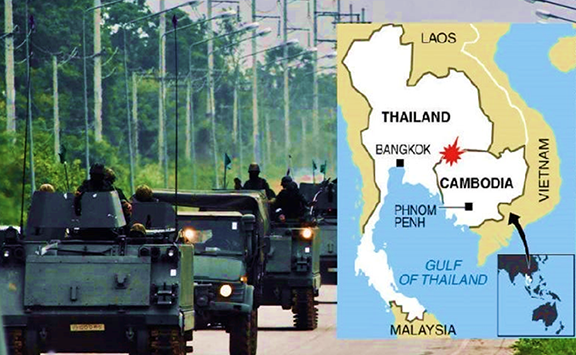
PHNOM PENH/BANGKOK (Agencies) July 29, 2025 — Cambodian and Thai authorities announced an “immediate and unconditional” ceasefire early today, halting six days of intense fighting along their disputed frontier. The flare-up, centered near the Preah Vihear Temple complex and fueled in part by newly identified rare earth element deposits, has killed at least 35 people and displaced more than 300,000 residents on both sides.
The two governments reached the ceasefire agreement in talks mediated by Malaysian Prime Minister Anwar Ibrahim in Putrajaya late on July 28. Under the pact, all cross-border artillery, rocket and drone strikes were to cease at midnight local time.
“At Malaysia’s invitation, we have agreed to end hostilities unconditionally,” Cambodian Prime Minister Hun Manet said in a joint statement with Acting Thai Prime Minister Phumtham Wechayachai. Thailand’s foreign ministry recalled its ambassador from Phnom Penh but stopped short of a full diplomatic rupture.
Despite the formal truce, both sides reported sporadic gunfire in the early hours of July 29. Thai military spokesmen accused Cambodian border posts in Oddar Meanchey province of opening fire first; Cambodia’s Defense Ministry denied the claim, insisting its forces have strictly adhered to the ceasefire terms. A joint General Border Committee meeting, under ASEAN observation, is scheduled for August 4 in Phnom Penh to monitor compliance and negotiate long-term confidence measures.
Casualties from the fighting include 13 Thai civilians, one Thai soldier, eight Cambodian civilians and six Cambodian soldiers, according to official tallies. More than 300,000 people—farmers, traders and daily wage earners—have fled their homes, many taking refuge in schools and temples. The clashes have also disrupted cross-border trade, which reached 67 billion baht in the first half of 2025.
Analysts warn that this latest outbreak of violence is not solely about ancient territorial claims. In July, Cambodian and independent geologists confirmed the presence of lateritic soils with total rare earth oxide concentrations exceeding 500 parts per million near the Preah Vihear–Surin corridor. Elevated levels of neodymium, dysprosium and scandium—critical components for electric vehicle motors, wind turbines and advanced defense systems—have transformed the frontier into a resource battleground.
“Control of these deposits could alter Southeast Asia’s role in the global technology supply chain,” said Prachanda Phan, a Phnom Penh–based mineral economist. “Both capitals recognize that whoever holds the border holds leverage over an emerging $600 billion market.”
International actors swiftly weighed in. The United States and China dispatched special envoys to Putrajaya, where President Joe Biden and Premier Li Qiang praised Malaysia’s mediation. Both superpowers underlined the importance of ASEAN-led mechanisms for dispute resolution and resource management.
With ceasefire lines drawn but mutual distrust intact, lasting peace hinges on a formal border demarcation agreement and a jointly managed framework for rare earth exploration. Observers recommend transparent environmental safeguards and benefit-sharing arrangements for border communities.
As ASEAN prepares to convene in Manila next month, member states will face mounting pressure to prevent a relapse into armed conflict and secure the stability of a geopolitically vital region.